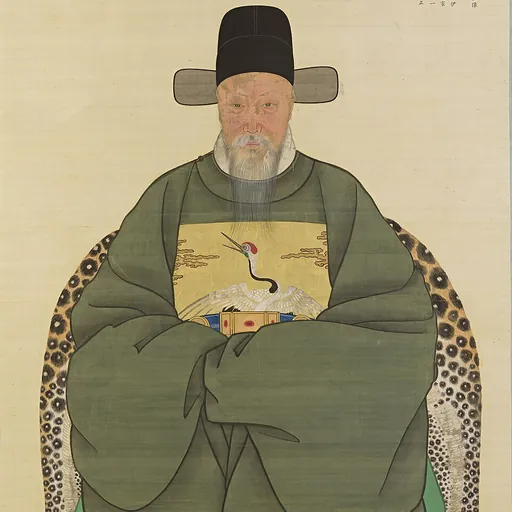
About Kim Yuk
Lived 1570 – 1658 (aged 87–88). Kim Yuk was a Korean philosopher and politician.
Kim Yuk (; 1580 – September 1658) was a Korean Neo-Confucian scholar, politician and writer of the Korean Joseon Dynasty. His art name was Chamgok and Hoejŏngdang , his courtesy name was Paekhu , and his posthumous name was Munjŏng . He came from the Cheongpung Kim clan (
When he was 13 years old, Kim Yuk had to undergo the Imjin war. While he moved to the countryside to seek shelter, he did not stop reading books. During the war, his father died at the age of 31. At the deathbed, his father told him to enhance the family grade by studying hard, and to avoid any liquors. Kim Yuk kept his promise for life. His household deteriorated significantly, and his mother also died. He had to depend on his father's sister for living. at Hanyang.
Judging from his personal experiences as a peasant at Jamgok-ri and a front-line public official at Eumseong, Chungcheong province, Kim Yuk had got a firm belief that Daedongbeop was the best solution to alleviate the burden of peasants and to prevent corruptive practices of local government officials and merchant-middlemen . A half of fiscal revenues had to be supplemented by indigenous products of the region. Its purport seemed to benefit common people in the country. The problem was the intentional exploitation by the local government officials and merchant-middlemen. Occasionally, they demanded in collusion regional products which were hardly available owing to flood, drought or harmful insects, or even refused the direct provision of farmers on account of defects or quality of goods.
So Kim Yuk's countermeasures included the unitary taxation of 12 mal per gyeol . It may be interpreted as 5 mal by the modern measurement over eight thousand pyeong or 26,450 square meter. It's reasonable for a tax payer. While he served as Governor of Chungcheong province, Kim Yuk realized that it was urgently necessary to replace the indigenous products contribution system with Daedongbeop which called for proportionate sharing of rice produced at the farm land.
However, factional interests were divided on the issue of Daedongbeop. If Daedongbeop was implemented nationwide, it was largely to the benefit of farmers and common people. On the contrary, Confucian scholars and wealthy gentlemen in the country could find few benefits from the new system. Local government officials would lose the source of fringe benefits. That's why Daedongbeop failed to be continuously implemented beyond Gyeonggi province. Opponents argued that its nationwide implementation would cause the decrease of fiscal revenues.
Kim Yuk tried to persuade King Hyojong to adopt Daedongbeop. At last in 1651, King Hyojong endorsed Daedongbeop in Chungcheong province. Unavoidably, Kim Yuk was departed from the mainstream bureaucrats represented by Kim Jip and Song Si-yeol , and caused the separation of anti-Kim Sandang (산당, 山黨, meaning 'the Mountain Party') and pro-Kim Handang (한당, 漢黨, meaning 'the Han River Party'). Kim Yuk was criticized as stubborn to the extreme. Even at his deathbed, he was wishing that Daedongbeop should be expanded to Jeolla province, which was finally completed in 1657 by his successor Seo Pil-won , Governor of Jeolla province.
Other pragmatic policies In addition to Daedongbeop, Kim Yuk stressed on the use of currency or coin. Until then, only rice and cotton cloth were traded in exchange for merchandise. He asserted the circulation of coins would be conducive not only to distribution of goods but also to securing fiscal revenues. In 1651, was first circulated in the metropolitan area and the Northwestern territory. In this regard, he suggested the government to permit the private persons to develop silver mines across the country.
Kim Yuk was eager to make his thoughts on economy and pragmatic ideas to be realized in real life, for example: to use water wheels for irrigation in the farmland; to employ big wheel carts for easy transportation; to encourage and promote commerce and engineering contrary to conventional thoughts; to adopt the Western-style calendar system for the convenience in real life; to print and distribute medical and disaster-survival reference books ; to develop printing business for publishing and distribution of good books to dredge rivers in Hanyang to prevent flood in a rainy season.
Assessment and legacy Kim Yuk was the best reformist-statesman of the Joseon dynasty. Regardless of the mainstream Neo-Confucianism, he paid attention to how to stabilize the living of common people. It was possible because Kim Yuk had an advantage of the descendant of a famous Kimyo martyr, and he was open-minded to pragmatism rather than philosophically oriented. He knew the limitation of a human being. As a matter of fact, he was taught by Neo-Confucianist Sŏng Hon and belonged to the Westerners faction. But he managed to make a transition bridge to the Silhak school in the next century.
Assessment Sometimes, he was called a Wang Anshi of Joseon by his critics and opponents. Truly, Kim Yuk was an unprecedented statesman of far-sighted view and action in that: He saw the current situation after the invasion of foreign armies as a critical moment of the nation; He warned the crisis might cause the alienation of common people; He suggested the tax burden of common people should be alleviated; He asserted the nationwide implementation of Daedongbeop and use of currency would help common people to survive such economic crises; He proposed a simple thing like a water wheel, a big wheel cart, and the new calendar system based on the solar system would make the living of people more convenient. Kim Yuk's thoughts and policies are assessed to have a big influence on the Silhak movement in the 18th century.
Legacy Thanks to Kim Yuk's reform, the impoverished state revived and fiscal revenues increased. However, the power elite groups were indulged in factional strife-based disputes on the Confucian courtesy issues over royal funeral services. As the mainstream Neo-Confucianist Song Si-yŏl took power, such pragmatic policy ideas as proposed by Yu Sŏngnyong and Kim Yuk were excluded in governing the nation. In the age of King Yeongjo and King Jeongjo, it seemed the Joseon dynasty and people enjoyed a renaissance.
When King Jeongjo died abruptly in 1800, the maternal relatives of royal family meddled in the policy-making and administration continuously, the Joseon dynasty came near to demise. For the sake of policy-making like Daedongbeop, Kim Yuk sought cooperation from power elite groups regardless of their fractional belonging. Although he belonged to the Westerners faction, he was taught by Cho Hoik from the Southerners faction, and close relationship with other politicians like Kim Se-ryeom, Cho Gyeong, etc. from the Southerners faction.
Works 'Chamgok Yugo' (Posthumous Works of Chamgok, 잠곡유고, 潛谷遺稿): Collection of Chamgok's poetry in Chinese, petitions addressed to King, official/private letters and essays, which were edited and published by Kim Yuk's descendant in the 18th century. 'Kimyo P'arhyŏn chŏn' (Biographies of Eight Wise Men, 기묘팔현전, 己卯八賢傳): Kim Yuk recorded, and published in 1639, the life, career, achievements, etc. of eight scholars and public officials who had been sacrificed during the purge of literati in the year of Kimyo (기묘사화, 己卯士禍, 1519) including his Great-Great-Grandfather Kim Sik. 'Chamgok P'iltam' (Chamgok's communications by writing, 잠곡필담, 潛谷筆談): Essays on what the author saw or heard of while studying, living, serving as a public official. 'Yuwŏn Ch'ongbo' (Encyclopedia edited by Chamgok, 유원총보, 類苑叢寶): Encyclopedic reference books condensed and edited by Kim Yuk. Originally, the time-honored encyclopedia of 171 volumes published in China (古今事文類聚) had been read and used for citation by Joseon scholars and gentlemen until many of them were lost during the two wars. In view of difficulties faced with scholars and students at that time, Kim Yuk contributed his time and energy in condensing and editing the original books into 47 volumes. 'Songdoji' (Official records of Songdo, 송도지, 松都誌): The history, geography, palaces and castles, population, economy and industry and administration of Songdo (old capital of the Goryeo dynasty, modern Gaeseong), compiled and written by Kim Yuk. 'Haedong Myŏngsinnok' (Biographies of Great Scholars and Public Officials of Korea, 해동명신록, 海東名臣錄) modeled after the biographies written by Zhuzi (朱子 宋名臣言行錄): Kim Yuk authored this book in 1651, about over 300 great scholars and government officials of Silla, Goryeo and Joseon. 'Hwangmyŏnggiryak' (History of the Ming Dynasty, 황명기략, 皇明紀略) of China compiled by Kim Yuk in 1642. 'Chongdŏk Sinp'yŏn' (New Text on Virtues, 종덕신편, 種德新編) modeled after the Learning for Minors. Kim Yuk authored this book in 1644 to educate moral virtues to common people based on the Confucian ethics.
Gallery
Don’t just read it —
keep it.
Full-length biographies made to live with: read them, listen on the way to work, watch them tonight.
- E-book
- Audio
- Video
Instant download · yours to keep · every purchase keeps this site free
Important facts
People in Kim Yuk's life
Named in this biography and alive at the same time
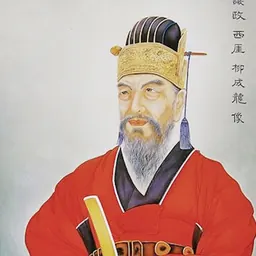


Related people
Same field, nearest in time



Contemporaries
People whose lives overlapped Kim Yuk's



Frequently asked questions
Who was Kim Yuk?
Korean politician (1570-1658)
When was Kim Yuk born?
Kim Yuk was born in 1570.
When did Kim Yuk die?
Kim Yuk died on 1 October 1658.
What was Kim Yuk's occupation?
Kim Yuk was a philosopher and politician.
What nationality was Kim Yuk?
Kim Yuk was Korean.
Sources & further reading
Cite this page
APA: Biography.guide. (2026). Kim Yuk. https://biography.guide/kim-yuk/
MLA: "Kim Yuk." Biography.guide, https://biography.guide/kim-yuk/.
Chicago: "Kim Yuk." Biography.guide. https://biography.guide/kim-yuk/.
Data last updated: 2026-09-23 · Spot an error? Report a correction.
Portrait: Wikimedia Commons · author & licence
Page generated 2026-09-27 05:06 UTC