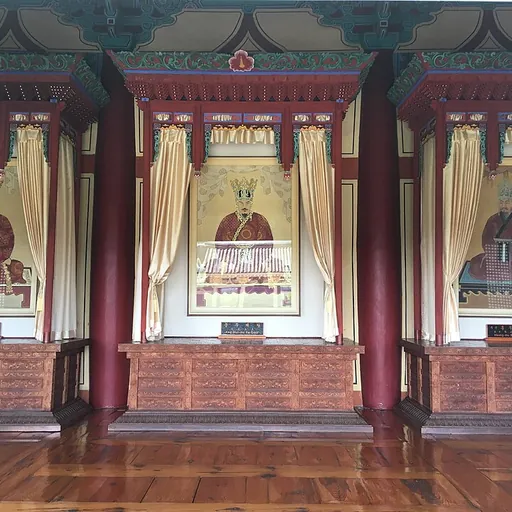
About Kim Pusik
Lived 1075 – 1151 (aged 75–76). Kim Pusik was a Korean official, writer, historian and politician.
Kim Pusik (; 1075–1151) was a Korean calligrapher, military general, philosopher, poet, historian, and politician during the Goryeo period. He was a scion of the Silla royalty and a member of the Gyeongju Kim clan. Later he was the supreme chancellor from 1136 to 1142 and was in charge of the suppression of the Myoch'ŏng rebellion. Kim is best known for supervising the compilation of the Samguk sagi, the oldest extant written Korean history.
Early life and background The Gyeongju Kim clan was a direct descendant of the last Silla king, Kim Pu. The clan seat (bongwan) name derives from Kim's great grandfather, a member of the royal Kim clan, who became the administrator in charge of the former Silla capital (renamed Gyeongju at the beginning of the Goryeo period). The first Goryeo king Taejo married into the Gyeongju Kim, and the clan played a leading role in early Goryeo politics. Three of its members were the officials of the first and second rank during 981-1069.
Kim's father, Kim Kun, was an official (reached the junior 3rd rank
Career
Early career, 1096–1122
Kim himself passed the civil service examination in 1096 on the Book of Documents and was appointed as an official in the Anseo prefecture. Subsequently he was selected for a position at the Hallimwon (Academy of Letters), Many of the royal lecturers belonged to the Han An-in faction that opposed Yi Cha-gyŏm. Both Kim Puch'ŏl and Kim Pusik delivered royal lectures, expounding the teachings of Confucius and Mencius. Kim Pusik lectured on the Book of History and the Book of Changes. However, Song had to pay an annual tribute (that was not named as such) of 200,000 taels of silver and 300,000 bolts of silk, that was equivalent to several percent of the Song government revenues. Goryeo was a tributary of Liao, even if the tribute was not paid after 1054. Jurchen tribes were vassals of Liao, that exercised a variable degree of control over their tribal groupings. Jurchen had complicated relationships with Goryeo. These ranged from a tributary status and mercenary service to cross-border warfare and informal alliances, particularly during the reign of King Yejong.
Basic tenets of Goryeo's political theory were expressed in the Ten Injunctions of Taejo. This document advised a cautious following of the Chinese practices, and expressed abhorrence of Khitan, and by extension, other nomadic "barbarians". The status of Goryeo rulers can be roughly summarized as naeje oewang (emperor at home and king abroad). They were titled kings, were tributaries of Khitan Liao dynasty, and were careful to keep these conventions in the correspondence with the suzerains. On the other hand, many aspects of the government were fashioned after following the imperial conventions. A majority view of the scholars-officials, including the Kim brothers, was that Goryeo was a realm in itself and thus "a possible center of the world". During this period Kim Pusik drafted a significant portion of the diplomatic correspondence with both Liao and Song.
Throughout their careers Kim brothers demonstrated a pragmatic approach both domestically and internationally. At the beginning of the century the Liao Dynasty appeared strong and Kim Puil congratulated Emperor Tianzuo of Liao as a ruler who "developed and enlarged [his] territory and made both Chinese and barbarians follow [him] peacefully." In a letter to the Song court Kim Pusik derived the Goryeo legitimacy as successors of Jizi (Giji, a semi-legendary sage who is said to have ruled Gojoseon in the 11th century BCE), who was enfeoffed by the Chinese Son of Heaven. After a long and mutually complementary discourse Pusik "concluded by stating that it was the barbarians who stood between Goryeo and the Song, literally and figuratively." This letter was written just before Kim Pusik finally ensured the recognition by Goryeo of the Jin dynasty ruler as the Son of Heaven in 1126.
Jurchen leader Wanyan Aguda started a successful rebellion against Liao in 1114. While a majority of the Goryeo officials were anti-Jurchen, both the king's father-in-law Yi Cha-gyŏm and Kim Pusik aimed to keep Goryeo out of the fray and benefit from the changing geopolitical situation. For example, the first Liao request for help was debated (8th month of the 10th year of Yejong's reign, July 1115) at the extended meeting of the Privy Council that included also the top military commanders. The majority of officials supported sending the troops. The opposition was voiced by a relatively junior associate of Yi Cha-gyŏm and by Kim Puil and Kim Pusik, who argued that `sending troops for another country could be the cause of trouble and would undoubtedly be dangerous for the future'. They succeeded in stalling the motion. At approximately the same time Kim Pusik acknowledged the increasing strength of the Jurchen in the official letters to the Liao court, but swore that Goryeo was loyal to Liao; if not, "may the gods destroy it".
Wanyan Aguda scored a number of victories over Liao; and proclaimed the establishment of the Jin dynasty with himself as its first emperor in 1115. In 1116–1117, Kim Pusik was part of the embassy to the Song court. Goryeo consistently refused any military help to Liao and in the wake of the Jurchen advances recaptured the Uiju (Poju) area and once again established the Yalu River as its border. While the majority of Yenjong's officials believed in the eventual Liao downfall, a crisis in the relationship with the Jurchen was precipitated by the request of Taizu of Jin to be recognized as the 'elder brother' of the Goryeo king in 1117. A majority of the officials opposed this request and even considered beheading the envoy. The factions of Yi Cha-gyŏm and Kim Pusik stalled the rash moves, but the formal submission of Goryeo to Jin was made only during the reign of Injong.
In fact, Kim Puch'ŏl (voicing a position of Kim Pusik who was at the time in China) submitted a memorandum proposing to accede to the demands of Emperor Taizu of Jin, giving the following rational: "Now even the great Song calls itself the younger brother of the Khitan and they have gotten along peacefully for generations. And although there is nothing under heaven that can measure up to the dignity of the Son of Heaven [of Goryeo], submitting to and obeying the barbarians like this is the proper policy, one that the sages called 'the temporarily putting aside of one's principles as circumstances demand it' and 'the protection of the whole country.'" Later Kim Pusik himself provided an example of temporizing in the correspondence with the Jin, arguing why Goryeo cannot be its vassal.
In his book Gaoli tujing Xu Jing (1091–1153), a member of the Song mission to Goryeo in 1122–1123, mentions Kim Pusik.
Reign of Injong (1122–1146)
Early years of the reign of Injong (1122–1126) were dominated by Yi Cha-gyŏm, his maternal grandfather. Shortly after Injong took the throne, Kim was an executive, and in 1124 was promoted to the position of the deputy minister of the Ministry of Rites . Using his position Kim opposed Yi Cha-gyŏm hold on power, aiming at Yi's attempts to enhance his public image. Already in 1122 Kim argued against giving special recognition to Yi Cha-gyŏm as king's grandfather. Later he questioned the appropriateness of calling Yi's birthday Insujel (Celebrating Humaneness and Longevity), and a planned performance of the ritual music at the Yi's family graves. Nevertheless, after a failed coup against Yi in early 1126 Kim Pusik not only remained in power, but was promoted to the position of the Chief Censor.
The role of Kim Pusik in toppling Yi Cha-gyŏm is unknown. Kim Puil, on the other hand, was one of the intermediaries between Injong and Yi's military supporters, inducing them to defect. Kim is an author of the inscription honoring a Buddhist monk Ŭich'ŏn (the son of King Munjong and the National Preceptor, one of the three highest Buddhist hierarchs of the country). There he recalls their only meeting, when as a boy he visited his brother in a monastery. In retirement Kim became a lay monk (keosa).
Worship of native spirits and guardian spirits (animism) was widely practiced by populace and part of the royal rituals prescribed by the Ten Injunctions of Taejo. During the 1135–1136 Myoch'ŏng rebellion, Kim Pusik is recorded as swearing an oath "by the heaven and the earth, the mountains and streams and the gods and spirits". He made a sacrifice to the guardian deities of the Western Capital following its capture from the rebels.
Family Father: Kim Kŭn Grandfather: Kim Wŏnch'ung Older brother: Kim Pup'il Older brother: Kim Puil (김부일, 金副佾; 1071–1123) Younger brother: Kim Puŭi Unnamed wife 1st son: Kim Tonjung (김돈중, 金敦中; 1119–1170) Grandson: Kim Kunsu 2nd son: Kim Tonsi (김돈시, 金敦時; d. 1170)
Don’t just read it —
keep it.
Full-length biographies made to live with: read them, listen on the way to work, watch them tonight.
- E-book
- Audio
- Video
Instant download · yours to keep · every purchase keeps this site free
Important facts
People in Kim Pusik's life
Named in this biography and alive at the same time


Related people
Same field, nearest in time






Contemporaries
People whose lives overlapped Kim Pusik's





Frequently asked questions
Who was Kim Pusik?
Korean official, general and scholar (1075–1151)
When was Kim Pusik born?
Kim Pusik was born in 1075 in Gyeongju.
When did Kim Pusik die?
Kim Pusik died in 1151 in Kaesong.
What was Kim Pusik's occupation?
Kim Pusik was an official, writer, historian and politician.
What nationality was Kim Pusik?
Kim Pusik was Korean.
Sources & further reading
Cite this page
APA: Biography.guide. (2026). Kim Pusik. https://biography.guide/kim-pusik/
MLA: "Kim Pusik." Biography.guide, https://biography.guide/kim-pusik/.
Chicago: "Kim Pusik." Biography.guide. https://biography.guide/kim-pusik/.
Data last updated: 2026-09-22 · Spot an error? Report a correction.
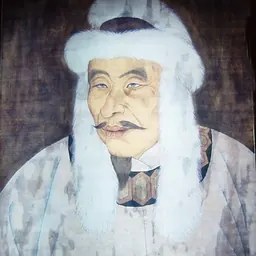
Portrait: Wikimedia Commons · author & licence
Page generated 2026-09-27 05:01 UTC