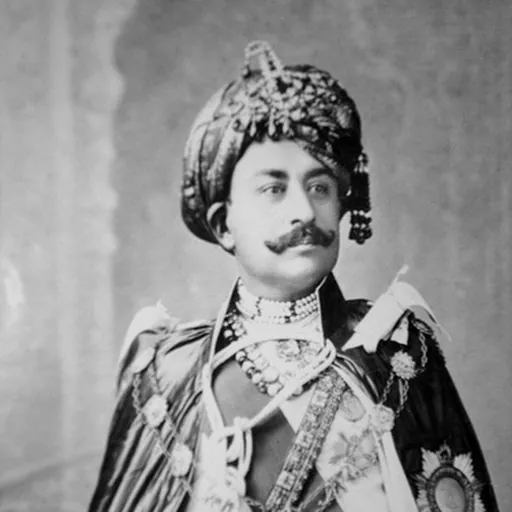
About Khengar III of Kutch
Lived 1866 – 1942 (aged 75). Khengar III of Kutch was an Indian writer.
Maharajadhiraj Mirza Maharao Sir Khengarji III Sawai Bahadur (23 August 1866 – 15 January 1942) was a progressive and one of the longest ruling monarchs and also the longest ruling king of the Princely State of Kutch from 1875 to 1942.
Life With Alfred Ezra in London. Khengarji is the one with the medals. Silver 5 Kori coin of Kutch, struck in 1919 in the name of Khengarji III. He ascended the throne in 1875 after his father Maharao Shri Pragmalji II died on 19 December 1875. He ascended the throne on 3 January 1876 and reigned under a Council of Regency until he came of age, 11 August 1884 and was invested with full ruling powers on 14 November 1884. In 1892, during his reign Cutch was raised to 17-gun salute. He appointed Shri Seth Ranmalsha Askaran Sisodia of Anjar as Diwan of Cutch state.
At the pinnacle of the Jadeja clan of Rajputs, he advanced his state drastically over the sixty-six years of his reign, modernising it and bringing it forth into the 20th century. During the latter part of Queen Victoria's reign, Sir Khengarji came to be appointed as an aide de camp to the Queen-Empress in her declining years, which excited some jealousy amongst the officials of the Government of India. He often travelled abroad to Europe and was noted for his personal relations with the members of the ruling houses there. Khengarji III was one of the very few Indian monarchs to attend all three Delhi Durbars – in 1877, 1903 and 1911. He was raised to the hereditary titles of Sawai Bahadur on 2 March 1885 and Maharao on 1 January 1918 by British. In 1919, he was granted a local salute of 19-guns, and represented India at a League of Nations conference in Geneva in 1921 and also attended the Imperial Conference in London 1921. In year 1921, he also held the post of Vice-President of British Empire League. He was granted the Freedom of the Cities of London and Bath in 1921. Sir Khengarji died in 1942, aged 75, and was succeeded by his son Vijayaraji.
Some of the highlights of his reign and attributes: Giving finishing touches to Prag Mahal in 1878–79, which was commissioned by his father Maharao Pragmalji in 1865–66. The Fergusson Museum, now known as the Kutch Museum, was founded by him in 1877 AD to house the numerous wedding gifts he received. It is the oldest museum in Gujarat. He was a keen sportsman and naturalist. He was one of the early Indian members of the Bombay Natural History Society. and was a fellow of the Zoological Society of London from 1932. Promotion of Cutch State Railway, a narrow gauge line owned & managed by Princely State of Cutch. The laying of railway tracks between Tuna Port and Anjar started in 1900–01. Ostensibly the inaugural train carried the baraat (marriage entourage) of Yuvraj Vijayrajji. First train ran in year 1905. The line was extended to Bhuj from Anjar in 1908 and later to Bhimasar, Bhachau & Kandla. Ordered renovation of Suralbhit Jadeshwar Temple near Bhuj in 1914. Renovation work done by Mistris of Madhapar. Construction of Vijay Vilas Palace for his son & Yuvraj Vijayaraji at Mandvi in 1920 completed in 1929. Construction of Cutch Castle near Opera House at Bombay during decade of 1920 at behest & under supervision of Rai Bahadur Jagmal Raja. Sanctioned the Haji Pir (near Nara) Dargah complex in the Rann. Introduced Kutch into the electricity, automobile and aviation era, but preferred to keep his personal apartment at the Pragmahal Palace non-electrified. In 1930, he personally identified & selected the location for new port of Kandla. The Cutch State Railway lines were extended from Anjar to Kandla. Built public Hospitals at Bhuj and Mandvi. Commissioned in 1940 Darya Mahal, his monumental residence at Napsean Sea Road in Mumbai. Construction of Khengar Sagar dam at Chhasra over River Bhukhi in 1937 Throughout 66 years of his reign kept inflation in tight check. Interacted with Indian stalwarts, Swami Vivekanand, Mahatma Gandhi, Dadabhai Naoroji. Rare occurrence – saw five generation of Maharaos from Pragmalji II to Pragmalji III. Acknowledged as one of the finest rifle shots of his times. He purchased a 500/465 double rifle number 30379 from Holland and Holland in London in 1926. The rifle is now owned by William Battershill. Keen judge of horses.
Monuments Much after independence Khengar Park was established in Bhuj perpetuating his memory. Present Maharao Pragmulji III was instrumental to put up his bust at the main office Port Trust of New Kandla, Kandla, a port founded by him in 1930. A square has been named after him as Maharao Khengarji Chowk on Anjar – Adipur Road, where his bust is also placed. Khengar Sagar Dam near Mundra is named after him.
Titles 1866–1875: Maharajkumar Shri Khengarji Pragmulji, Yuvraj Sahib of Kutch 1875–1877: His Highness Maharajadhiraj Mirza Rao Shri Khengarji III Sahib Bahadur, Rao of Kutch 1877–1885: His Highness Maharajadhiraj Mirza Rao Shri Khengarji III Sahib Bahadur, Rao of Kutch 1885–1887: His Highness Maharajadhiraj Mirza Rao Shri Khengarji III Sawai Bahadur, Rao of Kutch 1887–1917: His Highness Maharajadhiraj Mirza Rao Shri Sir Khengarji III Sawai Bahadur, Rao of Kutch, GCIE 1917–1918: His Highness Maharajadhiraj Mirza Rao Shri Sir Khengarji III Sawai Bahadur, Rao of Kutch, GCSI, GCIE 1918–1929: His Highness Maharajadhiraj Mirza Maharao Shri Sir Khengarji III Sawai Bahadur, Maharao of Kutch, GCSI, GCIE 1929–1942: Colonel His Highness Maharajadhiraj Mirza Maharao Shri Sir Khengarji III Sawai Bahadur, Maharao of Kutch, GCSI, GCIE
Honours Empress of India Medal Gold-1877 Knight Grand Commander of the Order of the Indian Empire (GCIE)-1887 Queen Victoria Golden Jubilee Medal-1887 Queen Victoria Diamond Jubilee Medal Clasp-1897 Delhi Durbar Gold Medal-1903 King George V Coronation Medal Delhi Durbar Gold Medal & Clasp – 1911 Knight Grand Commander of the Order of the Star of India (GCSI)-1917 Freedom of the Cities of London and Bath-1921 King George V Silver Jubilee Medal-1935 King George VI Coronation Medal-1937
Political office
Don’t just read it —
keep it.
Full-length biographies made to live with: read them, listen on the way to work, watch them tonight.
- E-book
- Audio
- Video
Instant download · yours to keep · every purchase keeps this site free
Important facts
Family & relationships
People in Khengar III of Kutch's life
Named in this biography and alive at the same time

Related people
Same field, nearest in time


Contemporaries
People whose lives overlapped Khengar III of Kutch's



Frequently asked questions
Who was Khengar III of Kutch?
King of Kutch (1875 - 1942)
When was Khengar III of Kutch born?
Khengar III of Kutch was born on 23 August 1866 in Bhuj.
When did Khengar III of Kutch die?
Khengar III of Kutch died on 15 January 1942 in Bhuj.
What was Khengar III of Kutch's occupation?
Khengar III of Kutch was a writer.
What nationality was Khengar III of Kutch?
Khengar III of Kutch was Indian.
Sources & further reading
· Wikipedia: Khengar III of Kutch
Cite this page
APA: Biography.guide. (2026). Khengar III of Kutch. https://biography.guide/khengar-iii-of-kutch/
MLA: "Khengar III of Kutch." Biography.guide, https://biography.guide/khengar-iii-of-kutch/.
Chicago: "Khengar III of Kutch." Biography.guide. https://biography.guide/khengar-iii-of-kutch/.
Data last updated: 2026-09-21 · Spot an error? Report a correction.
Portrait: Wikimedia Commons · author & licence
Page generated 2026-09-27 04:58 UTC