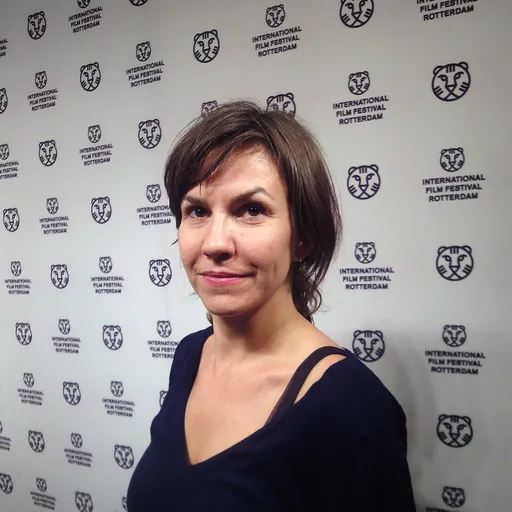
Kerry Tribe
Los Angeles/California visual artist/working primarily in film, video and installation (born 1973)
About Kerry Tribe
Born 1973. Kerry Tribe is an American installation artist, video artist, television producer and visual artist.
Kerry Tribe, The Aphasia Poetry Club, Three-channel video projection with sound, 28:27 min., Installation view, 365 Mission, Los Angeles, 2015. Kerry Tribe (born 1973) is an American visual artist and filmmaker based in Los Angeles. Her work includes video, film and sound installations, sculpture, performance, drawing and photography. Tribe's art investigates subjective aspects of consciousness such as memory, language, cognition, and empathy through subjects including medical conditions and clinical training, historical incidents, and collective and personal experience.
Tribe's work belongs to the public collections of the Los Angeles County Museum of Art, Museum of Modern Art (MoMA), Whitney Museum, San Francisco Museum of Modern Art (SFMOMA), and Hammer Museum, among others. She has exhibited at the latter four institutions, and others including The Power Plant, the High Line in New York and Museum of Contemporary Art Australia. In 2017, she received the Herb Alpert Award in the Arts for film and video.
Life and career Tribe was born in Boston and grew up in Cambridge, Massachusetts. She studied art and semiotics at Brown University, completing a B.A. degree in 1997, and attended the Whitney Museum Independent Study Program the following year.
In her early career, Tribe exhibited in group shows at SculptureCenter, the New Museum, Orange County Museum of Art and Hirshhorn Museum and solo shows at LACE (2003), Kunstlerhaus Bethanien (Berlin, 2006) and 1301PE (2009, Los Angeles), among others. In 2010, she was selected for the Whitney Biennial. Subsequent solo exhibitions took place at venues including Camden Arts Centre (2011), The Power Plant (2012), SFMOMA (2017) She has had performances and film screenings at Tate Modern, MoMA, Walker Art Center, Getty Center and the New York, London and Rotterdam film festivals.
Tribe has taught at Art Center College of Design and UCLA and been a visiting faculty member at CalArts, Harvard University and Stanford University. She is married to artist Mungo Thomson.
Work and reception Tribe employs both fictive and documentary methods—for example, performance, testimonial, investigation and research—in her projects. Her approach often involves establishing collaborative dialogues and relationships with individuals across disciplines and communities including support groups, medical personnel, actors and scientists. While her projects largely arise out of subjects of interest to her—as with documentary works—they exhibit elements of artifice and fantasy, often using actors in unconventional ways to re-enact personal experiences, portray historical figures or embody social roles. Of the work's layering, Dan Adler wrote, "The value of much of Tribe’s oeuvre resides in the provocative and profound staging of relationships—between isolated words, textures, or objects on the one hand, and coherent narrative elements on the other—reflecting the subjective processes of memory and desire, and their susceptibility to a host of personal and societal pressures, including the ideological notion that there is one definitive version of the truth." The book North Is West/South Is East (2002) delved into subjective perceptions of Los Angeles through a series of hand-drawn, often humorously inaccurate thumbnail memory-maps that Tribe solicited from visitors and locals at LAX Airport.
Kerry Tribe, H.M., Double projection of a single 16mm film, color and sound, 18:30 min., 2009, Installation view: Arnolfini, Bristol, 2009. Projects, 2009–present In later work, Tribe drew more directly upon the investigative impulse of documentary, considering the shifting nature of memory and its role in conceptions of the self, science and history. Tribe recounted his story through layered interview fragments and photographs (ultimately revealed to be dramatizations), historical stills, stock and on-location footage, animation and text. The video and sculpture exhibition "The Loste Note" (2015) centered on the communication disorder aphasia, which results from cerebral traumas such as strokes and reflects damage to the brain's language centers. FRAC Pays de la Loire, the Hammer Museum, Orange County Museum of Art, SFMOMA, Whitney Museum,
She has received fellowships and awards from the Durfee Foundation (2003, 2010), Louis Comfort Tiffany Foundation (2005), Creative Capital (2012), United States Artists (2012), Artadia (2013), and Herb Alpert Foundation (2017).
Don’t just read it —
keep it.
Full-length biographies made to live with: read them, listen on the way to work, watch them tonight.
- E-book
- Audio
- Video
Instant download · yours to keep · every purchase keeps this site free
Important facts
People in Kerry Tribe's life
Named in this biography and alive at the same time



Related people
Same field, nearest in time




Contemporaries
People whose lives overlapped Kerry Tribe's

Frequently asked questions
Who is Kerry Tribe?
Los Angeles/California visual artist/working primarily in film, video and installation (born 1973)
When was Kerry Tribe born?
Kerry Tribe was born in 1973 in Boston.
What is Kerry Tribe's occupation?
Kerry Tribe is an installation artist, video artist, television producer and visual artist.
What nationality is Kerry Tribe?
Kerry Tribe is American.
Sources & further reading
Cite this page
APA: Biography.guide. (2026). Kerry Tribe. https://biography.guide/kerry-tribe/
MLA: "Kerry Tribe." Biography.guide, https://biography.guide/kerry-tribe/.
Chicago: "Kerry Tribe." Biography.guide. https://biography.guide/kerry-tribe/.
Data last updated: 2026-09-20 · Spot an error? Report a correction.
Portrait: Wikimedia Commons · author & licence
Page generated 2026-09-27 04:58 UTC