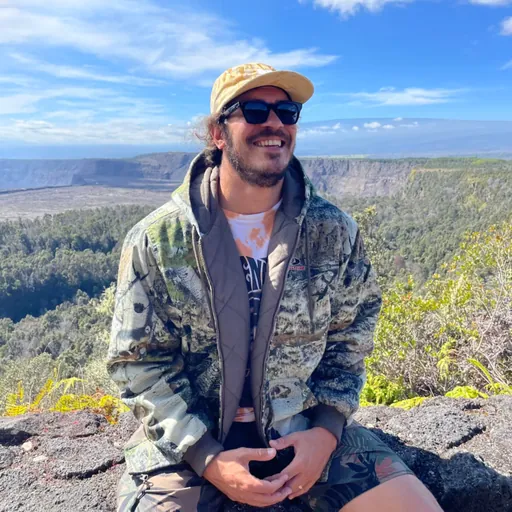
About Keolu Fox
Keolu Fox was a researcher.
Patrick Keolu Fox is an American anthropologist and human geneticist at the University of California, San Diego, where he is an assistant professor in the Department of Anthropology and an investigator at the J. Craig Venter Institute. Fox's academic publishing is focused on indigenous data sovereignty and bioethics. He has been an advocate for the community-based participatory research model as a strategy for increasing collaboration between the field of genetics and Indigenous communities. He has also examined the potential use of data trusts, federated machine intelligence, and blockchain technologies for Indigenous data sovereignty.
Early life Fox was born in the Bay Area, California. His family moved to Alaska during his first year of primary school, then to Hawaiʻi, then to Maryland, where he attended and graduated from Eleanor Roosevelt High School in 2004. His father Uziel Awret was an Israeli physicist and philosopher from Safed. Fox's mother is from the island of Hawaiʻi and is of mixed indigenous Hawaiian and Portuguese descent, a common ethnic makeup on the island owing to historical Portuguese immigration to Hawaiʻi Fox later worked with population geneticist Fernando Villanea, who described selective advantage among human blood group heterozygotes, on ABO variation in Neanderthals and Denisovans.
In 2024, Fox participated in the analysis of data from an 2021 epidemiological survey which gathered clinical and self-reported data on lifestyle habits from gout sufferers in French Polynesia. Fox has also studied the introduction and genetic history of leprosy in Oceania using ancient DNA.
Indigenous activism In 2020, Fox critiqued the NIH's All of Us program for exploiting Indigenous genetic data without proper safeguards in a perspective paper. Four months later, two of the program's leaders responded in the same journal, welcoming contributions from Fox and others engaged in activism and describing how they had been working with tribal leadership from American Indian and Alaska Native communities for over a year.
In 2019, Fox and paleoanthropologist John Hawks critiqued the lack of rules and regulations in the field of aDNA research on indigenous remains, describing it as colonial and extractive and calling for accountability and transparency in the use of such remains. In the United States, indigenous remains and any scientific research performed on them (including remains retroactively identified as Native American by aDNA sequencing) has been governed under the purview of NAGPRA since its passage in 1990.
Fox is an advocate of indigenous futurism, and has spoken publicly on integrating sustainable practices into large scale computation, particularly in AI development and data centers, drawing on analogies and trends in indigenous practices such as decentralization and circular economies.
In a 2024 TED Talk, Fox discussed researchers who are exploring the concept of using plant DNA as a storage medium.
Professional affiliations
Co-founder - Native BioData Consortium Co-founder - Indigenous Futures Institute Co-founder - EarthFrame Advisor - Variant Bio
Selected publications
Don’t just read it —
keep it.
Full-length biographies made to live with: read them, listen on the way to work, watch them tonight.
- E-book
- Audio
- Video
Instant download · yours to keep · every purchase keeps this site free
Important facts
Related people
Same field, nearest in time





Frequently asked questions
Who was Keolu Fox?
researcher (ORCID 0000-0003-4215-5273)
What was Keolu Fox's occupation?
Keolu Fox was a researcher.
Sources & further reading
Cite this page
APA: Biography.guide. (2026). Keolu Fox. https://biography.guide/keolu-fox/
MLA: "Keolu Fox." Biography.guide, https://biography.guide/keolu-fox/.
Chicago: "Keolu Fox." Biography.guide. https://biography.guide/keolu-fox/.
Data last updated: 2026-09-23 · Spot an error? Report a correction.
Portrait: Wikimedia Commons · author & licence
Page generated 2026-09-27 05:06 UTC