
About Ken Hashimoto
Lived 1931 – 2017 (aged 86). Ken Hashimoto was a Japanese dermatologist, physician, dermatovenereologist and university teacher.
was a Japanese professor of dermatology resident in the United States, who pioneered research in skin disease using electron microscopy and histochemistry.
He was born and brought up in Niigata City, Japan, where his father was professor and dean of the Niigata University School of Medicine. After graduating in medicine, he moved to the United States in 1956, and completed his training in dermatology at the University of Maryland and Massachusetts General Hospital.
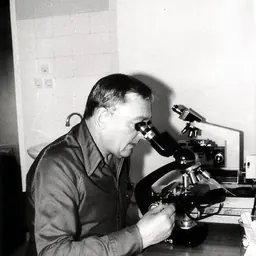
He is best remembered for his skill in using the electron microscope and histochemistry to determine the pathogenesis of Anderson-Fabry's Disease. His name is connected with two rare skin conditions, congenital self-healing reticulohistiocytosis and the blistering transient bullous dermolysis of the newborn.
In 1980, he was appointed to Wayne State University as professor. Many future dermatologists were trained by him and he wrote numerous articles, book chapters and books.
Early life Hashimoto was born on 19 June 1931, and grew up in Niigata City, Japan. His father was professor and chair of dermatology, dean of the Niigata University School of Medicine, and president of the university, where Hashimoto also graduated in medicine. His brother also became a dermatologist.
Career In 1956, Hashimoto moved to the United States. where he demonstrated the use of an electron microscope to look at endothelial cells, smooth muscle cells, fibrocytes and perivascular cells in people with Fabry disease, In addition, Transient bullous dermolysis of the newborn is named after Hashimoto who first described this condition with characteristic blister formations soon after birth, followed by rapid healing with or without scarring, in 1985.
Wayne State University He was appointed professor and chairman at Wayne State University in 1980, following faculty appointments at the University of Tennessee and Tufts University, and a position as chair of dermatology at Wright State University in Dayton, Ohio. Hashimoto died on 9 November 2017, at the age of 86 years, at his home in Ann Arbor, Michigan. He was survived by his wife, two sisters, one brother, four children and nine grandchildren.
Selected publications Books Skin Pathology by Light and Electron Microscopy. Igaku-Shoin, New York, 1983. (With Kan Niizuma) Tumors of Skin Appendages. Butterworths, 1987. (With Amir H. Mehregan and Masanobu Kumakiri) Tumors of the Epidermis. Butterworths, c.1990. (With Amir H. Mehregan)
Book chapters "Immunohistochemical Diagnosis of Skin Tumors", with M. Setoyama and E. Hashimoto, in Randall K. Roenigk & Henry H. Roenigk Jr. (Eds.) Surgical Dermatology: Advances in Current Practice. Martin Dunitz, London, 1993. pp. 131–138. .
Articles
Don’t just read it —
keep it.
Full-length biographies made to live with: read them, listen on the way to work, watch them tonight.
- E-book
- Audio
- Video
Instant download · yours to keep · every purchase keeps this site free
Important facts
People in Ken Hashimoto's life
Named in this biography and alive at the same time

Related people
Same field, nearest in time



Contemporaries
People whose lives overlapped Ken Hashimoto's

Frequently asked questions
Who was Ken Hashimoto?
professor of dermatology (1931-2017)
When was Ken Hashimoto born?
Ken Hashimoto was born on 19 June 1931 in Niigata.
When did Ken Hashimoto die?
Ken Hashimoto died on 9 November 2017 in Ann Arbor.
What was Ken Hashimoto's occupation?
Ken Hashimoto was a dermatologist, physician, dermatovenereologist and university teacher.
What nationality was Ken Hashimoto?
Ken Hashimoto was Japanese.
Sources & further reading
Cite this page
APA: Biography.guide. (2026). Ken Hashimoto. https://biography.guide/ken-hashimoto/
MLA: "Ken Hashimoto." Biography.guide, https://biography.guide/ken-hashimoto/.
Chicago: "Ken Hashimoto." Biography.guide. https://biography.guide/ken-hashimoto/.
Data last updated: 2026-09-20 · Spot an error? Report a correction.
Page generated 2026-09-27 05:29 UTC