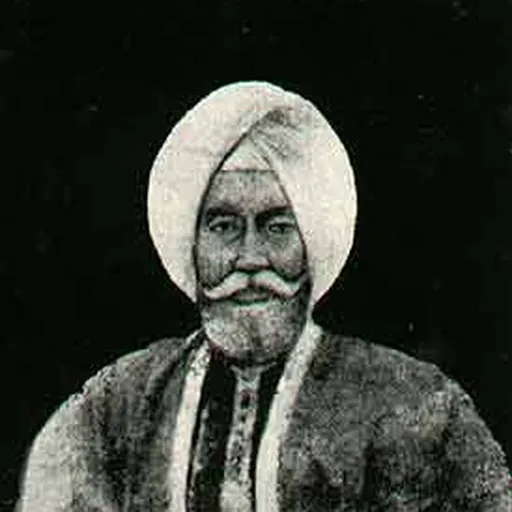
Kehar Singh
Sikh artist
About Kehar Singh
Kehar Singh (1820–1882 ) was a Sikh artist who was employed as a court painter by the Sikh states of Lahore and Kapurthala. Baba Kehar Singh Musawar was a prominent artist of the Sikh Naqqashi school of art and helped innovate it. The art of frescoes was introduced by the artist Bhai Kehar Singh Musawar under the patronage of Maharaja Ranjit Singh during the era of the Sikh Empire. Kehar Singh and his family were honoured as Fakhr-e-Qoum ("pride of the nation").
According to family genealogy narrated by Hakim Gurcharan Singh, a descendant of Kehar Singh (with the information being cross-checked and verified by the artist Hari Singh of Amritsar), it can be known that Kehar Singh was the son of Bhai Ambir Singh and that Kehar had a brother named Ram Singh (with Ram Singh being the father of Ishar Singh). The feat worked and Kehar Singh was hired as a court painter. After Ranjit Singh witnessed the fine artwork of Kehar Singh, he decided to commission him for beautifying the Golden Temple shrine in Amritsar to embellish it with mural work (such as the domes, walls, and roofs). Kehar Singh also worked at decorating the Akal Takht complex. Types of structures in Amritsar and Lahore that were decorated by Kehar Singh include havelis and temples (both gurdwaras and mandirs), with him also being active in neighbouring areas of Amritsar and Lahore. Kehar Singh is credited with establishing a school of naqqashes in Punjab. He was influenced by European-styles of watercolour, print, photography, and oil painting. B. N. Goswamy distinguishes the works of Kehar Singh from that of the Bazaar School, as they are more "more serious, more aware of quality". To suit English tastes, Kehar Singh began producing artwork using translucent wash, which is unalike the opaque watercolor used in traditional Indian painting. As to Kehar Singh's work, there was European influence on the effects of light and shade in his art pieces. Many real-life locations are depicted in his extant paintings, such as the Naulakha Pavilion of the Lahore Fort. When portraying a particular societal grouping, such as an occupation or caste, Kehar Singh portrayed actual living, breathing individuals rather than creating generalized depictions.
Collection Artwork that was produced by the familial atelier and lineage of Kehar Singh can be found in the collections of the Lahore Museum (Pakistan), Government Museum and Art Gallery (Chandigarh), Victoria and Albert Museum (London), and the Central Sikh Museum (Amritsar, pre-1984). A series of work attributed to Kehar Singh dating to circa 1875 are kept in the collection of the Government Museum and Art Gallery in Chandigarh.
Gallery
Don’t just read it —
keep it.
Full-length biographies made to live with: read them, listen on the way to work, watch them tonight.
- E-book
- Audio
- Video
Instant download · yours to keep · every purchase keeps this site free
Frequently asked questions
Who was Kehar Singh?
Sikh artist
Sources & further reading
· DBpedia: Kehar Singh (artist)
Cite this page
APA: Biography.guide. (2026). Kehar Singh. https://biography.guide/kehar-singh-q81b4a474/
MLA: "Kehar Singh." Biography.guide, https://biography.guide/kehar-singh-q81b4a474/.
Chicago: "Kehar Singh." Biography.guide. https://biography.guide/kehar-singh-q81b4a474/.
Data last updated: 2026-09-21 · Spot an error? Report a correction.
Portrait: Wikimedia Commons · author & licence
Page generated 2026-09-27 05:00 UTC