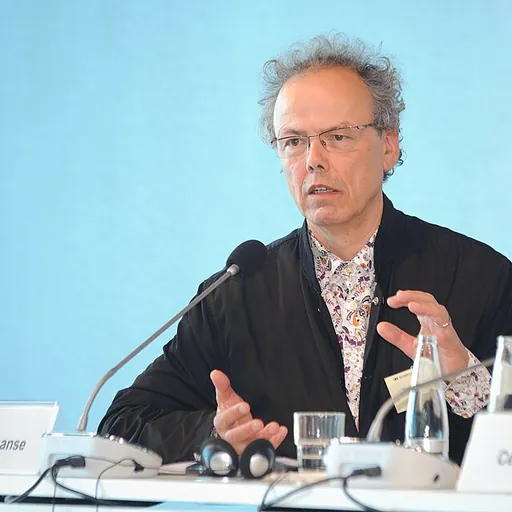
About Kees Christiaanse
Born 1953. Kees Christiaanse is a Dutch architect, university teacher, lecturer and researcher.
Kees Christiaanse (born 1953, Amsterdam) is an architect and urban planner from the Netherlands. After working with Rem Koolhaas, he started two firms, KCAP (Kees Christiaanse Architects & Planners, in Rotterdam) in 1989 and Architects and Planners (ASTOC, in Cologne) in 1990, where he was a partner till 2002. Christiaanse has "tackled some of the highest profile urban design schemes in the Netherlands, hosting buildings by" the finest Dutch and several international architects.
Life and work Christiaanse worked with Rem Koolhaas' architecture firm, OMA, where he was made a partner in 1983 at the age of 30, he worked with ASTOC until 2002. He was also artistic director of the Dutch Building Department from 1993 to 1996.
Two monographs on Christiaanse's work have been published, and an exhibition of the work done by his firms, "The City as Loft," was held at DeSingel in Antwerp in 2003. He is known for his urban planning work and "has quietly become the power behind the throne of Dutch architecture." His latest project is the design of a masterplan for an "engineering campus" (or "science park") in the Bavarian city of Augsburg, a project for which the state government (Freistaat Bayern) and the city are contributing 60 million Euros.
Urban planning philosophy Of particular interest to Christiaanse is the modern city, especially its openness or lack thereof. His designs as well as his public statements propagate the idea of "mixed communities," as he explained in an interview, to counteract the modern move toward gated communities and to increase different kinds of interactions among citizens. Such interactions, and the social control that comes along with it, also increase security, a concern in many European lower-income neighborhoods. The buildings to be built in such new neighborhoods Christiaanse calls "socializing machines." The metaphor Christiaanse often uses, of the city as a tree, is borrowed from architect and urban theorist Christopher Alexander, whose 1965 essay "A City Is Not A Tree" had suggested that cities grow like trees at their peril, with branches only connected to each other via the trunk. Alexander's fear, Christiaanse suggests, has become real, according to a keynote speech he delivered at the Holcim Forum 2007 for the Holcim Foundation, which is the key to his lament that "The city becomes a tree [the urban landscape becomes a forest of trees]." In a presentation given to the Urban Age South America Conference, December 2008, he gave some characteristics of the openness he wants cities to encourage in order to prevent this segmentation. Cities should be (or have): Walkable Fine maze public space grid Active street front typologies Mix use mix size mi social mix age No style.
Buildings Poseidon, office building, The Hague (1996) Kavel 25, housing project, The Hague (1992) Snackbar Bram Ladage, snackbar with Pepsi can (1992) Housing blocks on Java Island, Amsterdam (1998) Hogeschool Rotterdam, building for Arts, Architecture, Education departments (1998) Kenniscentrum NISA, building for the Netherlands Institute of Ship and Underwater Archeology (1999) Het Baken, residential tower, Deventer (2002) De Witte Keizer, residential high-rise, Rotterdam (2005) The Red Apple, residential high-rise with office buildings, Rotterdam (2009) Park and ride facilities for Uithof, Utrecht (2011)
Urban planning
Masterplan for housing festival, Hague (1987) Urban plan for Leidsche Rijn Vinex near Utrecht (1995) City plan Zuidhavenkwartier, Rotterdam Master plan for Eastern Docklands, Amsterdam (1998) Urban plan for Vinex location Schuytgraaf, Arnhem (1998) Urban plan for Lelystad South area of the Flevoland Vinex (1999) Winning proposal in 1999 for HafenCity in Hamburg, one of the largest European rebuilding projects of the 21st century "Vexierbild," three buildings in Hamburg Holzhafen, first building finished 2003 ("Vexierbild" translates as "impossible object"—the buildings suggest the earlier warehouses and by virtue of their open architecture allow an observer to see through to them to the city) Olympic Legacy Masterplan for the 2012 Summer Olympics Stadionpark Rotterdam Europaallee Jurong Lake District
Don’t just read it —
keep it.
Full-length biographies made to live with: read them, listen on the way to work, watch them tonight.
- E-book
- Audio
- Video
Instant download · yours to keep · every purchase keeps this site free
Important facts
People in Kees Christiaanse's life
Named in this biography and alive at the same time


Related people
Same field, nearest in time




Contemporaries
People whose lives overlapped Kees Christiaanse's


Frequently asked questions
Who is Kees Christiaanse?
Dutch architect (born 1953)
When was Kees Christiaanse born?
Kees Christiaanse was born in 1953 in Amsterdam.
What is Kees Christiaanse's occupation?
Kees Christiaanse is an architect, university teacher, lecturer and researcher.
What nationality is Kees Christiaanse?
Kees Christiaanse is Dutch.
Sources & further reading
· Wikipedia: Kees Christiaanse
Cite this page
APA: Biography.guide. (2026). Kees Christiaanse. https://biography.guide/kees-christiaanse/
MLA: "Kees Christiaanse." Biography.guide, https://biography.guide/kees-christiaanse/.
Chicago: "Kees Christiaanse." Biography.guide. https://biography.guide/kees-christiaanse/.
Data last updated: 2026-09-23 · Spot an error? Report a correction.
Portrait: Wikimedia Commons · author & licence
Page generated 2026-09-27 05:07 UTC