About Kazuo Umezu
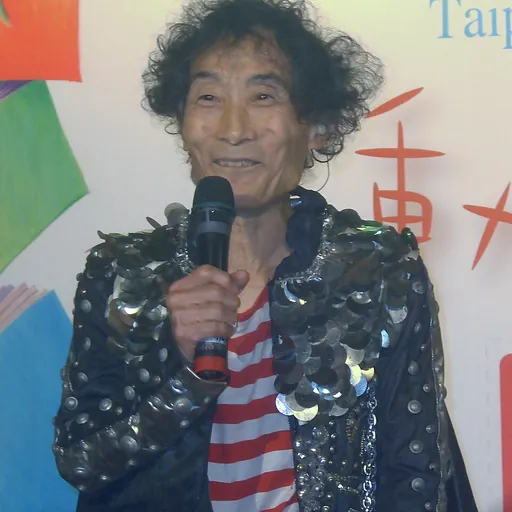
Lived 1936 – 2024 (aged 88). Kazuo Umezu was a Japanese mangaka, lyricist, tarento, film director and cartoonist.
was a Japanese manga artist, musician and actor. Starting his career in the 1950s, he is among the most famous artists of horror manga and has been vital for its development, considered the "god of horror manga". In 1960s manga like Reptilia, he broke the industry's conventions by combining the aesthetics of the commercial manga industry with gruesome visual imagery inspired by Japanese folktales, which created a boom of horror manga and influenced manga artists of following generations. He created successful manga series such as The Drifting Classroom, Makoto-chan and My Name Is Shingo, until he retired from drawing manga in the mid 1990s. He was a public figure in Japan, known for wearing red-and-white-striped shirts and doing his signature "Gwash" hand gesture.
Life and career
Early life and career Umezu was born on September 3, 1936, His father would tell him local legends about ghost and snake women before going to bed. He was part of a drawing circle with others called "Kaiman Club".
In 1955, he published his first manga at the age of 18 with Mori no Kyōdai based on the fairytale Hansel and Gretel with the kashihon publisher Tomo Book. Horror manga like Nekome no Shōjo and Reptilia became a hit in the commercial manga magazine Shōjo Friend in the mid 1960s. In 1974 he won the 20th Shogakukan Manga Award for his series The Drifting Classroom about a school including its schoolchildren and teachers being teleported into an alternate post-apocalyptic universe.
In 1975, Umezu started becoming a public figure also apart from creating manga. He recorded songs based on his horror manga and released them as the solo album Yami no Album.
His comedy manga Makoto-chan, which he published from 1976 to 1981 in Weekly Shōnen Sunday, became a hit. The hand gesture "Gwash" from the manga became Umezu's own trademark hand gesture as well in public. In 2011, he released a second music album with his songs. On November 5, 2024, Shogakukan announced that Umezu died on October 28. He was 88. A private funeral was held by his family and close friends. Umezu was planning a new work prior to his death.
Style and themes
"Fear manga" Umezu coined the term "fear manga" (kyōfu manga) in 1961 to describe his work, consciously distinguishing it from "weird tale" (kaiki) manga, which he felt overemphasized grotesque visuals. For Umezu, true "fear" was something that "makes you shudder even if you can't see it." Scholar Akihiko Takahashi argues that Umezu's "fear manga" was established when he broke the implicit constraint that "weird tales were for boys" and "fantasy was for girls," synthesizing these elements. A key transitional work was The Moment the Mouth Splits to the Ears (1962), the first to be explicitly labeled a "fear manga."
Umezu's own commentary and common criticism posit a linear evolution from "physiological fear" (e.g., motifs of snakes, spiders) in the mid-1960s to "psychological fear" in the late 1960s. Takahashi problematizes this, noting that psychological terror was present from the start. He posits that "fear" is the fundamental concept that subsumes both the "weird" and the distinction between physiological and psychological terror, representing a deeper, more holistic approach to the human condition. However, scholar Akihiko Takahashi cautions against interpreting this simply as an expression of "Japanese native spirituality or folkloric spirit," arguing that for Umezu, folklore served primarily as raw material and inspiration for story construction, not as an attempt to express or manifest a mystical otherworld.
In his later works from the mid-1980s onward, such as My Name Is Shingo and God's Left Hand, Devil's Right Hand, Umezu increasingly used the motif of a transcendent "God." Takahashi, building on the analysis of Yoshiyuki Koizumi, argues that Umezu does not depict a traditional, absolute deity governing a separate world. Instead, he presents a structure of infinite regression (e.g., a guardian spirit that itself has a guardian spirit), undermining the concept of a singular, original transcendent being. This approach introduces a simulacral structure to spiritual manga, challenging Platonic hierarchies and affirming both the "real" world and other accessible worlds simultaneously. Umezu initially focused on this topic as he found that relationships between mothers and children in manga in the early 1960s were portrayed only as caring, never as scary. His manga Reptilia depicts an intense conflict between a schoolgirl and her sick mother, who turns out to be a snake woman when she visits her in hospital. Manga scholar Tsuchiya Dollase compares this character with the Jungian "Terrible Mother". and Kanako Inuki got her career start in a magazine compiled by him. Rumiko Takahashi briefly worked as an assistant for him, while he was working on Makoto-chan. His reputation gave him the nickname "god of horror manga" (ホラーまんがの神様) in Japanese media.
In 2019, Umezu received the Commissioner for Cultural Affairs award from the Agency for Cultural Affairs. It is an award for "individuals who have made distinguished accomplishment in artistic and cultural activities". It is rarely awarded to people in the manga industry.
Assistants Noboru Takahashi Robin Nishi Rumiko Takahashi
Works Manga Original title English title Year Notes Siblings of the Forest 1955 published by Tomo Book one-shot in Shōjo Book 1959 published by Tōhō MangashaMaboroshi Shōjo (まぼろし少女)1959 serialized in Niji 1964 published by Tōkyō Mangasha 1964 Scared of Mama 1965 serialized in Shōjo Friend Half-Fish Man 1965 serialized in Shōnen Magazine Cracked Human 1966 serialized in Shōnen Magazine Reptilia 1966 serialized in Shōjo Friend Ultraman 1966–1967 serialized in Shōnen Magazine Cat Eyed Girl 1967 serialized in Shōjo Friend Cat Eyed Boy 1967–19681968–19691976 serialized in Shōnen Gahoserialized in Shōnen Kingserialized in Weekly Shōnen Sunday Baby Girl 1967 serialized in Shōjo Friend March of the Dead 1967 serialized in Shōnen Magazine 1968–1969 serialized in Big Comic 1968 serialized in Teen Look Butterfly Grave 1968 serialized in Teen Look Fear 1969 Orochi 1969–1970 serialized in Weekly Shōnen Sunday 1970 serialized in Big Comic 1971 serialized in Teen Look Again 1971–1972 serialized in Weekly Shōnen Sunday The Drifting Classroom 1972–1974 serialized in Weekly Shōnen Sunday Baptism 1974–1976 serialized in Shōjo Comic Makoto-chan 1976–1981 serialized in Weekly Shōnen Sunday My Name Is Shingo 1982–1986 serialized in Big Comic Spirits God's Left Hand, Devil's Right Hand 1986–1988 serialized in Big Comic SpiritsChō! Makoto-chan (超!まことちゃん)1988–1989serialized in Weekly Shōnen Sunday Fourteen 1990–1995 serialized in Big Comic Spirits
Paintings
Films Nekome Kozo (anime television series) Drifting Classroom (movie) Blood Baptism (movie) Drifting School (movie) Long Love Letter: Drifting Classroom (TV drama) Kazuo Umezu's Horror Theater (6-part TV anthology) The Snake Girl and the Silver-Haired Witch ("Hebimusume to hakuhatsuma", ) (1968) (Daiei/Kadokawa Pictures) Tamami: The Baby's Curse (film) Mother (film) (director)
Albums Yami no Album (闇のアルバム, 1975) Yami no Album 2 (闇のアルバム・2, 2011)
Video games Umezma (ウメズマ, 1996)
Musicals In 2016, his manga My Name Is Shingo was adapted into a musical. It stars Mitsuki Takahata and Mugi Kadowaki as the lead characters and is directed and choreographed by Philippe Decouflé.
Don’t just read it —
keep it.
Full-length biographies made to live with: read them, listen on the way to work, watch them tonight.
- E-book
- Audio
- Video
Instant download · yours to keep · every purchase keeps this site free
Important facts
People in Kazuo Umezu's life
Named in this biography and alive at the same time




Related people
Same field, nearest in time




Contemporaries
People whose lives overlapped Kazuo Umezu's


Frequently asked questions
Who was Kazuo Umezu?
Japanese writer
When was Kazuo Umezu born?
Kazuo Umezu was born on 3 August 1936 in Mount Kōya.
When did Kazuo Umezu die?
Kazuo Umezu died on 28 October 2024 in Tokyo.
What was Kazuo Umezu's occupation?
Kazuo Umezu was a mangaka, lyricist, tarento, film director and cartoonist.
What nationality was Kazuo Umezu?
Kazuo Umezu was Japanese.
Sources & further reading
Cite this page
APA: Biography.guide. (2026). Kazuo Umezu. https://biography.guide/kazuo-umezu/
MLA: "Kazuo Umezu." Biography.guide, https://biography.guide/kazuo-umezu/.
Chicago: "Kazuo Umezu." Biography.guide. https://biography.guide/kazuo-umezu/.
Data last updated: 2026-09-22 · Spot an error? Report a correction.
Portrait: Wikimedia Commons · author & licence
Page generated 2026-09-27 05:02 UTC