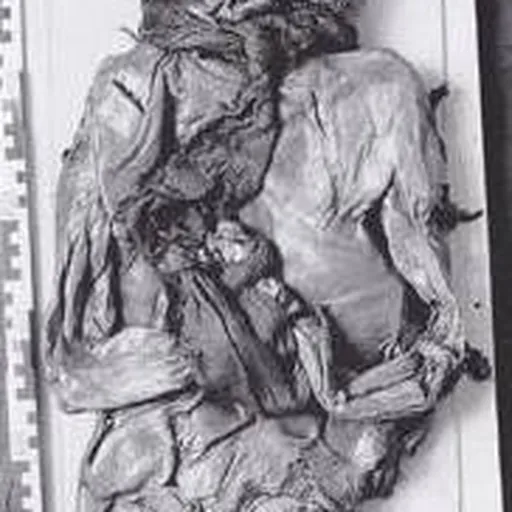
Kayhausen Boy
The mummy, naturally preserved in a sphagnum bog in Lower-Saxony, Germany
About Kayhausen Boy
Kayhausen Boy is the preserved body of a young child from the Iron Age, discovered in 1922 in the Kayhauser Moor, a raised sphagnum bog in Lower Saxony, Germany. He is one of the rare examples of a child preserved as a bog body.
Radiocarbon analysis and earlier pollen studies indicate that the child lived between the fourth century BCE and the first century BCE. Dental examination shows that he was no more than about seven and a half years old at the time of death and stood between tall. The child had a chronic hip infection that would likely have restricted his mobility. Examination of the body indicates that he died from multiple stab wounds to the neck and had been bound with wool textiles and wrapped in a calfskin cloak before being placed in the bog.
Discovery
The body of the Kayhausen Boy was discovered on 3 July 1922 in the Kayhauser Moor, a raised peat bog near the settlement of Kayhausen in present-day Lower Saxony, Germany. A peat cutter named Roggemann was working in an area where earlier peat extraction had already removed the upper of the bog. While cutting into deeper peat, about below the surface, he uncovered a lower leg bone together with fragments of a calfskin cloak. Realizing that he had found a human body, he exposed the remains, which lay extended on their back within the compacted peat.
Roggemann notified Sandstede, the representative of the local museum in Bad Zwischenahn. Sandstede then contacted archaeologist J. Martin, Director of the State Museum for Natural History and Prehistory in Oldenburg. Martin arrived the following day to examine and photograph the find in situ. Because the peat had begun to dry and the remains were fragile, the body was removed promptly for further study.
The hair had turned reddish due to chemical reactions in the bog, though small patches of the original dark blond color remained visible. The skull and facial tissues were distorted by long-term compression. The ears were lost during the find, and most teeth and nails had detached by the time the body reached the museum. Despite these losses, the preservation of skin, hair, and textile fibres provided a rare level of detail about the child's physical condition at death. One textile sample was later shown to be modern contamination introduced after excavation, but the remaining samples consistently support a late Iron Age context.
Although only seven years old, the Kayhausen Boy had lived with a significant physical condition. Radiographic studies revealed a pronounced abnormality in the right hip joint where the head of the femur had been altered by a healed infection. A possible reason for the boy's demise is that he had suffered from an infected socket at the top of his femur, and hence would not have been able to walk without assistance. Because of the high incidence of deformities among bog bodies, such as the Yde Girl, anthropologists have suggested that the disabled were sacrificed because they were considered to be disfavoured by their gods. The boy's body is preserved in a formalin solution and is not displayed.
Don’t just read it —
keep it.
Full-length biographies made to live with: read them, listen on the way to work, watch them tonight.
- E-book
- Audio
- Video
Instant download · yours to keep · every purchase keeps this site free
Frequently asked questions
Who was Kayhausen Boy?
The mummy, naturally preserved in a sphagnum bog in Lower-Saxony, Germany
Sources & further reading
Cite this page
APA: Biography.guide. (2026). Kayhausen Boy. https://biography.guide/kayhausen-boy/
MLA: "Kayhausen Boy." Biography.guide, https://biography.guide/kayhausen-boy/.
Chicago: "Kayhausen Boy." Biography.guide. https://biography.guide/kayhausen-boy/.
Data last updated: 2026-09-21 · Spot an error? Report a correction.
Portrait: Wikimedia Commons · author & licence
Page generated 2026-09-27 04:59 UTC