
About Kathryn Morrison
Lived 1942 – 2013 (aged 71). Kathryn Morrison was an American politician.
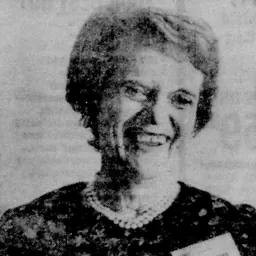
Kathryn Morrison (May 22, 1942 – June 30, 2013) was an American educator and Democratic Party politician who was the first woman to be elected to serve in the Wisconsin Senate. Morrison was born in Madison, Wisconsin, and graduated from Madison East High School. Morrison was elected November 1974, seated January 1975 and served one term representing the 17th District.
After leaving the Wisconsin State Senate Morrison pursued a career in health care administration with the United States Government, the New York City Health and Hospitals Corporation, and the March of Dimes. She published about the topic of health care economics. Morrison had a BA and MBA from the University of Wisconsin–Madison.
Early life Kathryn Morrison was born in Madison to parents Gould E. and Geraldine D. Morrison. She went through the Madison public school system, where she attended Lowell Grade School and Madison East High School. In the book, What Two Can Do: Sam & Mandy Stellman's crusade for social justice, the author discuss the events and political environment that led to Morrisons's decision to run for the Senate seat. Morrison was active in various progressive women's movements throughout the state, working closely with Mandy Stellman on numerous issues that plagued the state, including supporting the change to the language in Wisconsin state statutes and legislation to make them gender neutral. Hearings were held on October 19, 1973, to address this issue, and the committee was chaired by State Senator Gordon Roseleip, who Morrison would later run against and then defeat. Roseleip belittled Stellman and was against any attempts to change the terminology. The bill eventually got out of committee and passed by a wide margin, but that was one of many examples of Senator Roseleip fighting against any advancements of women in the state and politics. After Stellman's negative encounter with Roseleip in the committee hearings, Stellman and some of her esteemed peers in the women's rights movement, such as Gene Boyer, Midge Miller, Mary Lou Muntz, Barbara Ulichny, and Morrison, were eating at a restaurant on State Street to regroup after the difficult hearings. Their frustration with Roseleip led to their desire to rid him from office, and these women helped create the spark that would lead to Morrison later running for office. When she went back to the capitol to lobby for various women's rights issues, it was her looking at the male legislators and realizing that she could do it too. Watching the men legislate and hearing the encouragement from several of her peers provided Morrison with the confidence to run for state office to be the first female state senator. After she was elected, the Sexual Assault Act of 1976 was passed, but she was active in the women's liberation movement before she was elected, and helped lay the foundations for the eventual support of the Sexual Assault Act. In 1974, Morrison worked with Barbara Ulichny to organize a summit meeting for women in leadership positions throughout the state. Ulichny eventually was elected to the State Assembly in 1978, to the State Senate later, and then eventually became a private attorney. The women's summit's goal was to write the first draft for a new sexual assault law, and help push the legislation through many state congressional meetings and with important key players, including women that Morrison worked with such as Sandra Edhlund, Sara Bates, Julilly Kohler, and Linda Roberson. The Sexual Assault Law's plan was to move the state forward in terms of progressive legislation that would protect rape victims and close the loopholes in the previous laws. It broadened the definition of sexual assault by dividing it into four categories, such as touching without permission to forced intercourse. They wanted to have the punishment fit the crime, the previous law defined sexual assault only as rape, and the only legal punishment was 30 years. The women activists wanted these different levels of punishment, in order to reassure many male legislators and judges, who were reluctant to place a man behind bars for 30 years for a smaller crime. There was still rampant negative attitudes towards brushing off sexual assault cases that allowed many offenders to walk free, so their attempts to create this middle ground legislation gained a lot of supporters. The proposed law also included the provision to change the name "rape" to "sexual assault" in legal wordings, to be more all-encompassing and ensure more acts of sexual assault would be punished. Other aspects of the law that Morrison and other female activists supported was to put to rest the myth that unless a woman physically fought her attacker she consented to the sexual action, and they also wanted to ensure that if a woman had to testify or go through any legal proceedings that her previous sex life wouldn't also go on trial. Morrison and other activists held a public forum on September 23, 1974, at the University of Wisconsin-Milwaukee. Their efforts got the attention of many, but it still took a few years for the legislation to pass, later in 1976. Morrison decided to run for state senate in 1975, where she was elected to one term in the legislature, as a member of the Democratic party. She flipped the seat in what was a very Republican 17th Senate District when she was elected, and it was the first time in 82 years that the Democrats regained control of Wisconsin's higher chamber. It was a very agricultural district in the western part of the state, but now there were some liberal streaks to the district that caused it to be a little unpredictable. She defeated incumbent Gordon Roseleip, a resident of Darlington, a vocal opponent of women's rights and one of the most conservative members of the State Senate, in order to win the seat. Roseleip was a staunch anti-communist, who was also very anti-birth control and pro-war, but his fame predominantly came from his famous blindfolded attempt to tell the difference between margarine and butter back in 1965, which failed. After working for Carter, she came back to Wisconsin to work for the Wisconsin Regional Geriatrics Center in Milwaukee as an economics specialist, then later she became the administrator of the Wisconsin Division of Health in 1983. In 1990 Morrison moved into the nonprofit sector, where she became senior vice president for finance and administration for the March of Dimes, a position she held until her retirement in 2004.
After leaving the Senate, she served for a time in the United States Department of Health and Human Services as a Deputy Commissioner of the Department on Aging, and was Administrator of the Division of Health in Wisconsin.
Legacy After Morrison died she was honored by many from all over the state for being the first woman in the State Senate and paving the way for other women to follow after her. University of Wisconsin-Platteville faculty and staff, various members of the community, and legislators from all over the state attended a ceremony in Morrison's honor on December 15, 2014. Notable people in attendance included Wisconsin State Senators Dale Schultz, Tim Cullen, and Fred Risser as well as former University of Wisconsin System President Katharine C. Lyall, a dear friend of Morrison's, as well as various members of her family. Held in the Nohr Gallery in Ullsvik Hall, a plaque memorializing her work was revealed during the ceremony. Morrison was well-remembered for her time in the Wisconsin State Senate and is included in various governmental and educational curriculums and programs, including the Wisconsin State Senate Scholar Program. Morrison is survived by two brothers, Phillip and his wife Pam who live in Mesa, Arizona, and Paul and his wife Lynn, who live in Fort Collins, Colorado; her nephews David Morrison, Scott Morrison, and Kenneth Morrison, and her niece, Valorie Smith She was interred in Wheeler in Dunn County at a private ceremony.
Works Morrison, Kathryn, "Internal Budgeting at HHC" (1992) in Public hospital systems in New York and Paris. New York: New York University Press.
Don’t just read it —
keep it.
Full-length biographies made to live with: read them, listen on the way to work, watch them tonight.
- E-book
- Audio
- Video
Instant download · yours to keep · every purchase keeps this site free
Important facts
People in Kathryn Morrison's life
Named in this biography and alive at the same time





Related people
Same field, nearest in time




Contemporaries
People whose lives overlapped Kathryn Morrison's


Frequently asked questions
Who was Kathryn Morrison?
American politician
When was Kathryn Morrison born?
Kathryn Morrison was born on 22 May 1942 in Madison.
When did Kathryn Morrison die?
Kathryn Morrison died on 30 June 2013.
What was Kathryn Morrison's occupation?
Kathryn Morrison was a politician.
What nationality was Kathryn Morrison?
Kathryn Morrison was American.
Sources & further reading
· DBpedia: Kathryn Morrison (politician)
Cite this page
APA: Biography.guide. (2026). Kathryn Morrison. https://biography.guide/kathryn-morrison/
MLA: "Kathryn Morrison." Biography.guide, https://biography.guide/kathryn-morrison/.
Chicago: "Kathryn Morrison." Biography.guide. https://biography.guide/kathryn-morrison/.
Data last updated: 2026-09-20 · Spot an error? Report a correction.
Page generated 2026-09-27 05:14 UTC