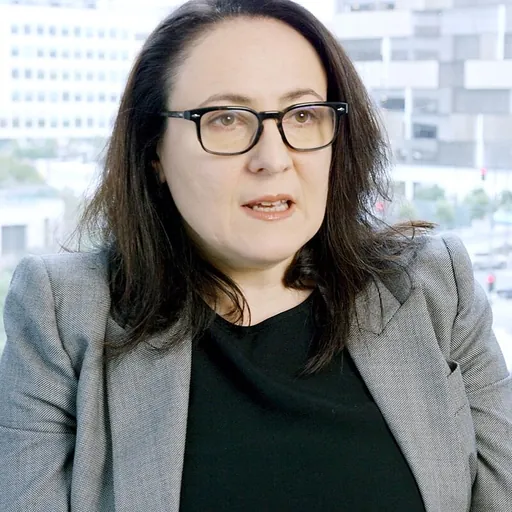
Katerina Akassoglou
Neuroscience researcher
About Katerina Akassoglou
Katerina Akassoglou was a Greek neuroimmunologist.
Katerina Akassoglou is a neuroimmunologist who is a Senior Investigator and Director of In Vivo Imaging Research at the Gladstone Institutes. Akassoglou holds faculty positions as a Professor of Neurology at the University of California, San Francisco. Akassoglou has pioneered investigations of blood-brain barrier integrity and development of neurological diseases. She found that compromised blood-brain barrier integrity leads to fibrinogen leakage into the brain inducing neurodegeneration. Akassoglou is internationally recognized for her scientific discoveries.
Early life and education Akassoglou was born in Athens, Greece. She was inspired to pursue science in her undergraduate degree after her high school biology teacher assisted her in securing a summer internship in an Immunology lab.
Akassoglou pursued her undergraduate degree at the University of Athens, graduating with a Bachelor of Science in biology in 1996. During her PhD, Akassoglou pursued training in neuropathology under the mentorship of Hans Lassman at the University of Vienna, Austria. She completed her postdoctoral training with Strickland in 2002 and then pursued a second postdoctoral fellowship at the New York University in the Skirball Institute of Biomolecular Medicine until 2003.
Research To explore the biology of Tumor Necrosis Factor signalling and probe its role in promoting disease, Akassoglou expressed TNFα in a transmembrane form on various brain cells. She found that when she specifically expressed TNFα on astrocytes, this led to chronic inflammation and neurodegeneration. After inducing expressing of TNF from glial cells, she found oligodendrocyte death and myelin degeneration in the central nervous system, similar to the pathology one would find in MS. Akassoglou and her colleagues then probed the underlying mechanisms with which fibrin mediates neuronal damage, and they found that fibrin has an effect on Schwann Cell differentiation, keeping these cells in their non-myelinating state. They further found that fibrin deposition also changes the extracellular matrix which inhibits Schwann Cell migration, further preventing re-myelination and leading to degeneration of peripheral nerves.
Career In 2004, Akassoglou joined the faculty in the Department of Pharmacology at the University of California, San Diego, where she is Adjunct Professor of Pharmacology. Akassoglou's lab was centered around exploring neurovascular regulation of inflammation and tissue repair in the context of various neurological diseases. Akassoglou's lab seeks to understand how blood proteins interact with cells and disrupt signalling in the brain parenchyma in times of blood-brain barrier disruption. Her research elucidated the role that fibrin, a blood protein implicated in coagulation, has in the activation of microglia and the development of inflammation and neurodegeneration. They found that when fibrinogen binds to the microglial receptor CD11b/CD18 it leads to microglial migration towards vasculature and the release of reactive oxygen species that damage neurons and lead to neuronal death. Again, they used two-photon imaging to track the progress of disease and directly observe the role fibrinogen plays in microglial activation, spine elimination, and subsequent cognitive decline. These findings suggest that early detection of thrombin might be a suitable diagnostic for later neurodegeneration. They generated a monoclonal antibody, 5B8, that binds to fibrin and is able to inhibit CNS inflammation and oxidative stress without affecting blood clotting capabilities. 2009 EUREKA Award from the National Institutes of Health 2019 Barancik Prize for Innovation in Multiple Sclerosis Research 2019 Greek Top Women Award 2021 Election as a Fellow of the American Association for the Advancement of Science
Don’t just read it —
keep it.
Full-length biographies made to live with: read them, listen on the way to work, watch them tonight.
- E-book
- Audio
- Video
Instant download · yours to keep · every purchase keeps this site free
Important facts
Related people
Same field, nearest in time


Frequently asked questions
Who was Katerina Akassoglou?
neuroscience researcher
When was Katerina Akassoglou born?
Katerina Akassoglou was born in Athens.
What was Katerina Akassoglou's occupation?
Katerina Akassoglou was a neuroimmunologist.
What nationality was Katerina Akassoglou?
Katerina Akassoglou was Greek.
Sources & further reading
· Wikipedia: Katerina Akassoglou
· DBpedia: Katerina Akassoglou
Cite this page
APA: Biography.guide. (2026). Katerina Akassoglou. https://biography.guide/katerina-akassoglou/
MLA: "Katerina Akassoglou." Biography.guide, https://biography.guide/katerina-akassoglou/.
Chicago: "Katerina Akassoglou." Biography.guide. https://biography.guide/katerina-akassoglou/.
Data last updated: 2026-09-20 · Spot an error? Report a correction.
Portrait: Wikimedia Commons · author & licence
Page generated 2026-09-27 04:58 UTC