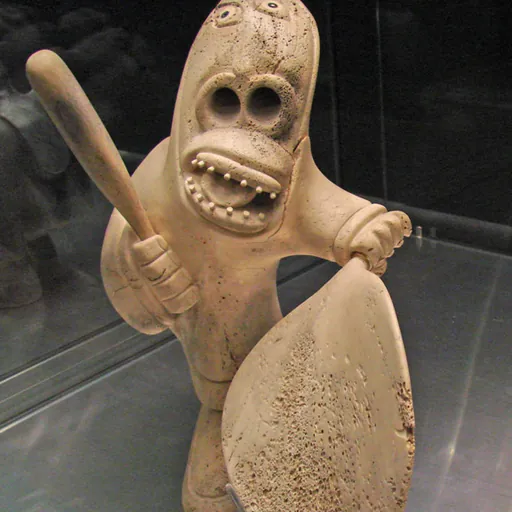
About Karoo Ashevak
Lived 1940 – 1974 (aged 33–34). Karoo Ashevak was a Canadian sculptor.
Karoo Ashevak (Inuktitut: ) (1940 – October 19, 1974) was an Inuk sculptor who lived a nomadic hunting life in the Kitikmeot Region of the central Arctic before moving into Spence Bay, Northwest Territories (now Taloyoak, Nunavut) in 1960. His career as an artist started in 1968 by participating in a government-funded carving program. Working with the primary medium of fossilized whale bone, Ashevak created approximately 250 sculptures in his lifetime, and explored themes of shamanism and Inuit spirituality through playful depictions of human figures, angakuit (shamans), spirits, and Arctic wildlife.
In 1970, the Canadian Eskimo Art Council held the Centennial competition in Yellowknife. Ashevak's sculptures won third prize in that competition, and he became a recognizable artist after his solo exhibition at the American Indian Art Centre in New York in 1973. Ashevak's works were also widely traded on the auction market. Despite his early death — he died in October 1974 from a house fire, Ashevak was crucial to the development of Inuit sculpture by visualizing an imaginative world with supernatural beings and shamanistic practices.
Early life
Ashevak was born in 1940 in the Kitikmeot Region, of the central Arctic of Nunavut. Like many Netsilik youths, he lived a traditional Inuit life by acquiring hunting skills that were necessary to support himself in later life. However, Ashevak grew up at a time when the establishment of wage-earning settlements rapidly replaced the Eskimo lifestyle and economy. In the past, Netsilik people lived in small communities and worked as nomadic hunters. Since they moved off the land to Spence Bay (Taloyoak), they were forced to adopt a southern-style economy such as living in a house and having a stable job. He is now acknowledged as an important artist in Canadian Inuit art. He was not exclusively recognized until spring of 1972 when Avrom Isaacs used Karoo's sculptures in a one-man exhibition at the Inuit Gallery in Toronto. Despite its success, it did not make him famous he was mainly known to those associated with Eskimo art. Finally, in January 1973, his exhibition at the American Indian Art Centre in New York established his local fame and overall reputation in the eastern U.S. and Canada. This marked the height of his career, just a year prior to his death.
Ashevak would first come up with an idea for a sculpture before selecting the medium to use.
Ashevak and the art market
According to Leon Lippel, Ashevak's sculptures evoked an overwhelmingly affirmative response at his own time. Each of his pieces portrays an individual being with no cultural references to particular myths, stories or events. Therefore, Ashevak's work could speak to the audience who did not have any knowledge of the Inuit culture and attract the audience based on its purely aesthetic values. Shamanism is based on the animistic belief that a spirit could exist in every being and take different forms. Some spirits are friendly to human beings, and they function as helping spirits to assist angakuit performing supernatural tasks. In contrast to the helping spirits, evil spirits attack or eat humans, and they would bring misfortune and disasters to the community. Ashevak portrayed various helping spirits in animal forms such as Bear (1973), Flying Walrus (1972), and a mystical four-legged creature with wings.
Another favourite subject of Ashevak's sculptures are birds. In the Netsilik tradition, angakuit could be transformed into birds, and travel to all regions in the cosmos. During their magical journeys, angakuit fly into the sky, the land of the dead, and even to the homes of ancient Inuit deities. By the end of the practice, an elder angakkuq would transmit his power to the young angakkuq by placing his hands on the young shaman's head. Moreover, Ashevak's use of incised lines was related to the Thule culture. In his sculptures, Bird of 1970 and 1971, incised lines are used to depict the skeleton of the birds, which is a typical characteristic of shamanism.
Personal life
Ashevak was known for having a distinctive personality among the Inuit artists by being openly expressive about his emotions. It was uncommon for Inuit adults to display their feelings because they highly valued the idea of Ihuma, which was the ability of emotional restraint. Ihuma was a significant indigenous personality, and the grown-ups exercised Ihuma by hiding their joy or anger in front of the public. However, Ashevak freely vented his emotions, and sometimes he even displayed aggressive and antagonistic behaviours.
Ashevak enjoyed the creative process of carvings, and he took enormous pride in his work. Although the artist was aware of the market value of his sculptures, he priced them accurately by himself. Carving was the primary resource of Ashevak's income, but money was not the only factor to inspire his continuous creations. Ashevak's favourite part of sculpture was to apply finishing touches, which gave the final piece distinctive details. Ashevak respected the originality of carvings, and he became irritated when other sculptors copied his works since he did not know how to deal with the imitators.
In August 1974, Ashevak's life started to come to a tragic end. His adopted son, Lary, was killed by dogs. On October 19 of the same year, Ashevak and his wife Doris both died in a fire that destroyed their house.
Achievements Ashevak established a well-known reputation in his community and the nearby area of Uqsuqtuc, otherwise recognized as Gjoa Haven, during his artistic career. His work inspired a whole generation of Kitikmeot carvers. Although he only created about 250 sculptures during his short artistic career, his works have been included in multiple exhibitions and continue to be widely collected as well as traded on the art market and during auctions. They are also included in many corporate and museum collections. He executed solo exhibitions in Toronto, Montreal, and New York. When he was first officially noticed in 1970 during the Centennial competition in Yellowknife, he won third prize and honourable mention for his entries of Bird and Drum Dancer, respectively. This was the beginning of his successful career. Ashevak's early exhibitions between 1972 and 1974 had very successful outcomes as many works were sought after and sold even though he was not well-known yet. Two features that make these exhibitions stand out is the type of purchaser and the audience reaction. The sculptures were popular amongst Eskimo and non-Eskimo art collectors as well as people who normally do not collect Eskimo art. The audience were also immediately captivated by his work, especially in exhibitions at the Inuit Gallery in Toronto and the American Indian Arts Centre in New York.
Theatrical producer, Max Weitzenhoffer, ranked Ashevak as one of the top contemporary Canadian sculptors because he viewed Askevak's work apart and unique from the other Inuit artists’ production. He believes that they are universally accepted and appeal to a mass majority. Scholar, George Swinton, compared him to Henry Moore who is a well-known English artist famous for his sculptures.
Exhibitions 1972: "Eskimo Fantastic Art", University of Manitoba, Winnipeg 1973: "Cultures of the Sun and the Snow: Indian and Eskimo Art of the Americas", Montreal Museum of Fine Arts, Quebec 1973: "Karoo Ashevak: Spirits", at the American Indian Arts Centre, New York City 1973: "Karoo Ashevak Whalebone Sculpture", Lippel Gallery, Montreal 1973: "Spirits", Franz Bader Gallery, Washington, D.C. 1977: "Karoo Ashevak", Winnipeg Art Gallery, Manitoba 1977: "White Sculpture of the Inuit", Simon Fraser University Art Gallery, Burnaby, B.C. 1977: "Karoo Ashevak (1940-1974): Sculpture", Upstairs Gallery, Winnipeg 1978: "The Coming and Going of the Shaman: Eskimo Shamanism and Art", Winnipeg Art Gallery, Manitoba 1980: "Whalebone Carvings and Inuit Prints", Memorial University of Newfoundland Art Gallery, St. John's 1983: "Inuit Masterworks: Selections from the Collection of Indian and Northern Affairs Canada", McMichael Canadian Art Collection, Kleinberg, Ontario 1985: "Uumajut: Animal Imagery in Inuit Art", Winnipeg Art Gallery, Manitoba 1986: "Contemporary Inuit Art", National Gallery of Canada, Ottawa 1988: "Building on Strengths: New Inuit Art from the Collection", Winnipeg Art Gallery, Manitoba 1988: "In the Shadow of the Sun: Contemporary Indian and Inuit Art in Canada", Canadian Museum of Civilization, Gatineau, Quebec 1990: "Arctic Mirror", Canadian Museum of Civilization, Gatineau, Quebec 1990: "Inuit Art From the Glenbow Collection", Glenbow Museum, Calgary 1994: "Transcending the Specifics of Inuit Heritage: Karoo in Ottawa", at the National Gallery of Canada 1999 – 2000: "Carving and Identity: Inuit Sculpture from the Permanent Collection", National Gallery of Canada, Ottawa 1999: "Iqqaipaa: Celebrating Inuit Art, 1948 - 1970", Canadian Museum of Civilization, Gatineau, Quebec
Collections
Museum and gallery collections that permanently houses his works: Art Gallery of Ontario (Toronto) Canadian Museum of Civilization (Gatineau, Quebec) Glenbow Museum (Calgary, Alberta) Heard Museum (Phoenix, Arizona) McMichael Canadian Art Collection (Kleinburg, Ontario) Montreal Museum of Fine Arts (Quebec), Museum of Anthropology (University of British Columbia, Vancouver) Museum of Inuit Art (Toronto, Ontario) Prince of Wales Northern Heritage Centre (Yellowknife, Northwest Territories) Quebec Museum of Fine Arts (Quebec City) Smithsonian Institution National Museum of the American Indian (Washington, D.C.) University of Alberta (Edmonton, Alberta) Winnipeg Art Gallery (Manitoba) National Gallery of Canada (Ottawa) Lorne Balshine Inuit Art Collection at the Vancouver International Airport (Vancouver, B.C.) TD Gallery of Inuit Art at the Toronto-Dominion Centre (Toronto, Ontario)
Don’t just read it —
keep it.
Full-length biographies made to live with: read them, listen on the way to work, watch them tonight.
- E-book
- Audio
- Video
Instant download · yours to keep · every purchase keeps this site free
Important facts
People in Karoo Ashevak's life
Named in this biography and alive at the same time








Related people
Same field, nearest in time


Contemporaries
People whose lives overlapped Karoo Ashevak's

Frequently asked questions
Who was Karoo Ashevak?
Native American carver and sculptor (1940–1974)
When was Karoo Ashevak born?
Karoo Ashevak was born in 1940 in Taloyoak.
When did Karoo Ashevak die?
Karoo Ashevak died in 1974 in Taloyoak.
What was Karoo Ashevak's occupation?
Karoo Ashevak was a sculptor.
What nationality was Karoo Ashevak?
Karoo Ashevak was Canadian.
Sources & further reading
Cite this page
APA: Biography.guide. (2026). Karoo Ashevak. https://biography.guide/karoo-ashevak/
MLA: "Karoo Ashevak." Biography.guide, https://biography.guide/karoo-ashevak/.
Chicago: "Karoo Ashevak." Biography.guide. https://biography.guide/karoo-ashevak/.
Data last updated: 2026-09-22 · Spot an error? Report a correction.
Portrait: Wikimedia Commons · author & licence
Page generated 2026-09-27 05:01 UTC