
About Karl Rydingsvärd
Lived 1863 – 1941 (aged 77). Karl Rydingsvärd was an American artist and furniture maker.
Karl Arthur von Rydingsvärd was a Swedish-American furniture maker and teacher influential in the Arts and Crafts movement in the United States.
His work was exhibited at the Louisiana Purchase Exhibition, and he had a direct influence on future generations of craftsmen due to his work training future teachers of technical arts at the Teachers College in New York and future generations of artists at the Rhode Island School of Design. to Axel and Emma Rydingsvärd. He records on his census that he received up to an eighth grade formal education. He learned to carve furniture at the Royal Technical School in Sweden Anna taught as a professor in the Massachusetts Normal Art School in Boston, and was an accomplished translator and author, who wrote magazine articles and a manual for art education in schools, as well as translating from Swedish several books including My Lady Legend by Albrekt Segerstedt in 1891, and Vera Vorontzoff by Sonja Kovalevsky in 1895. (She is also credited with translating Verner von Heidenstam's Endymion and Tor Hedberg's Judas, despite Rydingsvärd having no prominent noble descent, a fact that was reported in Boston area Swedish-language newspapers. Anna referred to herself as Baroness von Proschwitz in her translation work, and gave interviews claiming the title. When Anna filed for divorce in 1897,
In 1899, Rydingsvärd married his former student, Ida Jackson.
Rydingsvärd became a naturalized citizen of the United States on December 24, 1900. and newspapers of the 1910s introduce him with the title of Baron.
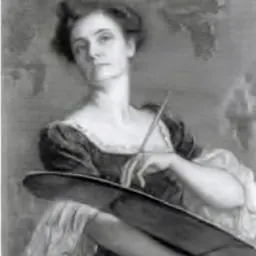
He was friends with many other notable artists of the period, including Amanda Brewster Sewell, who painted his portrait in 1905. Karl and Ida von Rydingsvärd, with Wendell Volk, standing in front of the 85 Clinton St. house in Portland, ME. The house was purchased in 1925. The label on the backside of this photograph, which comes from the Douglas Volk papers, describes Rydingsvärd as a count. Note the carved panels surrounding the door. in Portland, Maine.
Career Rydingsvärd was an active contributor to many craft-focused periodicals, writing tutorials and publishing decorative designs intended to be copied by amateur woodcarvers. He provided a multi-part series, "Lessons in Woodcarving", in the Arts & Crafts magazine (London, published by Hutchinson and Co.), as well as publishing in Art Amateur, International Studio, and The Craftsman.
In addition to producing his own work, Rydingsvärd ran a school for woodcarving for many years, taking both men and women as pupils
From 1891 to 1896, Rydingsvärd taught at the Rhode Island School of Design. He was a major proponent of women's work in woodcarving, and often spoke about their ability to carve both as a hobby and as a profession.
In 1895, he was a department director in the Manual Training and Arts Education department at the Horace Mann School of the Teachers College in New York This was the same publisher with which his wife Anna published her translation of Vera Vorontzoff. The cover design and title page illustration for that book are uncredited and unsigned, and showed work there.
In 1904, the Louisiana Purchase Exposition, for the first time in the history of world's fairs, separated displays of machine-made furniture and goods from handmade goods, called "original products of Art workmanship." These were exhibited along with other fine arts in the Palace of Art, rather than the Palaces of Manufactures or Varied Industries as they would have been in previous years. This recognition of handicraft was a major victory for the design reform movement, of which he Rydingsvärd was part. He exhibited at the Exposition for the state of New York, submitting a Norse style bridal chair. as well as at the New York City YWCA. In 1909, he taught at the Troy School of Arts and Crafts in Troy, New York.
He exhibited his work many times at the National Arts Club where he was a member, He won a life membership as a prize in the 1914 Society of Craftsmen exhibition. In 1908, he exhibited a desk and other smaller articles (his wife Ida also exhibited at this time ); his 1909 exhibition comprised seven pieces, including a copy of a 15th century Flemish picture frame; in 1916, a table and chairs; and his 1919 exhibition featured eight sculpted wood panels with scenes of American pioneers. . In 1919, Rydingsvärd was the instructor of Art Wood Carving at the Otis Art Institute in Los Angeles, California.
In 1921, Rydingsvärd served as an advisory member of the Committee of the Swedish Section of America's Making.
In 1933, he was a founding member of the Maine Architectural Society.
Awards and honors
1914 – Society of Craftsmen – Eighth Annual Exhibition – First place 1918 – Society of Craftsmen – Board of Directors 1940 – World's Fair – Wall of Fame
Artistic style Rydingsvärd worked in the Arts and Crafts style, which was popular in the United States beginning in the late 1890s. His decorative work often features Viking ships, dragons, and scenes from Norse mythology. Detail view of a desk carved by Rydingsvärd (see model published in the 1909 issue of The Craftsman ), showing the Skåäng Runestone in Sweden. Rydingsvärd was very influenced by the folklore of his native land.
He sometimes worked in a more English Gothic style, especially when designing for clients.
Like many of the Arts and Crafts style furniture makers of the period, he did not use glue or nails in the construction of his furniture, holding the pieces together primarily with heavy pegs and tenons.
Works Throughout his life, Rydingsvärd made and sold furniture and architectural features. He often took large commissions to carve sets of furnishings for entire homes, and for friends and artistic collaborators such as Douglas Volk.
Much of Rydingsvärd's surviving work is scattered in private collections, and, aside from the 2016 exhibit and the furniture for Robert and Amanda Brewster Sewell's Long Island home "Fleetwood" have been broken up and sold individually. A chair from the Robert Sewell home "Fleetwood", with carved animal decorations signature to Karl von Rydingsvärd's decorative style, as featured in American Homes and Gardens.
Surviving work Desk carved in Norwegian style as published in a 1909 issue of The Craftsman. At least two variations of this desk exist, one as shown with the crouching lions, and another with walrus figures used aboard the Aloha, now held in the Mystic Seaport Museum .
The Hermitage Museum in Norfolk, Virginia contains furniture and architectural features carved by Rydingsvärd, including cabinets, an outdoor shrine, and the building's vergeboards. Door carvings on Karl von Rydingsvärd's house in Portland, Maine depicting "the whole story of the development of water transportation" including panels of Christopher Columbus sailing to America and the Norse Volsung saga. The Aloha was scrapped in 1938 and many of its furnishings were salvaged. Some or all of the panels Rydingsvärd carved are in the permanent collection of the Mystic Seaport Museum, as is a desk with walrus figures and other furniture. These were displayed as part of the "Sea as Muse" exhibit, from September 2021 – July 2025. The Portland Museum of Art has a carved panel, "The History of Sea Travel", in their permanent collection. The former home of Douglas Volk, Hewnoaks in Center Lovell, Maine, contained furnishings and architectural features carved by Rydingsvärd. Much of the Hewnoaks collection was sold at auction in 2006, but the architectural features, including the carved support beams, remain in the house
Don’t just read it —
keep it.
Full-length biographies made to live with: read them, listen on the way to work, watch them tonight.
- E-book
- Audio
- Video
Instant download · yours to keep · every purchase keeps this site free
Important facts
People in Karl Rydingsvärd's life
Named in this biography and alive at the same time



Related people
Same field, nearest in time




Contemporaries
People whose lives overlapped Karl Rydingsvärd's


Frequently asked questions
Who was Karl Rydingsvärd?
American artist
When was Karl Rydingsvärd born?
Karl Rydingsvärd was born on 22 November 1863.
When did Karl Rydingsvärd die?
Karl Rydingsvärd died on 2 May 1941.
What was Karl Rydingsvärd's occupation?
Karl Rydingsvärd was an artist and furniture maker.
What nationality was Karl Rydingsvärd?
Karl Rydingsvärd was American.
Sources & further reading
· DBpedia: Karl von Rydingsvärd
Cite this page
APA: Biography.guide. (2026). Karl Rydingsvärd. https://biography.guide/karl-rydingsvard/
MLA: "Karl Rydingsvärd." Biography.guide, https://biography.guide/karl-rydingsvard/.
Chicago: "Karl Rydingsvärd." Biography.guide. https://biography.guide/karl-rydingsvard/.
Data last updated: 2026-09-20 · Spot an error? Report a correction.
Page generated 2026-09-27 05:16 UTC