
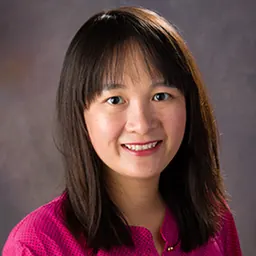
Karissa Sanbonmatsu
American structural biologist
About Karissa Sanbonmatsu
Karissa Sanbonmatsu was an American structural biologist, known for Structural Biology, https://aip.scitation.org/doi/abs/10.1063/1.874132 and https://doi.org/10.1073%2Fpnas.0503456102.
Karissa Y. Sanbonmatsu is an American structural biologist at Los Alamos National Laboratory. She works on the mechanism of non-coding RNA complexes including the ribosome, riboswitches, long non-coding RNAs, as well as chromatin. She was the first to perform an atomistic simulation of the ribosome, determine the secondary structure of an intact lncRNA and to publish a one billion atom simulation of a biomolecular complex.
Education and early career Sanbonmatsu was born in Rochester, New York, the daughter of Joan Loveridge-Sanbonmatsu, and Akira Loveridge-Sanbonmatsu, who are both professors of speech communication in the State University of New York. She attended Oswego High School, and was valedictorian. She won the Pembroke College Stokes Society Scientific Lecture Competition at the University of Cambridge. Sanbonmatsu studied physics at Columbia University, where she used the Very Large Array radio telescope to estimate the distance to supernova remnant G27.4+0.0 and its central X-ray source, which is now known to be a magnetar. Karissa's early research was in plasma physics. She earned her PhD in astrophysical sciences at University of Colorado Boulder under Martin V. Goldman (a student of Donald F. Dubois). Her dissertation entailed analytical treatments of non-linear wave-wave interactions in plasmas, elucidating the competition between Langmuir wave-wave and wave-particle effects in the auroral ionosphere. In 1997, after earning her doctorate, Sanbonmatsu joined Los Alamos National Laboratory as a postdoctoral scholar under Donald F. Dubois (a student of Murray Gell-Mann), determining the effect of kinetic processes on Langmuir waves in plasmas. She became interested in what distinguishes life from matter. In 2002 Los Alamos built Q-machine, one of the world's fastest supercomputer.
Research The Sanbonmatsu Laboratory at Los Alamos National Laboratory was established in 2001. and chromatin. In 2005, Sanbonmatsu was awarded the Presidential Early Career Award for Scientists and Engineers. At the time, epigenetics was beginning to develop, and Sanbonmatsu realised that RNA could be involved in how genes are turned on and off. It works by controlling the internal triggers that tell a plant to stop flowering, which work in combination with a repressor protein called Flowering Locus C. She went on to look at how the structure of RNA impacted the fate of a cell. She uses illumina dye sequencing for high throughput SHAPE probing.
Don’t just read it —
keep it.
Full-length biographies made to live with: read them, listen on the way to work, watch them tonight.
- E-book
- Audio
- Video
Instant download · yours to keep · every purchase keeps this site free
Important facts
Related people
Same field, nearest in time

Frequently asked questions
Who was Karissa Sanbonmatsu?
American structural biologist
When was Karissa Sanbonmatsu born?
Karissa Sanbonmatsu was born in Rochester.
What was Karissa Sanbonmatsu's occupation?
Karissa Sanbonmatsu was a structural biologist.
What was Karissa Sanbonmatsu known for?
Karissa Sanbonmatsu was known for Structural Biology, https://aip.scitation.org/doi/abs/10.1063/1.874132, https://doi.org/10.1073%2Fpnas.0503456102, https://onlinelibrary.wiley.com/doi/abs/10.1002/jcc.25840 and https://www.nature.com/articles/529423a.
What nationality was Karissa Sanbonmatsu?
Karissa Sanbonmatsu was American.
Sources & further reading
· Wikipedia: Karissa Sanbonmatsu
· DBpedia: Karissa Sanbonmatsu
Cite this page
APA: Biography.guide. (2026). Karissa Sanbonmatsu. https://biography.guide/karissa-sanbonmatsu/
MLA: "Karissa Sanbonmatsu." Biography.guide, https://biography.guide/karissa-sanbonmatsu/.
Chicago: "Karissa Sanbonmatsu." Biography.guide. https://biography.guide/karissa-sanbonmatsu/.
Data last updated: 2026-09-20 · Spot an error? Report a correction.
Page generated 2026-09-27 05:29 UTC