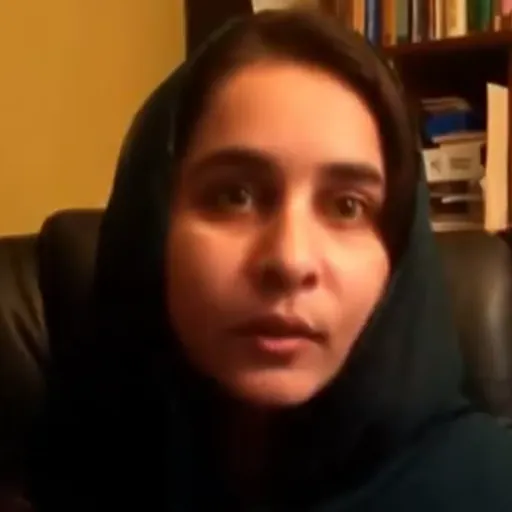
About Karima Baloch
Lived 1985 – 2020 (aged 34–35). Karima Baloch was a Pakistani human rights defender, known for 100 Women (BBC).
Karima Baloch (; 8 March 1983 – 20/22 December 2020), also known as Karima Mehrab , was a Baloch human rights and pro-independence activist from Balochistan, Pakistan. She was the first female chairperson of the Baloch Students Organization - Azad (BSO-Azad). She joined the Baloch Students Organization (BSO) in 2006, serving in several different positions and eventually becoming the organization's chairperson in 2015.
In an interview in 2014, she said,
Exile from Pakistan In 2015, Baloch went into self-imposed exile after terrorism charges were filed against her by the Government of Pakistan, ) with her younger sister Mahganj Baloch stating that, "She didn't go abroad because she wanted to, but because... open activism in Pakistan had become impossible." A year later, in 2016, she was granted asylum in Canada, where she lived until her disappearance and death in December 2020. In 2016, following Indian Prime Minister Narendra Modi's public speech on India's Independence Day in which he mentioned the situation in Pakistani Balochistan, Baloch addressed him in a video and thanked him for mentioning the issue, stating: "We will fight our own war, you just be our voice" .
Baloch was included in the 100 Women List by the BBC in 2016, where she was identified as a political activist who "campaigns for independence for Balochistan from Pakistan". Baloch listed Dad Shah and Hatun Bibi—both Baloch rebels who fought against the Imperial State of Iran in Iranian Balochistan—as the primary inspirations behind her activism. She also raised issues related to Balochistan in Canada, such as during a meeting in Toronto, where she mentioned Pakistani Military's role in Balochistan.
In December 2017, Baloch received a message that if she won't return to Pakistan, her uncle Noor Mohammed, a schoolteacher, will be killed. As she refused to go back, a few hours before her asylum hearing, on 2 January 2018, she got the news that her uncle had been found dead.
Personal life and family Baloch had two siblings, a brother named Sameer Mehrab and a sister named Mahganj Baloch.
Disappearance and death A protest in Pakistan following the discovery of Karima Baloch's body in Canada. Protests were held in Pakistani cities including in Lahore and Karachi. Baloch was last seen alive on 20 December 2020. On 22 December 2020, her dead body was found submerged at the Toronto waterfront. The Toronto Police Service initially reported that her body was found near Lake Ontario, although no further details were given. Small-scale protests demanding an investigation into her death occurred in Pakistani Balochistan and Canada; ethnic Baloch, Pashtun and Sindhi minority groups in Canada issued a joint statement in this regard. Canadian police acknowledged the concerns around Baloch's death, but stated that they had found no evidence of foul play, Chris Alexander, the former Canadian Minister of Immigration, Refugees and Citizenship, stated in a tweet: "All of us who knew Karima see the circumstances of her death as deeply suspicious. We must leave no stone unturned in uncovering & confronting the reality of what happened to her." CBC News conducted a year long investigation documenting evidence about how Karima's was likely killed by the Pakistani intelligence agency, in the podcast "The Kill List. Leading human rights advocates like Agnès Callamard, the Secretary General of Amnesty International, and Kiran Nazish, founding director of the Coalition For Women In Journalism vouched for this narrative".
Baloch's husband Hammal Haider openly blames the Pakistani military, especially the Pakistani ISI, for her killing. A few months before her death Sajid Hussain, a journalist who wrote about human rights violations in Balochistan, was found drowned in Sweden, where he had sought asylum.
Don’t just read it —
keep it.
Full-length biographies made to live with: read them, listen on the way to work, watch them tonight.
- E-book
- Audio
- Video
Instant download · yours to keep · every purchase keeps this site free
Important facts
People in Karima Baloch's life
Named in this biography and alive at the same time




Related people
Same field, nearest in time

Contemporaries
People whose lives overlapped Karima Baloch's


Frequently asked questions
Who was Karima Baloch?
Pakistani human rights activist
When was Karima Baloch born?
Karima Baloch was born in 1985 in Kech District.
When did Karima Baloch die?
Karima Baloch died in 2020 in Toronto.
What was Karima Baloch's occupation?
Karima Baloch was a human rights defender.
What was Karima Baloch known for?
Karima Baloch was known for 100 Women (BBC).
What nationality was Karima Baloch?
Karima Baloch was Pakistani.
Sources & further reading
Cite this page
APA: Biography.guide. (2026). Karima Baloch. https://biography.guide/karima-baloch/
MLA: "Karima Baloch." Biography.guide, https://biography.guide/karima-baloch/.
Chicago: "Karima Baloch." Biography.guide. https://biography.guide/karima-baloch/.
Data last updated: 2026-09-22 · Spot an error? Report a correction.
Portrait: Wikimedia Commons · author & licence
Page generated 2026-09-27 05:02 UTC