
About Karel Frederik Wenckebach
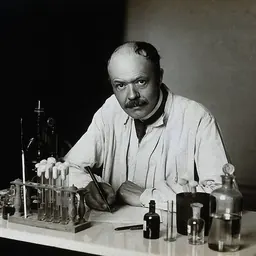
Lived 1864 – 1940 (aged 76). Karel Frederik Wenckebach was a Dutch physician, cardiologist, internist, university teacher and anatomist.
Karel Frederik Wenckebach (; March 24, 1864 – November 11, 1940) was a Dutch anatomist who was a native of the Hague.
He studied medicine in Utrecht, and in 1901 become a professor of medicine at the University of Groningen. Later he was a professor at the Universities of Strasbourg (1911–14) and Vienna (1914–29).
Contributions in cardiology Wenckebach is primarily remembered for his work in cardiology. In 1899 he provided a description of irregular pulses due to partial blockage of atrioventricular conduction, creating a progressive lengthening of conduction time in cardiac tissue. The condition was referred to as a "second degree AV block" and later named the "Wenckebach phenomenon" and reclassified as Mobitz type I block in Mobitz's 1924 paper. A similar phenomenon can also occur in the sinoatrial node where it gives rise to type I second degree SA block, and this is also known as a Wenckebach block; the two have distinct features on an ECG however.
Sinus rhythm with acute inferior infarction complicated by Type I A-V block manifest in the form of 5:4 Wenckebach periods; R-P/P-R reciprocity.
Wenckebach is credited for describing the median bundle of the heart's conductive system that connects the sinoatrial node to the atrioventricular node. This bundle was named Wenckebach's bundle, and is also known as the middle internodal tract. Wenckebach's bundle is one of the three internodal pathways, the others being the "posterior internodal tract" (Thorel's pathway), and the "anterior internodal tract" (some fibers of which also project to Bachmann's bundle, and then into the left atrium).
Wenckebach was an early advocate involving the use of quinine for treatment of paroxysmal atrial fibrillation.
Family His father Eduard (1813–1874) has been credited with developing the very first telegraphic communications line in the Netherlands, between Haarlem and Amsterdam. He had two brothers, Henri Johan Eduard (1861–1924), director of the State Mines and later of the Dutch Ironworks in IJmuiden, and Ludwig Willem Reymert (1860–1937), a well-known painter and book illustrator. His son Oswald became a sculptor, painter and medallist, most widely known for his war monuments and designing the Dutch coins issued between 1948 and 1981.
Selected writings Arythmie als Ausdruck bestimmter Funktionsstörungen des Herzens (1903, Engelse vertaling: (1904) Die unregelmässige Herztätigkeit und ihre klinische Bedeutung (1914) Herz- und Kreislaufinsufficienz (1931)
Don’t just read it —
keep it.
Full-length biographies made to live with: read them, listen on the way to work, watch them tonight.
- E-book
- Audio
- Video
Instant download · yours to keep · every purchase keeps this site free
Important facts
Related people
Same field, nearest in time





Contemporaries
People whose lives overlapped Karel Frederik Wenckebach's


Frequently asked questions
Who was Karel Frederik Wenckebach?
Dutch cardiologist (1864-1940)
When was Karel Frederik Wenckebach born?
Karel Frederik Wenckebach was born on 24 March 1864 in The Hague.
When did Karel Frederik Wenckebach die?
Karel Frederik Wenckebach died on 11 November 1940 in Vienna.
What was Karel Frederik Wenckebach's occupation?
Karel Frederik Wenckebach was a physician, cardiologist, internist, university teacher and anatomist.
What nationality was Karel Frederik Wenckebach?
Karel Frederik Wenckebach was Dutch.
Sources & further reading
· Wikipedia: Karel Frederik Wenckebach
· DBpedia: Karel Frederik Wenckebach
Cite this page
APA: Biography.guide. (2026). Karel Frederik Wenckebach. https://biography.guide/karel-frederik-wenckebach/
MLA: "Karel Frederik Wenckebach." Biography.guide, https://biography.guide/karel-frederik-wenckebach/.
Chicago: "Karel Frederik Wenckebach." Biography.guide. https://biography.guide/karel-frederik-wenckebach/.
Data last updated: 2026-09-20 · Spot an error? Report a correction.
Page generated 2026-09-27 05:20 UTC