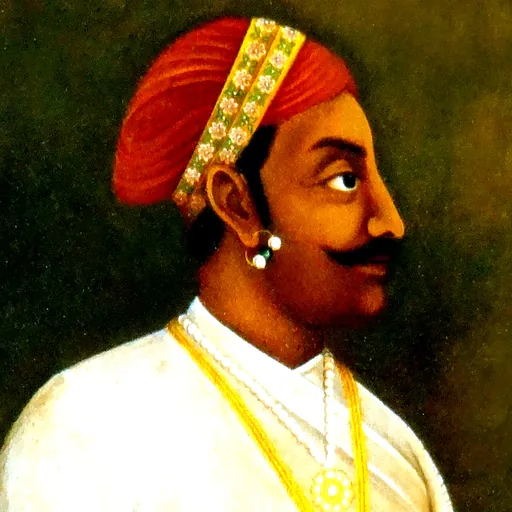
About Karam Chand Bachhawat
Lived 1542 – 1607 (aged 64–65). Karam Chand Bachhawat was a civil servant.
Karamchand Bachhawat (1542–1607; Karmacand Bacchāvat ) was the Dewan, Prime Minister of Bikaner State in the former Rajputana (now Rajasthan) from 1571 to 1591. Karamchand, a descendant of Bachhraj, was a valiant warrior, a good administrator and a strategist in Bikaner and had a good relationship with Akbar. In 1591, fearing for his life, he resigned. At Akbar's invitation, Karamchand later joined the emperor as an adviser to the Lahore court.
Ancestors Karamchand Bachhawat belonged to Bachhawat gotra (sect) of Oswal community. The Bachhawats belong to the feudal aristocratic order of former states of Rajputana (Rajasthan), who faced many ups and downs in life. They were brave, and many sacrificed their lives fighting for the state against Muslim invaders. They were visionary administrators par excellence but at times suspected to be anti-state but pro-Mughal and pro-British regime. The members of this clan were associated with the administration of the state for generations. Among them many were independent rulers in Delwara state (former small kingdom near Udaipur), Raja Sagar, Rana Shri Karan, Raja Bohitya Deora Chauhan. There were as many as six Prime Ministers of Jodhpur and Bikaner states from amongst the direct ancestors, Bachhraj, Karam Singh, Var Singh, Nagraj, Sangram Singh, and Karamchand Bachhawat. Later, in Mewar state, five of his descendants, Agarchand, Devichand, Sher Singh, Gokalchand and Pannalal Bachhawat Mehta, served as Prime Ministers, nine members were appointed as Kiledars (Governors of Forts; किलेदार) and more than 25 members of this clan served as Hakims (Administrators; हाकिम) in various districts of Mewar.
The Bachhawats, trace their origin from the Chauhan dynasty of Samrat Prithviraj Chauhan. The ancestors were Deora (देवड़ा) Chauhans, who ruled Delwara (city of gods; देवकुलपाटननगरी) state, in 13th-14th century. The ruler of Delwara, Raja Sagar, a Deora Chauhan and a descendant of Rao Kirtipal of Jalore, was the progenitor of Bachhawats. Later, in 14th century, this clan embraced Jainism. Thus, the Bachhawat gotra in Oswal community was born. Since, for generations many of them were in the service of rulers (Maharajas & Maharanas), the Bachhawats also followed Vaishnavism alongside Jainism. With the passage of time the influence of Bachhawats grew by leaps and bounds. Each descendant of this clan was appointed as Dewan of Bikaner. Although ancestors of Bachhawats were Kshatriyas (Deora Chauhans), they now belonged to Vaishya (Bania) caste; hence they understood military strategy better than any Kshatriya adviser as royal blood runs in them. They used their pen and sword with equal skill and impact.
Loyal to state, brilliant administrator & suave strategist Karamchand was born in 1542 AD (Vikram Samvat 1599, Paush vid 11; Indian lunar calendar). In 1571, Rao Kalyanmal, on demise of Dewan Sangram Singh, a descendant of Bachhraj, appointed his son Karamchand as Dewan of Bikaner. He was popular in Bikaner and had built a good rapport with Emperor Akbar Jalal-u-din (1556-1605). The royal family of Bikaner had marital relations with the Mughals. Daughter of Kalyanmal was married to Emperor Akbar in 1570 and later his son Rai Singh's daughter was married to prince Salim (later Emperor Jahangir). Thus, the ruling family of Bikaner was one among the chosen families from Rajputana, being part of marriage alliance arranged by Karamchand. Neither event is alluded to in the ‘Kiyant’ but the facts are recorded by Ferishta (pages 234 and 260, Brigg's Translation). Thus, Kalyan's son Rai Singh, who succeeded him in 1573, was one of Akbar's most distinguished generals. In 1571, while travelling with Prince Rai Singh from Bikaner to the court of Emperor Akbar at Lahore, the much-indebted Dewan Karamchand, before his departure asked Rao Kalyanmal, "My Lord, order me as you please". Rao Kalyanmal said that he has everything but wants to fulfil the wishes of his ancestors. He said,“I want to perform Kamal Puja (prayers for departed souls of ancestors) sitting in the ‘gavaksh’ (balcony) of Jodhpur palace to fulfil the wishes of late Rao Bika”.Karamchand along with Rajkumar Rai Singh paid their obeisance to Emperor Akbar. Since Karamchand enjoyed a good equation with Akbar, he asked him for a favour, for Rao Kalyanmal to perform puja at the Jodhpur palace. Since Jodhpur was under the rule of Akbar, his wishes were granted instantly. Thus, Rao Kalyanmal could fulfil the wishes of his ancestors and asked Karamchand what he would like in return. Karamchand politely said, “I have everything given by you. However, you may like to grant that during the four months of chaturmaas (monsoon) – teli (oilman), kumhar (potter), kandoi (confectioner), etc to stop violence related work. Do not collect tax on ‘maal’ (goods), goats, sheep, etc”.Rao Kalyanmal accepted his wishes and granted four villages on stamped paper to Karamchand. Since Karamchand was on good terms with Emperor Akbar, the rulers of Bikaner were among the most loyal adherents of the empire and held high ranks as Mansabdars of special order in the imperial court, like Raja Man Singh I of Amber (Jaipur). They served as military commanders in various Mughal campaigns all over the Indian sub-continent. Karamchand fought alongside Raja Rai Singh to defeat the Sultan of Gujarat. Emperor Akbar was pleased with the strategist in Dewan Karamchand and asked him what he wished for. He replied, “I do not want anything for myself but a grant of 52 parganas for my king”.Karamchand had three wives – Ajaib Devi, Jeeva Devi and Kapur Devi (Ajaibde, Jibade and Kapurde). He along with his family often travelled to Jain pilgrim centres – Shatrunjay, Girnar, Mt Abu, etc. and gave away plenty of alms in charity. He was an able disciple of Acharya Jinachandra Suri.
Kind hearted and saviour of Jainism in medieval period In 1573, Rao Kalyanmal was succeeded by Rao Rai Singh. With the help of strategist Karamchand, Rao Rai Singh expanded his kingdom and brought in a lot of prosperity for Bikaner state. The kingdom of Rao Rai Singh extended up to Harappa in Sindh (Sindhu Desh) by defeating the forces of Balochis. At the behest of Karamchand, the captured Baluchi prisoners of war were properly clothed, fed and returned to their homes, with dignity.
In 1586, Karamchand learnt that Jain temples at Shatrunjay (Palitana) and other places in Saurashtra were being destroyed by Navarang Khan. Fearing destruction of more Jain temples in the area, he immediately petitioned Akbar for the protection of Jain temples. Akbar at once issued a farmaan (stamped order) to Azam Khan of Gujarat to put Shatrunjay and other Jain temples in Saurashtra under the control of Karamchand for their protection. Later, a Jain temple was constructed by Karamchand at Palitana and at his maternal home (nanihal) in Merata city in memory of his mother. to successfully ward off evil effects. Karamchand presented Prince Salim with a precious pearl necklace worth 1300 gold mohars (coins). Emperor Akbar was mighty pleased with Karamchand and he granted the honour to the ladies of Bachhawat family to wear gold in the foot. Till then this honour was reserved for only Sarang family of Oswal clan. The title of Mehta (a person engaged in important assignment; महत्त्वपूर्ण कार्यकर्ता) was also granted to him. All his direct descendants settled in Mewar use the title of Mehta. Karamchand Bachhawat Mehta, a close friend and strategist of Emperor Akbar became a historical person and came to be known as the saviour of Jainism during medieval period. As Dewan of the state, Karamchand had a guarded attitude in the interest of the state treasury and did not like this extravaganza on bards. Hence Karamchand often protested to the king over the rewards.
The bohemian between Raja Rai Singh and Dewan Karamchand could not last long and very soon tensions surfaced in their relationship.
Bachhawats do not worship Dyadi Mata Traditionally, on completion of Navratri festival, Dyadi Mata (Ashapura Mata; Kuldevi of Chauhans as Bachhawats are their descendants) is commonly worshipped by all castes in Rajasthan. Once, during the later part of the 16th century, when Karamchand was engaged in the worshipping of Dyadi Mata, a disciple of Jain Muni, the Maharajsaab, came to Bachhawat's Haveli (Mansion) for gochari (food and alms). Karamchand felt disturbed, and told the disciple to convey to Maharajsaab to come later for gochari. The Maharajsaab was displeased and through his spiritual powers, let Dyadi Mata's idol speak to Karamchand, This was naturally most galling to Rai Singh, who conceived hatred towards his servant and sought to eliminate him after his return home from Burhanpur.
By 1591, tension started building up between the Rai Singh and Karamchand. Rai Singh discovered a conspiracy against his life. A conspiracy was hatched to dislodge Rai Singh from the gaddi (throne) of Bikaner. The prime mover behind the conspiracy was allegedly Karamchand, which was not true. It is also strange to say, notwithstanding the Raja's magnificent treatments of Brahmins and minstrel class, a Purohit (priest) also figure amongst the conspirators. The objective was to place Raja's eldest son Dalpat Singh or his brother Ram Singh on the throne, thus Karamchand monopolizing the power of the state. These rumours were spread by the detractors of Dewan Karamchand. Karamchand and his family, having received timely warning, escaped to Delhi, where they were well received at the court of Akbar.
It is further stated by Capt Powlet in Gazetteer of Bikaner State, “They were made the supreme authority of Emperor Akbar and acquainted him with Bikaner secrets, an offence still held in native states to be one of the most heinous possible. But in other respects, Karamchand was now able to be a thorn in the side of the Raja Rai Singh”.Capt Powlett further clarifies, “It must be understood that these expressions are those of the writers of Khyats”. The Khyats are written by Charans, a caste of warrior-poets who compose poems and stories of battles and heroes with the greatest of ease and keep alive the oral tradition. The stories are passed down from father to son. In a sense they are the early historians, and were respected to do so.
However, another version of this story from ‘Karamchand Vansh-kavyam’ by Jaysom states, “Raja Rai Singh turned against Karamchand and wanted to take revenge. Sensing development of ill will of Raja Rai Singh towards himself, Dewan Karamchand politely took permission to settle in Merta city along with his family members, to spend his time in the service of Parshvanath Swami and Shri Jindutt Surij at a nearby village of Phalodi. He was invited by Raja Man Singh of Amber (Jaipur), one of the famous 'Navaratnas' (the nine gems at the royal court of Akbar) and other kings but he refused as he had his singular loyalty towards Raja Rai Singh of Bikaner”.
Invited to Lahore court by Akbar Around 1591, Emperor Akbar being aware of the talent and loyalty of Dewan Karamchand sent a letter to invite him to his court at Lahore through Raja Rai Singh. On the orders of his king, Karamchand left Merta for Lahore along with his aides. He visited Ajmer en route to seek blessings at the memorial (stupa) of his guru Dada sahib Shri Jindutt Suri. When at Lahore he was immediately called in by the Emperor Akbar for an audience, whereas, people would wait for days to have audience. The Emperor knew everything about him and reassured Karamchand that his lost glory would be restored shortly.
Bhanwarlal Nahata writes in his book ‘Mantri Karamchand Bachhawat’, “Emperor Akbar appointed Dewan Karamchand as Gajjadhikari (Head of State Council, Treasury &Stores). Emperor presented him with a hunting horse loaded with gold. He was also appointed as the Samrajyadhipati (Governor; स्म्राज्यधिपति) of Toshampur (now in Haryana) with appropriate number of elephants, horses and foot soldiers”.It meant that all Kings and Mansabdars under Mughal Empire would have to first meet Dewan Karamchand before calling on Emperor.
Acharya Jinchandra Suri invited to Lahore court
During one of the meetings with the learned religious people, Akbar asked the pundits, "Who was the most learned Jain philosopher?" The pundits replied, "Acharya Jinchandra Suri was one such person". Emperor asked, "Who is his disciple?" The pundits replied, "Dewan Karamchand".
Bhanwarlal Nahata of Prakrit Bharati Academy, Jaipur writes in his book ‘Mantri Karam Chand Bachhawat’ that Emperor Akbar, while in Lahore dealing with the Uzbeks had sought to subjugate the upper Indus valley to secure the frontier provinces. He sent an army to conquer Kashmir in the upper Indus basin. In 1585, Ali Shah surrendered immediately to the Mughals, but another of his sons, Yaqub, crowned himself as king, and led a stubborn resistance to Mughal armies. Finally, in June 1589, Akbar himself travelled from Lahore to Srinagar to receive the surrender of Yaqub and his rebel forces.
Bravery and heroism of Bachhawats at Bikaner Sur Singh ascended the throne of Bikaner in 1613. Around 1619, Raja Sur Singh went to Delhi to pay his obeisance to Emperor Jahangir, where he was restored 11 mansabs by the Emperor. He also called on Bhagchand & Lakshmichand, sons of late Dewan Karamchand. He took them in absolute confidence and invited them to Bikaner. He went so far as to dismiss his minister, to give the office to Bhagchand and Lakshmichand. Both sons of Karamchand did not remember their father's advice and started in good faith for Bikaner. They were appointed as Mantris very respectfully. Raja Sur Singh remained extra benevolent towards these brothers in the following months. He also accepted the invitation to visit the Bachhawat haveli, wherein the Bachhawat brothers gave a nazrana (offerings to king) of one lakh rupee and other gifts for the felicitation of the King. Jinsaar Suri Raas, written in 1623 mentions that around 1619 Acharya Jinsagar Suri was hosted at Bikaner by Mantri Bhagchand and his nephew Manohar Das.
The Bachhawats thereupon were resettled in Bikaner but one fine morning at daybreak by treachery their quarters were surrounded by 4000 royal troops of Bikaner and they soon perceived that their destruction was intended. Though they belonged to one bania (trader) caste, they had, like many of their class who lived amongst and held office under Rajputs, imbibed much of the Rajput spirit and they resolved to die hard. At that time Bhagchand was resting and his brother Lakshmichand and his son Manohar Das were at the Durbar. Lakshmichand's wife announced with both pride and anger,
“The royal forces have surrounded our haveli. If I have your permission I shall adorn men’s uniform and show them my power”.Upon which Bhagchand refused permission and himself, after destroying their valuable jewels and sword in hand, fell upon the Rajputs of Rai Singh. The brave Bachhawats retaliated by their well-trained 500 guards. But the guards of Bachhawats could not withstand the mighty power of royal soldiers for a long. The wives of Karamchand, Lakshmichand, Manohar Das and the other women of Bachhawat household killed themselves by Jal-Johar (jumping into the haveli well), whilst their men died fighting royal soldiers. Lakshmichand and Manohar Das who were in Durbar were killed there.
Bachhawats exterminated by deceit In Rangdi-ka-Chowk (formerly Maneck Chowk), opposite Bada Upasara there used to be a well owned by Bachhawats, which was later closed, and a platform built. Today, a ‘Hanuman Mandir' stands tall on its side. This was the well, in which Bachhawat women performed Jal-Johar to protect their honour when troops of Sur Singh invaded their quarters.
However, the Raja Sur Singh failed in total exterminating the Bachhawats, since one pregnant lady, Mewariji, (Jigishabai) wife of Bhag Chand, was not allowed to sacrifice herself. She, with the assistance of a trusted servant Raghunath escaped to Karni Mata temple at Deshnoke. As per convention the pregnant lady was granted safe passage to return to her father’s home at Udaipur. Mewariji (Jigishabai) was the daughter of Bhamashah, then Pradhan of Mewar state during Maharana Pratap’s time. Thus, Karamchand and Bhamashah were related through marriage alliance between their son and daughter respectively.
Capt PW Powlett writes in ‘Gazetteer of Bikaner State’, “In the same year that the slaughter of the Bachhawats occurred, Sur Singh further carried out the dying behest of his father by confiscating the jagirs of the descendants of conspirators, Purohit Man Mahesh and Bharat Chotaji. Thereafter, these people came to Bikaner (Chintamani / Junagarh) Fort and protested outside Karanpol and were intentionally not stopped from self-immolation during the protest. Another of those denounced by the late Raja Rai Singh, a Bharta Jat was also killed mercilessly”.Mohammed Iqbal in his book ‘Bikaner Rajya ka Itihas – Kuch Anchue Pahelu’ notes that these events were heart breaking and were considered inauspicious for the state. In the act of showing regret and repentance for all the killings, Raja Sur Singh built a lake on the spot where self-immolation by Brahmins was carried out. The lake later came to be known as Sur Sagar. It is said that due to bad omen, the water of the lake from time to time gets mysteriously polluted by some underground water source and needs to be cleaned periodically.
Epilogue Dewan Karamchand Bachhawat Mehta was a brilliant administrator, clever strategist, suave politician and a very cultured person. He is also well known as the saviour of Jainism during medieval period. He was indeed loyal to the king like his forefathers. The hero of Jain tradition who became the villain of the royal house of Bikaner is a historical person.
Don’t just read it —
keep it.
Full-length biographies made to live with: read them, listen on the way to work, watch them tonight.
- E-book
- Audio
- Video
Instant download · yours to keep · every purchase keeps this site free
Important facts
People in Karam Chand Bachhawat's life
Named in this biography and alive at the same time
Related people
Same field, nearest in time




Contemporaries
People whose lives overlapped Karam Chand Bachhawat's





Frequently asked questions
Who was Karam Chand Bachhawat?
Diwan Bikaner
When was Karam Chand Bachhawat born?
Karam Chand Bachhawat was born in 1542.
When did Karam Chand Bachhawat die?
Karam Chand Bachhawat died in 1607.
What was Karam Chand Bachhawat's occupation?
Karam Chand Bachhawat was a civil servant.
Sources & further reading
· Wikipedia: Karam Chand Bachhawat
· DBpedia: Karam Chand Bachhawat
Cite this page
APA: Biography.guide. (2026). Karam Chand Bachhawat. https://biography.guide/karam-chand-bachhawat/
MLA: "Karam Chand Bachhawat." Biography.guide, https://biography.guide/karam-chand-bachhawat/.
Chicago: "Karam Chand Bachhawat." Biography.guide. https://biography.guide/karam-chand-bachhawat/.
Data last updated: 2026-09-23 · Spot an error? Report a correction.
Portrait: Wikimedia Commons · author & licence
Page generated 2026-09-27 05:05 UTC