About Kara Fatima Khanum
Kara Fatima Khanum was a Turkish military personnel and leader.
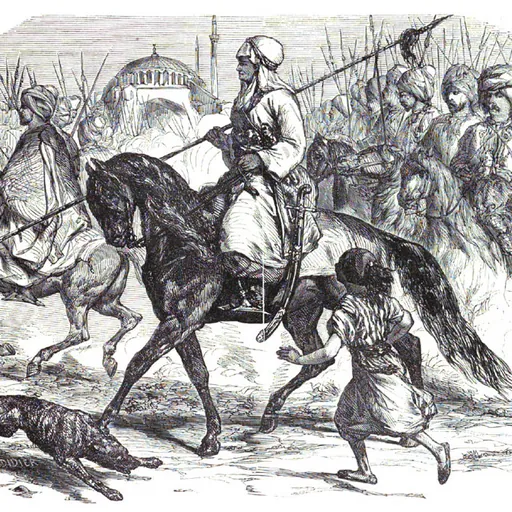
Kara Fatma Hanım (, literally "Black Fatma"; also rendered Kara Fatima Khanum, Fatima Hanoun, and, in Kurdish, Fata Reş) was a nineteenth-century Kurdish chieftain who commanded irregular cavalry during the Crimean War. Contemporary British and French publications repeatedly identified her and her mounted followers as Kurdish, called her the "heroine of Kurdistan", and associated her with Marash. Modern historian Martin van Bruinessen likewise describes her as the female chieftain of a Kurdish tribe from Marash.
Ottoman records identify her personal name as Asiye, associate her administratively with the Cerid tribe in the Adana region, and call her the kethüda of one of its sections. Because the Cerid were commonly classified as Turkmen or Yörük, some modern works present a Cerid-Turkmen identity as an alternative to the Kurdish and Sinemilli identification. The Ottoman documents record tribal and regional affiliation, however, rather than calling her an ethnic Turk. The conflicting descriptions have led historians to debate whether one leader commanded a composite following or whether accounts of more than one woman called Kara Fatma became combined.
She travelled to Constantinople in 1854 with a mounted retinue and proceeded to the Ottoman army in the Danubian and Bulgarian theatre of the war. The size of her force changed as other irregulars joined or left it: contemporary accounts give figures ranging from about 30 or 50 riders to 300, 400, 500, or more. An Ottoman petition written in her name in 1863 states that she had come from Adana with "several hundred cavalry", that one of her brothers had been killed and another wounded on the battlefield, and that she herself had performed various services. The petition, an 1854 award file, and an account by Ahmed Cevdet Pasha provide official Ottoman confirmation of her military service.
Despite the name of the conflict, the reliable sources do not place her in combat on the Crimean peninsula. They place her in Constantinople, Varna, Devnya, Shumen, and, in a later Ottoman narrative, the Deliorman region. Describing her simply as having "fought in Crimea" therefore confuses the Crimean War with its Crimean theatre.
Name, Kurdish identity and tribal affiliation
Kara Fatma and its Kurdish equivalent Fata Reş both mean "Black Fatma" and functioned as descriptive names rather than a unique legal name. The honorific Hanım was variously transliterated by European writers as Khanum, Hanoun, or Hanum. French and British publications also occasionally called her Kara Kız or Kara Güzel, but the consistency and meaning of those variants are uncertain.
Kurdish oral histories collected much later identify Fata Reş as a woman of the Sinemilli tribe and as a sister of the chief Kara Bilal. In this tradition she married into the Emiruşağı or Emiran group, eventually became a leader after the deaths or displacement of male chiefs, and left descendants who adopted the surname Fataraş. Mehmet Bayrak and van Bruinessen have discussed this tradition, but it cannot be securely matched in all particulars to Asiye of the Cerid in the Ottoman documents.
The fullest Ottoman literary narrative is Ahmed Rıza Trabzonî's 1869 verse chronicle, Manzume-i Sivastopol. In a section titled "The Battle of Kara Fatma", it says that she came with 500 or 600 cavalry, fought Russian forces in the Deliorman region, was wounded, and lost a brother. As an epic poem, the work uses conspicuously inflated army totals elsewhere and cannot establish exact numbers or tactics. Its claims about the brother's death and her battlefield service are nevertheless independently consistent with her 1863 petition. A later Russian military history by A. N. Petrov, based on wartime intelligence, records that 400 irregulars at Mangalia in May 1854 were commanded by an unnamed woman whom the report called an Arab, and that the band was consequently nicknamed a "women's force". Modern Russian authors have compared this report with Kara Fatma, but Petrov did not name her and the identification remains uncertain.
Award and petition
Two Ottoman archival files dated in early October 1854 state that Kara Fatma was renowned for courage and good service in the battles in which she had been present. Sultan Abdülmecid ordered a gold medal as her reward and inspected it before it was delivered. The files survive in the Ottoman Archives as BOA, İ.DH 308/19650 and H.H.İ 13/22.
Kara Fatma became a recurring figure in Ottoman, Turkish, and Kurdish writing about female military heroism. Later retellings have sometimes merged her with other women, credited her with service in wars decades apart, or treated literary works as eyewitness testimony. Modern scholarship therefore regards the documentary Kara Fatma both as an important example of a woman exercising authority in an Ottoman tribal setting and as a case in which fame, shared nicknames, and nationalist memory have produced a composite biography.
Don’t just read it —
keep it.
Full-length biographies made to live with: read them, listen on the way to work, watch them tonight.
- E-book
- Audio
- Video
Instant download · yours to keep · every purchase keeps this site free
Important facts
Related people
Same field, nearest in time


Frequently asked questions
Who was Kara Fatima Khanum?
Kurdish female chieftain
What was Kara Fatima Khanum's occupation?
Kara Fatima Khanum was a military personnel and leader.
What nationality was Kara Fatima Khanum?
Kara Fatima Khanum was Turkish.
Sources & further reading
· Wikipedia: Kara Fatima Khanum
Cite this page
APA: Biography.guide. (2026). Kara Fatima Khanum. https://biography.guide/kara-fatima-khanum/
MLA: "Kara Fatima Khanum." Biography.guide, https://biography.guide/kara-fatima-khanum/.
Chicago: "Kara Fatima Khanum." Biography.guide. https://biography.guide/kara-fatima-khanum/.
Data last updated: 2026-09-22 · Spot an error? Report a correction.
Portrait: Wikimedia Commons · author & licence
Page generated 2026-09-27 04:59 UTC