
About Kanji Swami
Lived 1890 – 1980 (aged 90). Kanji Swami was a writer and academic.
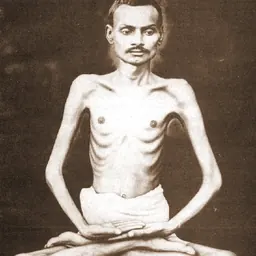
Kanji Swami (1890–1980) was a teacher of Jainism who founded the Kanji Swami Pantha. While ordained in the Sthānakavāsī monastic order of the Shvetambaras, he was deeply influenced by the Samayasāra, attributed to Kundakunda, and by Shrimad Rajchandra, and lectured on these teachings for 45 years to comprehensively elaborate on the philosophy described by Kundakunda and others. He was given the title of "Koh-i-Noor of Kathiawar" by the people who were influenced by his religious teachings and philosophy. thumb
Biography
Early years Kanji Swami was born in Umrala, a small village in the Kathiawar region of Gujarat, in 1890 to a Sthanakvasi family. Although an able pupil in school, he always had an intuition that the worldly teachings was not something that he was looking out for. His mother died when he was thirteen and he lost his father at the age of seventeen. After this, he started looking after his father's shop. He used the frequent periods of lull in the shop in reading various books on religion and spirituality. Turning down the proposals of marriage, he confided in his brother that he wanted to remain celibate and take renunciation.
Renunciation and later life Kanji Swami became a Sthānakavāsī monastic in 1913 under Hirachanda. During the ceremony, while riding on an elephant, he inauspiciously tore his robe, which was later believed to be an ill omen for his monastic career. Being a believer in self effort for achieving emancipation, he quickly became a learned and famous monk and, backed by his seventeen renditions of the Bhagavati Sutra. He was known as "Koh-i-Noor of Kathiawar" (the gem of the Kathiawad region).
During 1921, he read Kundakunda's Samayasāra, which influenced him greatly. He also studied writings of Pandit Todarmal and Shrimad Rajchandra. Other influences were Amritchandra and Banarasidas. During his discourses, he began to incorporate the ideas picked from these studies and began to lead a kind of double life, nominally a Sthānakavāsī monastic but referring to Digambara texts.
His assertions that "vows, giving and fasting were ultimately worthless if performed without any understanding of the soul" did not endear him to the Sthānakavāsī community. He left Sthānakavāsī monastic life and proclaimed himself a celibate Digambara lay scholar at Songadh in Gujarat in 1934.
Kanji Swami elaborated on the Kundakunda-narrative, first attested by Jayasena (ca. 1150–1200), by claiming that, in a previous life, he was present when Kundakunda visited Mahavideha receiving the teachings from Jina Simandhara which gave Kundakunda insight into the true nature of the soul. This presence was suggested to him by Campabahen Mataji, a female disciple, who said that she also had been present then.
In an interview in 1977, Kanji denied being hostile to the traditional Jain monasticism, and regarded monastics as personifying the fundamental principles of Jainism. However, he also pointed out that taking up formal initiation and behavioural practices, like the abandonment of clothes of Digambara monks, and of other possessions, could not make an individual a true monastic unless he had abandoned internal possessions as well.
Kanji Swami Panth Kanji Panth is a lay movement within Jainism, nominally belonging to the Śvetāmbara Bauer notes that "[in] recent years there has been a convergence of the Kanji Swami Panth and the Shrimad Rajcandra movement, part of trend toward a more eucumenical and less sectarian Jainism among educated, mobile Jains living overseas."
Temples
The Digambara Jaina Svādhyāya Mandira was built in 1937. It houses the text Samayasāra in the main temple and the words of Kundakunda's five main treatises have been engraved on its walls. A temple dedicated to Jain Tirthankara Simandhara was consecrated in 1941. Kanji Swami travelled throughout India where he gave discourses and consecrated many temples. Songadh is a major centre.
There is no centralized management of temples. All Temples are managed independently by a local board of trustees. Apart from numerous temples in India, temples exist in Brampton, Canada; Harrow, London, ; and Mombasa, Kenya.
Don’t just read it —
keep it.
Full-length biographies made to live with: read them, listen on the way to work, watch them tonight.
- E-book
- Audio
- Video
Instant download · yours to keep · every purchase keeps this site free
Important facts
People in Kanji Swami's life
Named in this biography and alive at the same time
Related people
Same field, nearest in time


Contemporaries
People whose lives overlapped Kanji Swami's




Frequently asked questions
Who was Kanji Swami?
Jain scholar, philosopher and spiritual leader
When was Kanji Swami born?
Kanji Swami was born on 21 April 1890 in Bhavnagar State.
When did Kanji Swami die?
Kanji Swami died on 28 November 1980 in Mumbai.
What was Kanji Swami's occupation?
Kanji Swami was a writer and academic.
Sources & further reading
Cite this page
APA: Biography.guide. (2026). Kanji Swami. https://biography.guide/kanji-swami/
MLA: "Kanji Swami." Biography.guide, https://biography.guide/kanji-swami/.
Chicago: "Kanji Swami." Biography.guide. https://biography.guide/kanji-swami/.
Data last updated: 2026-09-20 · Spot an error? Report a correction.
Page generated 2026-09-27 05:25 UTC