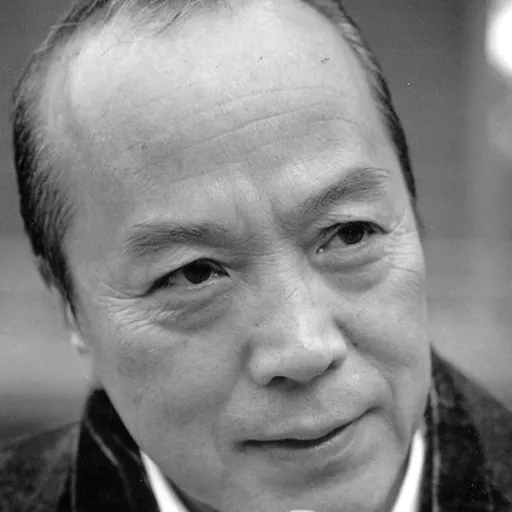
About Jūrō Kara
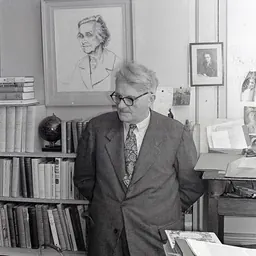
Lived 1940 – 2024 (aged 84). Jūrō Kara was a Japanese novelist, writer, screenwriter, playwright, singer and impresario.
was a Japanese avant-garde playwright, theatre director, author, actor, and songwriter. He was at the forefront of the Angura ("underground") theatre movement in Japan.
Career Graduating from Meiji University, Kara formed his own theatre troupe, Jōkyō Gekijo (Situation Theatre), in 1963. They began performing in a red tent in Hanazono Shrine in Shinjuku in 1967. Kara won the Kishida Prize for Drama for Shojo kamen (The Virgin's Mask) in 1969, and the Akutagawa Prize for his novel Sagawa-kun kara no tegami in 1982. He later became a professor at Yokohama National University.
The Little Theatre Movement in 1960s Japan didn't arise from nothing. It corresponded with many foreign influences such as the rise of the Off-Off-Broadway movement in New York, the productions of The Living Theatre, and Polish director Jerzy Grotowski's ideas of the importance of the body, who also had many of his writings translated into Japanese at the time. These and other experiments had a very real influence in Japan, but it would be wrong to conclude that it was foreign works that led to the birth of the Small Theatre Movement in Japan. The movement was very much a Japanese development which cultivated on Japanese soil even though it also received stimulation from the so-called international avant-garde. In Japan, this produced a few important things. First of all, it had created a bona fide and authentic Japanese contemporary theatre rooted in the Japanese character in lieu of being an imitation of the west. Second, these groups began creating their own works instead of depending on translated work often with the director of the company, usually a resident playwright, writing and staging a play on a subject of their choice. Third, the structure of dramatic literature in Japan transformed immensely. What was once mainly linear, realistic plays, became complex, multi-layered structures where time sequences were distorted and where the barriers that disconnected the ordinary from the extraordinary and reality from illusion were cast away. Fourth, there was a new attentiveness to the body of the actor, a movement away from the texts and oration. Kara's theory of the privileged body and Tadashi Suzuki's physical method arose from this range of work. This was a pursuit to absorb into contemporary theatre some of the characteristics of traditional Japanese theatre where the actor was primary over the text. Fifth, the theatre spaces were evolving. Formal theatres weren't the only places to venue performances anymore. Works were performed in small theatres, open spaces, tents, and even streets. And finally, there were numerous pursuits to bridge the gap between the traditional and contemporary. reinventing the practices and aesthetics of centuries of traditional theatre was a component in the creation a rooted theatre. Jūrō Kara formed one of the first major alternative groups called Jōkyō Gekijo (Situation Theatre), which was later known as Kara-gumi (the Kara Group). Kara and his Situation Theatre for example, explored the idea of freeing themselves from the limits of the theatre buildings.
The red tent had become as much their trademark as it was their mobile theatre. But Kara and his troupe didn't want to prove that they too could hop onto the bandwagon of bringing culture to the masses. Instead, he wanted to disprove the notion that people ought to be cultured. The ideas that Kara experimented with were based in the spirit of traditional Japanese theatre. In the past, actors couldn't even live amongst the poorest men and were treated with ridicule, yet at the same time they captivated those in the normal world. It was somewhat masochistic to attend the actors' performances, because the audience intentionally immersed themselves in a climactic world created by the lowly.
Influences One of the first companies that headed into the post-shingeki style of theatre was the Youth Art Theatre (Seinen Geikutsu Gekijō), established in 1959 by actors trained in Mingei's training program who were provided no spot in the shingeki troupe upon finishing their training. This group was also driven by the intensity and passion arising from their experiences participating in the massive Anpo Protests against the U.S.-Japan Security Treaty in 1959 and 1960. Yoshiyuki Fukuda, a committed socialist, joined Seinen as the resident playwright, best known for his work Find Hakamadare! (Hakamadare wa doko da, 1964), in which peasants look for a legendary hero to lead them. When he is exposed to being a self-serving opportunist and tells them a secret police is needed for his rule, they kill him and set up their own government. Fukuda had influenced Kara, as well as Minoru Betsuyaku and Satoh Makoto, all influential angura playwrights who worked with Seinen.
In many of Kara's plays' dialogue, which have been criticized as being irrational, he removes the restraints of cause and effect. To counter the flowing and coherent narratives of modern drama, he liberates the bodies of the actors from the constraints of the script and brings back the bizarre and eerie being and grim emotions that arise from Japan's Noh and Kabuki tradition. One of Kara's major early works, Shōjo kamen (The Virgin's Mask 1969), which was translated by John K. Gillespie, details Kara's opposition to realism, which is embodied by Stanislavski's system. Gillespie had commented on Kara's emphasis on the bodies of the actors: "Kara recalls the very origin of kabuki and the riverbed beggars who were dissipating their bodies for the highest bidder but were looking, perhaps in vain, for a stage body through which they could express themselves." A short passage from the opening of Shōjo kamen will help to represent this point.
Filmography
Actor Hanchô: Jinnansho Azumihan (TV Series, episode 4.1), 2011
Ekrio (TV Movie), 2009
The Woman Prosecutor of Kyōto (TV Series, episode 4.7), 2007
Dreaming of Light (as Jūrō Kara), 2005
Yoru o Kakete, 2002
Kita no Kuni Kara 2002 Yuigon (TV Movie), 2002
Dr. Akagi (as Umemoto), 1998
Umihoozuki (as Haida), 1995
800 Two Lap Runners (as Yasu-san), 1994
Rasuto Furankenshutain, 1991
Jazz Daimyo (as Kyunosuke), 1986
Yasha-ga-ike (as Denkichi), 1979
The Boxer, 1977
Kyōfu Gekijō Umbalance (TV Series), 1973
Demons (as Sango),1971
Zenigeba, 1970
Violated Angels (as The Handsome Boy), 1967
Summer (as Yoshihide Ôtsuru), 1956
Writer Dreaming of Light (novel "Garasu no Tsukai" - as Jūrō Kara) / (screenplay - as Jūrō Kara), 2005
Nonki na Neesan (novel), 2004
Genji Monogatari: Asaki Yume Mishi (written by), 2000
Umihoozuki, 1995
Namidabashi (writer), 1983
Violated Angels, 1967
Director Genkai-Nada, 1976
Self The Shiatorikaru: Juro Kara and His Stagework (Documentary, as himself), 2007
Gekiteki Document Report '78-'79 (Documentary, as himself), 1979
Diary of a Shinjuku Thief (as himself/singer), 1969
Honours Person of Cultural Merit (2021)
Don’t just read it —
keep it.
Full-length biographies made to live with: read them, listen on the way to work, watch them tonight.
- E-book
- Audio
- Video
Instant download · yours to keep · every purchase keeps this site free
Important facts
People in Jūrō Kara's life
Named in this biography and alive at the same time



Related people
Same field, nearest in time



Contemporaries
People whose lives overlapped Jūrō Kara's


Frequently asked questions
Who was Jūrō Kara?
Japanese playwright (1940–2024)
When was Jūrō Kara born?
Jūrō Kara was born on 11 February 1940 in Shitaya-ku.
When did Jūrō Kara die?
Jūrō Kara died on 4 May 2024 in Nakano.
What was Jūrō Kara's occupation?
Jūrō Kara was a novelist, writer, screenwriter, playwright, singer and impresario.
What nationality was Jūrō Kara?
Jūrō Kara was Japanese.
Sources & further reading
Cite this page
APA: Biography.guide. (2026). Jūrō Kara. https://biography.guide/juro-kara/
MLA: "Jūrō Kara." Biography.guide, https://biography.guide/juro-kara/.
Chicago: "Jūrō Kara." Biography.guide. https://biography.guide/juro-kara/.
Data last updated: 2026-09-23 · Spot an error? Report a correction.
Portrait: Wikimedia Commons · author & licence
Page generated 2026-09-27 05:07 UTC