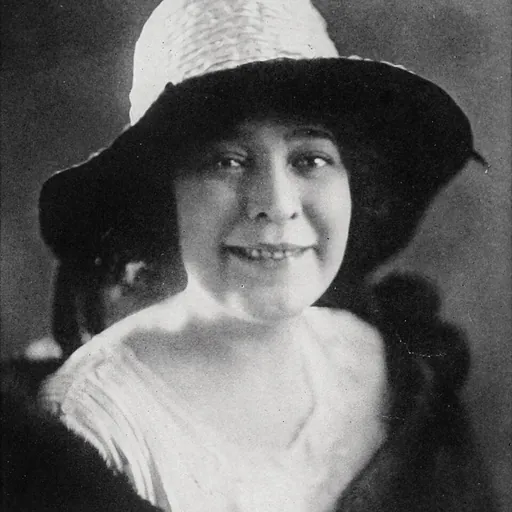
June Mathis
American screenwriter, producer and film studio executive
About June Mathis
Lived 1887 – 1927 (aged 40). June Mathis was an American screenwriter and film producer, known for Rudolph Valentino.
June Mathis (born June Beulah Hughes, January 30, 1887 – July 26, 1927) was an American screenwriter. Mathis was the first female executive for Metro/MGM and at only 35, she was the highest paid executive in Hollywood. In 1926 she was voted the third most influential woman in Hollywood, behind Mary Pickford and Norma Talmadge. Mathis is best remembered for discovering Rudolph Valentino and writing such films as The Four Horsemen of the Apocalypse, and Blood and Sand (1922).
Early life
June Mathis was born June Beulah Hughes in Leadville, Colorado, the only child of Virginia Ruth and Dr. Philip Hughes. Her parents divorced when she was seven and her mother remarried to William D. Mathis, a widower with three children whose name she would eventually adopt as a stage name.
She had been a sickly child and believed she healed herself through her sheer force of will. She believed everything was mental and everyone had certain vibrations, stating, "If you are vibrating in the right place, you will inevitably come in contact with the others who can help you. It's like tuning in on your radio. If you get the right wave-length, you have your station."
Mathis was educated in Salt Lake City and San Francisco.
Later she appeared in several Broadway shows and toured for four seasons with the female impersonator Julian Eltinge in the widely popular show The Fascinating Widow. Supporting her now twice-widowed mother, she would continue to perform in theatre for the next 13 years.
Career
Screenwriting Mathis was determined to become a screenwriter and, accompanied with her mother, she moved to New York City, where she studied writing and went to the movies in the evenings. She was one of the first heads of any film department and the only female executive at Metro.
During her early years, she had a close association with silent star Alla Nazimova. Their films together can be said to be marked by over-sentimentality; what little praise these films received was due to Nazimova's acting rather the conventional romantic stories. Despite her many other accomplishments, this "discovery" would grow to be her best-known act. For the same movie she also insisted the studio hire Rex Ingram as director. "She discovered me, anything I have accomplished I owe to her, to her judgment, to her advice and to her unfailing patience and confidence in me", said Valentino on Mathis in a 1923 interview with Louella Parsons.
Mathis looked after Valentino's welfare during his time at Metro, making sure he gained the best parts and was taken care of. When Valentino showed up on the set for The Conquering Power, another Mathis script with Rex Ingram at the helm, his new-found stardom went to his head, along with resentment at working for the same wage of $350 a week. The friction between him and Ingram, and his need for more money to support mounting debts, led Valentino to sign with Famous Players–Lasky (later known as Paramount Pictures) for $1,000 a week.
Mathis was also one of the people who helped bail Valentino out of jail when he was arrested for bigamy, having married Natacha Rambova without finalizing his divorce to Jean Acker. Though the two were inseparable, their relationship became strained during Valentino's marriage to Rambova. When Mathis submitted a script for The Hooded Falcon, one of Valentino's pet projects, the couple deemed it unacceptable and asked to have it rewritten. Mathis took it as a great insult and broke off all contact with Valentino.
Executive Mathis' position with Metro was called by the Los Angeles Times, "The Most Responsible Job ever Held by A Woman". She was arguably one of the most powerful women in Hollywood, even said to be almost as powerful as Mary Pickford. Mathis had influence over casting, choice of director and many other aspects of production.
After she had spent seven years at Metro, Famous Players–Lasky was able to lure her away with the promise that she could continue to write for her protégé Valentino. When Valentino moved to Goldwyn Pictures, she did as well, this time gaining sovereign control.
Greed Mathis continued to survive in Hollywood despite being involved in two of the greatest financial fiascoes of the 1920s. When Erich von Stroheim presented Goldwyn Pictures with his masterpiece Greed (1924), following Frank Norris's novel McTeague very closely, it was 42 reels and 10 hours long. Stroheim himself realized the original version was far too long, so he reduced it to 24 reels (6 hours), hoping the film could be screened with intermissions in two successive evenings. But Goldwyn executives demanded further cuts. Stroheim allowed his close friend Rex Ingram to reduce it to 18 reels (4½ hours).
There is speculation on whether Mathis took part in the actual cutting. However, for contractual reasons, her name was listed in the credits as a writer, and it was she who would be blamed for what Stroheim and his fans would call "tampering with his genius". A spiritualist with mystical bents, her scripts featured many heroes with a Christ-like demeanor. Since she believed in reincarnation, she always wore an opal ring when she wrote, as she was convinced it brought her ideas.
Mathis had been romantically linked to George Walsh and Rex Ingram; however, she returned from Italy engaged to an Italian cinematographer named Silvano Balboni. The couple married on December 20, 1924, at the Mission of St. Cecilia, in Riverside, California.
Death After Valentino's marriage to Rambova ended in 1925, the two reconciled at the premiere of Son of the Sheik when Valentino spotted Mathis with friends.
On July 26, 1927, during the third act of the Broadway show The Squall at the 48th Street Theatre while accompanied by her 81-year-old grandmother Emily Hawkes, Mathis suffered a fatal heart attack. Her last words were reportedly, "Mother, I'm dying!"
Her ashes were returned to California: instead of "evicting" Valentino, Mathis' husband, Sylvano Balboni, moved Valentino to the crypt beside hers, sold the remaining crypt to Valentino's family and returned to Italy. Mathis and Valentino repose side by side to this day.
Filmography
Don’t just read it —
keep it.
Full-length biographies made to live with: read them, listen on the way to work, watch them tonight.
- E-book
- Audio
- Video
Instant download · yours to keep · every purchase keeps this site free
Important facts
People in June Mathis's life
Named in this biography and alive at the same time






Related people
Same field, nearest in time

Contemporaries
People whose lives overlapped June Mathis's




Frequently asked questions
Who was June Mathis?
American screenwriter, producer and film studio executive (1887-1927)
When was June Mathis born?
June Mathis was born on 30 January 1887 in Leadville.
When did June Mathis die?
June Mathis died on 26 July 1927 in New York City.
What was June Mathis's occupation?
June Mathis was a screenwriter and film producer.
What was June Mathis known for?
June Mathis was known for Rudolph Valentino.
What nationality was June Mathis?
June Mathis was American.
Sources & further reading
Cite this page
APA: Biography.guide. (2026). June Mathis. https://biography.guide/june-mathis/
MLA: "June Mathis." Biography.guide, https://biography.guide/june-mathis/.
Chicago: "June Mathis." Biography.guide. https://biography.guide/june-mathis/.
Data last updated: 2026-09-21 · Spot an error? Report a correction.
Portrait: Wikimedia Commons · author & licence
Page generated 2026-09-27 04:59 UTC