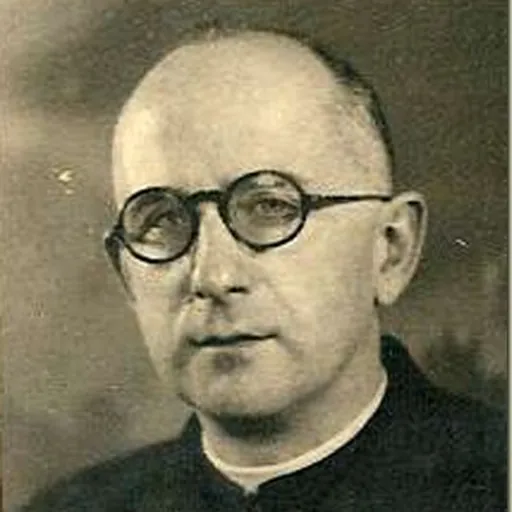
About Julio Meinvielle
Lived 1905 – 1973 (aged 67). Julio Meinvielle was an Argentine writer, catholic priest, philosopher, cleric and catholic theologian.
Father Julio Meinvielle (31 August 1905 – 2 August 1973) was an Argentine priest and prolific writer. A prominent traditionalist Catholic thinker and polemicist, he had a strong influence on the development of nacionalismo.
Background Meinvielle studied for his Doctorate in Philosophy and Theology in Rome and soon afterwards became a prolific writer of religious, historical and economic books within the school of Thomism. He came to see history as a process of decline in Catholic values, as determined by three events that he saw as catastrophic i.e. the work of Martin Luther, the French Revolution and the October Revolution.
Criticism of Jacques Maritain Meinvielle was a staunch critic of what he perceived as slipping standards in Catholic teaching. On this basis he had a well publicized feud with Jacques Maritain during the late 1930s. The conflict had begun in 1936 when Maritain visited Argentina for the first time and was initially well received by a number of leading Catholic figures. Meinvielle denounced Maritain as the 'advocate of the Spanish Reds', sparking off a war of words between the two. His book From Lammenais to Maritain was actually a critique of the ideas of Jacques Maritain, claiming that Maritain was defending the faithlessness of modern society by his endorsement of liberalism. Tracing the origins of Maritain's work to Hugues Felicité Robert de Lamennais as well as that of Marc Sangnier and Le Sillon, he argued that the humanism of these writers was incompatible with the Catholic faith.
He took as the basis for his Catholicism the works of Thomas Aquinas and the Papal encyclicals Rerum novarum and Quadragesimo anno, contrasting them with his twin political hates of liberalism and communism. In common with Rodolfo Irazusta he was a stern critic of usury and he blamed this practice on the Jews, citing Werner Sombart as his inspiration for this conclusion.
He further contended that Judaism had the destruction of Christianity as its basis and therefore argued that whatever ills befell the Christian world were inherently the fault of the Jews. As part of this critique he repeated the blood libel as well as suggesting that capitalism and communism were both Jewish constructs as part of their plan for world domination. Whilst his ideas owed a lot to the Protocols of the Elders of Zion, Meinvielle did not explicitly endorse that document, as a number of contemporary court cases had found it to be a fraud. His 1936 book El Judio distilled these fascist views and gave his thinking an Argentine dimension as he argued Buenos Aires was the archetype of 'Babylon', dominated as he felt it was by international Jewish financial interests.
Politically he was associated with a coterie of young Catholic intellectuals, including Máximo Etchecopar, Ignacio Anzoategui and Matías Sánchez Sorondo, who produced the 1937 document Programma Nacionalista.
Later years Meinville taught philosophy at Catholic institutions for much of his life and he would also serve as the chaplain at Santa Casa de Ejercicios.
In 1952 Meinvielle became a leading figure in the Union Fédérale, a post-Perón party of the right. He was also a strong critic of the regime of Juan Carlos Onganía, claiming that he was acting on behalf of Sinarquia.
In July 1973, Meinvielle was hit by a truck while crossing the road. The driver of the vehicle was the driver of the then mayor of Buenos Aires, the Peronist Leopoldo Frenkel. He was hospitalized for a month at the San Camilo Clinic with multiple fractures and died on 2 August 1973. His funeral mass was celebrated by Archbishop Juan Carlos Aramburu, and he was eulogized by his disciple, Carlos Alberto Sacheri, who called him "an exceptional figure." At his funeral procession, one handle of his coffin was carried by Carlos Mugica, and the other by Alberto Ezcurra Medrano.
Influence Meinvielle's influence was strong throughout the far right in Argentina. Practically, he served as advisor and spiritual inspiration to the highly anti-Semitic Tacuara Nationalist Movement. However, on a wider level he had a deep impact on the nationalist intellectual strand, with the likes of José López Rega (who shared his belief in the fictitious Sinarquia) and Jordán Bruno Genta heavily influenced by his words. Other future government figures such as Mario Amadeo, Alberto Baldrich and Samuel Medrano were also influenced by his works to an extent. Similarly Colonel Mohamed Alí Seineldín, who was arrested in 1987 for plotting a military coup also declared himself a disciple of Meinvielle. The diplomat Máximo Etchecopar had also written for Meinvielle's journal Balcón during his formative years.
He was also influential on the Argentine scouting movement as he was founder of the Union Scouts Católicos Argentinos.
Don’t just read it —
keep it.
Full-length biographies made to live with: read them, listen on the way to work, watch them tonight.
- E-book
- Audio
- Video
Instant download · yours to keep · every purchase keeps this site free
Important facts
People in Julio Meinvielle's life
Named in this biography and alive at the same time




Related people
Same field, nearest in time


Contemporaries
People whose lives overlapped Julio Meinvielle's


Frequently asked questions
Who was Julio Meinvielle?
Argentine writer and priest
When was Julio Meinvielle born?
Julio Meinvielle was born on 31 August 1905 in Buenos Aires.
When did Julio Meinvielle die?
Julio Meinvielle died on 2 August 1973 in Buenos Aires.
What was Julio Meinvielle's occupation?
Julio Meinvielle was a writer, catholic priest, philosopher, cleric and catholic theologian.
What nationality was Julio Meinvielle?
Julio Meinvielle was Argentine.
Sources & further reading
Cite this page
APA: Biography.guide. (2026). Julio Meinvielle. https://biography.guide/julio-meinvielle/
MLA: "Julio Meinvielle." Biography.guide, https://biography.guide/julio-meinvielle/.
Chicago: "Julio Meinvielle." Biography.guide. https://biography.guide/julio-meinvielle/.
Data last updated: 2026-09-22 · Spot an error? Report a correction.
Portrait: Wikimedia Commons · author & licence
Page generated 2026-09-27 05:00 UTC