
Juliana of Nicomedia
Anatolian saint
About Juliana of Nicomedia
Lived 285 – 304 (aged 18–19). Juliana of Nicomedia was a Roman.
Statue of St. Juliana in Jesuit church in Heidelberg, Germany Juliana of Nicomedia (Greek: ) is an Anatolian Christian saint, said to have suffered martyrdom during the Diocletianic persecution in 304. She was popular as a patron saint of the sick during the Middle Ages, especially in the Netherlands.
Historical background Both the Latin and Greek Churches mention a holy martyr Juliana in their lists of saints. The oldest historical notice of her is found in the Martyrologium Hieronymianum for 16 February, her place of birth being given as Cumae in Campania (In Campania Cumbas, Natale Julianae).
The only reference to Juliana is in the Codex Epternacensis. That it is nevertheless authentic seems upheld by a letter of Saint Gregory the Great, which testifies to the special veneration of Saint Juliana in the neighbourhood of Naples. A pious matron named Januaria had built an oratory on one of her estates, and for its consecration, she sought relics (sanctuaria, that is to say, objects which had been brought into contact with the graves) of Saints Severin and Juliana. Gregory wrote to Fortunatus II, Bishop of Naples, telling him to accede to the wishes of Januaria. Her life is listed in the Bibliotheca Hagiographica Graeca (BHG) 963 and Bibliotheca Hagiographica Latina (BHL) 4522–4527.
Two martyrs? Sometime after Juliana's martyrdom, a noble lady named Sephora travelled through Nicomedia and took a martyr's body with her to Italy to be buried in Campania. It then seems reverence paid to another Juliana, honoured in Nicomedia, might have become conflated with that due to the Juliana who suffered at Cumae.
Little that is satisfactory has survived of the accounts, respectively, of two quite distinct persons.
The legend Details of her biography are unclear. The Acts of Saint Juliana used by Bede in his "Martyrologium" may be legendary.
Juliana was beheaded after suffering torture in 304,
Alternative narrative Juliana's parents, who were pagans, wanted to betroth her to Eleusius, a prominent officer from Antioch. However, Juliana strongly resisted, leaving her parents surprised, as she had always been an obedient daughter who never opposed them.
It is said Eleusius' dignity was sorely dented. Nursing this grievance, he made enquiries. He discovered that Juliana had converted to Christianity, unbeknownst to either parent. Eleusius accused her before the Roman governor, leading to her arrest and imprisonment. While in prison, efforts to make Juliana the wife of Eleusius continued, to save her from execution. However, she preferred to die rather than take a pagan as her husband. The story continues that Eleusius, filled with hate and on orders from the Roman governor, ruthlessly flogged her. After that, he burned her face with a heated iron and said, "Go now to the mirror to see your beauty". At this, Juliana is said to have answered with a light smile: "At the resurrection of the righteous, there will not be burnings and wounds but only the soul. So Eleusius, I prefer to have now the wounds of the body which are temporary, rather than wounds of the soul which torture eternally." Juliana was eventually beheaded.
By this account, Eleusius was later eaten by a lion after a shipwreck on an island unknown.
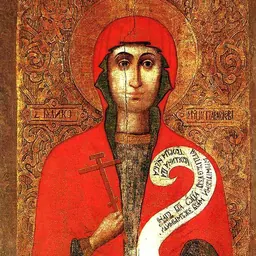
Later history An icon depicting Saints Paraskevi of Iconium, Barbara and Juliana. Devotion to Saint Juliana of Nicomedia became very widespread, persisting especially in the Netherlands. She became known as the patron saint of the sick.
Early in the 13th century, her remains were transferred to Naples. The description of this translation by a contemporary writer is still extant.
Veneration The feast of the saint is celebrated in the Catholic Church on 16 February; and in the Greek Orthodox Church on 21 December.
Since her Acts describe her conflicts with Satan, she is often depicted with a winged devil whom she leads by a chain. Other images show her enduring various tortures, or fighting a dragon. In the church of St Mary in Martham there is a medieval stained-glass depiction. In the church of St Andrew at Hempstead, near Holt, Norfolk, her effigy appears on a medieval rood screen. The church of St Mary at North Elmham contains an image of St Juliana on the rood screen.
St. Juliana is the subject of an Anglo-Saxon poem, believed to have been written by Cynewulf in the eighth century. This features an extended dialogue between Juliana and the demon she restrained.
Don’t just read it —
keep it.
Full-length biographies made to live with: read them, listen on the way to work, watch them tonight.
- E-book
- Audio
- Video
Instant download · yours to keep · every purchase keeps this site free
Important facts
People in Juliana of Nicomedia's life
Named in this biography and alive at the same time
Frequently asked questions
Who was Juliana of Nicomedia?
Anatolian saint
When was Juliana of Nicomedia born?
Juliana of Nicomedia was born in 285 in Nicomedia.
When did Juliana of Nicomedia die?
Juliana of Nicomedia died in 304 in Nicomedia.
What nationality was Juliana of Nicomedia?
Juliana of Nicomedia was Roman.
Sources & further reading
· Wikipedia: Juliana of Nicomedia
· DBpedia: Juliana of Nicomedia
Cite this page
APA: Biography.guide. (2026). Juliana of Nicomedia. https://biography.guide/juliana-of-nicomedia/
MLA: "Juliana of Nicomedia." Biography.guide, https://biography.guide/juliana-of-nicomedia/.
Chicago: "Juliana of Nicomedia." Biography.guide. https://biography.guide/juliana-of-nicomedia/.
Data last updated: 2026-09-20 · Spot an error? Report a correction.
Page generated 2026-09-27 05:18 UTC