About Julian Batchelor
Julian Batchelor was a New Zealand activist.
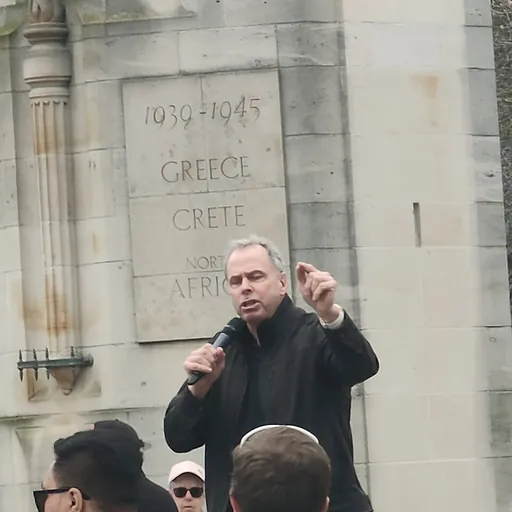
Julian Batchelor speaking at a rally in Christchurch. September 2023 Julian Geoffrey Peter Batchelor
Early life and religious conversion Batchelor was born in Kenya on 4 May 1958, where his parents lived during the colonial period. Kenya was granted independence by Britain in 1963. Batchelor emigrated with his parents from Britain to New Zealand in 1967. He studied educational psychology at Massey University's Palmerston North campus from 1980 to 1985 where he underwent a born again experience in 1982 and converted to Christianity. He attended Palmerston North Teachers' College (1983-1985). Although he initially considered becoming a Roman Catholic priest, Batchelor became an evangelical Christian. He obtained a degree in theology from New Zealand's Laidlaw College (1988-1990). to promote his evangelical ministry. With the help of mainly voluntary labour from Christian colleagues, Batchelor restored the two-storey villa and established a Christian retreat that would serve as accommodation for visitors to the Cape Brett track. To fund the development and restoration of the Lodge, Batchelor briefly became a real estate agent for Barfoot & Thompson in Auckland and Whangārei. By 2016, Batchelor had established a multimillion-dollar property portfolio.
In July 2020, a local iwi (tribe) applied for Heritage New Zealand to designate parts of his land as wāhi tapu. Batchelor said that he did not see the notifications from Heritage New Zealand before it approved the application in March 2022, after which he lodged an objection. He considered that designation to be equivalent to someone gaining unauthorised control of his land. He decided at that moment to channel his energy into anti co-governance activism, stating that "I'm mobilizing. That's enough - 14 years of living in tribal rule. It's absolute hell. And if this is what's coming to New Zealand, I need to go and warn people".
Political activism Anti-gay protests In 1997, Batchelor organised an anti-gay letter-writing campaign and over 200 letters arrived at Auckland City Council protesting the Hero Parade. In 1999, he co-founded and acted as spokesperson for a local chapter of American organization Stop Promoting Homosexuality. In 2000, Batchelor used images of Martin Luther King, Dame Whina Cooper, Mother Teresa and Mahatma Gandhi to protest against gay rights in Auckland. Both Cooper's family and King's Estate expressed upset that their images had been used without permission.
General elections Batchelor was the New Zealand First candidate in the Mount Albert electorate in the 2005 New Zealand general election. He gained fourth place, winning 1,089 votes. The electorate was retained by Prime Minister Helen Clark. Batchelor was reported in 2022 to still be a member of the New Zealand First Party. He also wanted English to be the official language in New Zealand to stop it being erased by Te Reo.
Stop Co-Governance tour In August 2022, Batchelor launched a "Stop Co-Governance Tour" roadshow tour of New Zealand, claiming that co-governance measures that had been derived from an interpretation of the Treaty of Waitangi, along with Māori electorates and Māori wards, were anti-democratic and racially divisive. His roadshow was controversial, with critics accusing Batchelor of promoting anti-Māori racism He referred to the diabolical behaviour of dictators in his talks in order to motivate his audience to reject co-governance by instilling fear.
Batchelor said there was "fraud and corruption" around the Treaty of Waitangi. He denied allegations of racism and claimed he was opposed to race-based legislation. Batchelor had previously filed a submission opposing the Rotorua District Council Representation Arrangements Bill that proposed local council have an equal number of Māori and general ward seats. Batchelor and others argued that Māori councillors needed to be elected, stating that "it was the democratic way of doing it". The Council had withdrawn its support for the Bill on 23 February 2023.
Batchelor's Stop Co-Governance meetings in 2023 in many locations were picketed by protesters and attended by police including in Dargaville (9 March), Hastings (24 July), Whangārei (6 August). Protestors wanted Batchelor's remarks fact-checked. or became physically hostile toward protestors.
Batchelor and his co-organizers of meeting appeared to selectively exclude Māori from meetings. Batchelor denied he was being racist but claimed that he only denied entry to "activists" or those that were not "good Māori" who would listen and be respectful. Batchelor recalled, however, that the crowd in Picton was "fully supportive" of his remarks and "there was not one Maori in the crowd".
A petition organised by Kaipara District Council Māori ward councillor Pera Paniora that gathered 1700 signatories in 24 hours requested Attorney-General David Parker take action against Batchelor for allegedly inciting racial disharmony as a result of his "misinformation, lies and insults toward Maori".
Reports of protest against Batchelor's tour in 2023 led venue owners to cancel his venue reservations in many locations including Rotorua (30 April), Dunedin (17 June), Picton and Blenheim (21 July), New Plymouth (25 July) which led to alternative venues or the use of a tent. Batchelor claimed his supporters had made the booking in good faith and he criticised the actions of the protesters for taking away his right to free speech. Batchelor "video-streamed" his meeting from private accommodation when venues were not available, which he reported increased his audience size considerably compared to holding a meeting in a physical venue.
Venues were cancelled by owners often at short notice who typically cited safety reasons for their decision. Batchelor criticized venue owners for cancelling on his blog. He published the venue owner's contact details and photograph and encouraged his followers to send an email to them objecting to their decision. Batchelor was also critical of the police when he considered they had not adequately protected him and meeting attendees. The contact details of the police person in charge at the time and their photo was published on his blog, and Batchelor encouraged his followers to send an email to them and to the Minister of Police to complain about the inadequate police presence at his meetings.
Some local mayors voiced support for and against Batchelor's tour. The mayor of Clutha District Bryan Cadogan, for example, said that he was not welcome in Balclutha and he denied Batchelor a venue. An online petition called for the mayor to apologise for his alleged "poor behaviour and cancellation of free speech". The mayor of Invercargill expressed support for the tour. At the meeting, Batchelor said that he had been told that his supporters had purchased guns and he called for peace. The mayor of the Kaipara District Council invited Batchelor to summarise his tour at a local council meeting, despite objections to his presence by council attendees. Batchelor advised that 350,000 of his "Stop Co-Governance" booklets had been published and distributed.
The Electoral Commission alleged in August 2023 that Batchelor's 31-page booklet breached electoral advertising laws during the lead-up to the 2023 New Zealand general election because the name and address of the promoter was not stated. Batchelor considered the infringement "extremely minor" and "difficult to prove in court". The Electoral Commission referred the matter to the police. Batchelor amended the online version of the booklet on 1 September 2023 with an official promoter statement, but he was unable to add a promoter statement to booklets already published and distributed.
On 10 August 2023 and in an effort to counter the disinformation provided in Batchelor's Stop Co-Governance roadshow, Taranaki Cathedral's Dean Jay Ruka announced that he would convene meetings with the local community to discuss the benefits of co-governance and the Treaty of Waitangi.
DB Breweries distanced itself from several Stop Co-Governance billboards that had appropriated the company's "Yeah, right" catchphrase. Batchelor's billboards that were erected on roadsides in various locations had slogans such as "Co-governance is in the Treaty" and "No cultural group receives special rights in NZ" alongside the sceptical catchphrase "Yeah, right". ) and in the capital Wellington (28 and 30 September 2023). Many roads close to parliament were closed as a safety precaution, which disrupted traffic and inconvenienced many shop owners and workers in central Wellington. Batchelor provided his views against co-governance at Destiny Church in Auckland. which ended with a political rally in support of Tamaki's The Freedoms & Rights Coalition and Convoy Coalition against the United Nation's 2030 Agenda and transgender rights. The march was met by a small group of counter protesters from Pōneke Anti-Fascist Coalition. All of the Stop Co-Governance marches contained far fewer marchers than Batchelor's goal of 300,000 to 400,000 people.
Issues highlighted by New Zealand's anti co-governance movement were recently summarised and compared with Australia's "Indigenous Voice to Parliament" referendum. The New Zealand First and ACT New Zealand parties have objected to the co-governance arrangements currently in place because they are 'divisive and undemocratic', and one has called for a referendum on the issue. However, Professor Dominic O'Sullivan from Charles Sturt University stated that Batchelor's objections to co-governance "did not have any foundation in democratic principles or inclusion – they are purely racist".
Defamation suit against TVNZ and Dr Hattotuwa Batchelor advised on 9 September 2023 that he would file a defamation lawsuit against TVNZ and The Disinformation Project director Dr Sanjana Hattotuwa, who had allegedly accused him of inciting racism against Māori people. Batchelor claimed the comments were hurtful and false. He sought a payment of $50,000 and a public apology. On 24 March 2026, Justice David Clark dismissed Batchelor's defamation claim against TVNZ and Dr Hattotuwa, ruling in favour of the broadcaster's defence based on truth, honest opinion and responsible communication. Clark also found Grenon liable to pay for Batchelor's legal fees and directed that a case management conference be held on 3 April 2026 to discuss whether Grenon wanted to be heard in Batchelor's case. On 28 May 2026, Clark rejected Grenon's lawyer Chris Patterson's bid to stop media coverage of Grenon's involvement as a "non-party," citing "genuine public interest" in the case.
On 3 July 2026, Clark ordered Grenon and Batchelor to pay $128,818.65 to TVNZ and $107,137 to Hattotuwa in legal costs. Clark also ordered the plaintiffs to pay further costs for additional submissions. He found that Grenon had instigated Batchelor's legal proceedings against TVNZ and Hattotuwa by providing a lawyer, and had sought to hide his involvement in Batchelor's proceedings against the defendants.
Notes and references
Don’t just read it —
keep it.
Full-length biographies made to live with: read them, listen on the way to work, watch them tonight.
- E-book
- Audio
- Video
Instant download · yours to keep · every purchase keeps this site free
Important facts
Related people
Same field, nearest in time




Frequently asked questions
Who was Julian Batchelor?
New Zealand anti-co-governance activist
What was Julian Batchelor's occupation?
Julian Batchelor was an activist.
What nationality was Julian Batchelor?
Julian Batchelor was New Zealand.
Sources & further reading
Cite this page
APA: Biography.guide. (2026). Julian Batchelor. https://biography.guide/julian-batchelor/
MLA: "Julian Batchelor." Biography.guide, https://biography.guide/julian-batchelor/.
Chicago: "Julian Batchelor." Biography.guide. https://biography.guide/julian-batchelor/.
Data last updated: 2026-09-24 · Spot an error? Report a correction.
Portrait: Wikimedia Commons · author & licence
Page generated 2026-09-27 05:08 UTC