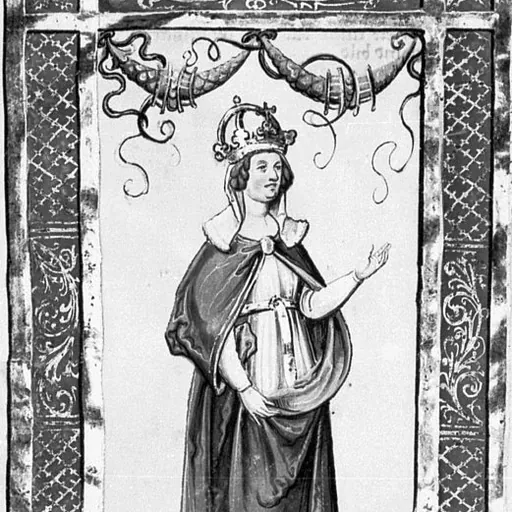
About Judith of Bavaria
Lived 797 – 843 (aged 45–46). Judith of Bavaria was a monarch.
Judith of Bavaria ( 797-805 – 19 April 843) was the Carolingian empress as the second wife of Louis the Pious. Marriage to Louis marked the beginning of her rise as an influential figure in the Carolingian court. She had two children with Louis, Gisela and Charles the Bald. The birth of her son led to a major dispute over the imperial succession, and tensions between her and Charles' half-brothers from Louis' first marriage. She eventually fell from grace when Charles' wife, Ermentrude of Orléans, rose to power. She was buried in 843 in Tours.
Early life
Judith was the daughter of Count Welf of Bavaria and Saxon noblewoman Hedwig. No surviving sources provide a record of Judith's exact date and year of birth. Judith was probably born around 797-805. Most girls in the Carolingian world were married in adolescence, with twelve years as the minimum age; her marriage to the 41-year-old King Louis occurred in 819, when she was probably between 13 and 22 years old.
Though the Welfs were noble, they were not part of the '"Imperial Aristocracy'" (Reichsaristokratie) that dominated high office throughout the Carolingian empire. The Welf clan's leaders, having lost influence in their home region of Alemannia (present-day southwestern Germany and northern Switzerland) eventually rose to power through cementing familial ties with the Carolingian Imperial Aristocracy in the 770s. Shortly after Christmas in 819 he married Judith in Aachen (North Rhine-Westphalia, Germany). Like many of the royal marriages of the time Judith was selected, prior to the marriage through a bridal show. It is at the bride show that, at the age of forty one, Louis chose the young Judith "after inspecting noble maidens who were brought to his court from all districts". In Frankish society, only women of the nobility were eligible to compete; this specific trait is highlighted in the Regesta Imperii, where Judith is referred to as stemming from a noble lineage (Edlen Geschlecht). Contemporary witnesses such as Ermoldus Nigellus, Walahfrid Strabo, and Louis' biographer Thegan attributed Judith's selection to her extraordinary beauty, intelligence, and musical ability. Although, according to modern sources, the dowry was indicative that the marriage was in fact a "Vollehe" (full marriage), it did not mean that the dowry would remain solely within the possession of the Queen in perpetuity; rather it could be taken from her depending on the political climate, as would later be the case in Judith's life, after her fall from power and influence.
It is not unlikely that, in order to complete these tasks, Judith would have had her own court personnel. This was not an uncommon phenomenon, it having existed according to sources since the time of the Merovingians.
After having spent most of her second pregnancy in Frankfurt, she had another child named Charles, who was born on 13 June 823. More commonly known as "Charles the Bald", he would eventually become emperor, following in the footsteps of his father Louis. The birth of Charles had a significant effect on Judith's life, because Charles was the only male heir of Louis' second marriage. His birth put the Ordinatio Imperii and its designations for successor under question. The ordinatio imperii outlined that only a full heir could rule, but since there were several viable candidates that met the requirements, (mainly Lothar, Peppin and Louis the German from the marriage to Ermengard and Charles from the marriage to Judith) an eventual strain on rightful succession was inevitable. Consequently, it became of the utmost importance for Judith to secure the throne for her son and protect him from the attacks and threats that his paternal brothers posed. Lothar, being the most prominent and the oldest of Ermengard's children, presented the greatest threat to Judith and Charles. Yet, realizing this, Judith selected Lothar as Charles' godfather. This strategic move meant Charles would have a political tie in the eventual disputes succession that would inevitably follow Louis' death.
Civil war
Imperial succession and partition
On 9 April 817 a timber roof collapsed on Louis and his men in Aachen. The event shocked Louis and led the emperor to reconsider the distribution of his power and succession for his heirs. The ordinatio Imperii was a reconfiguration and re-imagining of in the division of Charlemagne's inheritance, which he had always envisioned but never fully implemented. The ordinatio imperii stated that Louis oldest son Lothar would become co-emperor and would receive the whole of Francia. It also stated that Lothar's younger brothers, Pippin, aged 19, and Louis the German, aged 10, would inherit Aquitaine and Bavaria respectively (the regna).
A major sticking point that concerned Lothar was Louis' nineteen-year-old nephew Bernard of Italy getting in the way of his eventual rise to power. Bernard had been ruling Italy since 810. Yet, the ordinatio imperii did not specify Bernard as the immediate successor and continued ruler of Italy. Consequently, Bernard, alarmed by the fact that his future inheritance was at stake, rose up against Louis. The rebellion was swiftly quelled by Louis' forces. Bernard was blinded and would eventually die on 17 April 818
The birth of Charles as well as Lothar's marriage in 821 meant that two imperial households were now vying for control. Outlined in a letter to Pope Nicholas I Judith, upon Charles's birth, sent a ring to Ebbo, the archbishop of Rheims, asking him to pray for the health of Charles, but also promising that if he ever sent the ring back to her in times of trouble she would help him. |sign=Ermoldus Nigellus|source=Agobard of Lyons Not only does this highlight Judith's role as an influential force in Charles' life, but it also establishes an ambitious young Charles as a son that follows in the footsteps of his father Louis.
Other poetry by Ermoldus from 826 describes Judith following her son in procession, flanked on either side by the magnates Count Hugh of Tours, who was Lothar's father-in-law, and Count Matfrid of Orleans. Given that both magnates had extremely close ties with Lothar, this suggests Judith was already attempting to cultivate Lothar's sympathies and place herself and her son in a politically favourable position. and for her "good works". Louis spent the next year in Aachen as a captive of Lothar. Pippin and Louis the German, however, condemned the treatment of their father by Lothar and in 834 summoned armies from Aquitaine, Bavarians, Austrasians, Saxons, Alemans and the Franks to rise up against Lothar. Hearing of the vast armies approaching him, Lothar fled, leaving his father behind. Louis thus regained control and offered to forgive Lothar for his actions. Lothar, however, scorned the offer. It was during this turbulent political to-and-fro that followers of Louis the Pious who were in Italy, Bishop Ratold, Count Boniface and Pippin among them, heard of a plot to kill Judith. With their help Judith escaped and returned to Aachen in the same year.
Louis died in 840 at his palace in Ingelheim, leaving Judith a widow. She, however, continued to support her son Charles in his military campaigns and endeavours, gathering troops from Aquentine in 841. In April of that same year, Charles received his crown and all of his royal attire, which contemporaries of the time herald as a divine act. Most likely, however, Judith was well aware of Charles's location and had sent the royal artifacts to meet up with her son.
Charles married Ermentrude in 842 and fathered a daughter, Judith of Flanders, in 844, named after his mother. This marriage, however, proved disastrous for Judith's career, power and influence. With the introduction of a new queen, Judith became of ex officio importance, resulting in her forced retirement as well as withdrawal of the lands and wealth under her control. Her health began to fail in 842, and she died on 19 April 843 in Tours, outliving her husband by three years, after more than a year of ill health, including coughing and dizziness. It is believed that she was around 46 years of age when she died, her husband had been closer to 62. She was buried at the Basilica of Saint Martin, Tours.
Don’t just read it —
keep it.
Full-length biographies made to live with: read them, listen on the way to work, watch them tonight.
- E-book
- Audio
- Video
Instant download · yours to keep · every purchase keeps this site free
Important facts
Family & relationships
People in Judith of Bavaria's life
Named in this biography and alive at the same time






Related people
Same field, nearest in time



Contemporaries
People whose lives overlapped Judith of Bavaria's




Frequently asked questions
Who was Judith of Bavaria?
Carolingian empress and queen of the Franks
When was Judith of Bavaria born?
Judith of Bavaria was born in 797.
When did Judith of Bavaria die?
Judith of Bavaria died on 19 April 843 in Tours.
What was Judith of Bavaria's occupation?
Judith of Bavaria was a monarch.
Sources & further reading
· Wikipedia: Judith of Bavaria
· DBpedia: Judith of Bavaria (died 843)
Cite this page
APA: Biography.guide. (2026). Judith of Bavaria. https://biography.guide/judith-of-bavaria/
MLA: "Judith of Bavaria." Biography.guide, https://biography.guide/judith-of-bavaria/.
Chicago: "Judith of Bavaria." Biography.guide. https://biography.guide/judith-of-bavaria/.
Data last updated: 2026-09-22 · Spot an error? Report a correction.
Portrait: Wikimedia Commons · author & licence
Page generated 2026-09-27 05:04 UTC