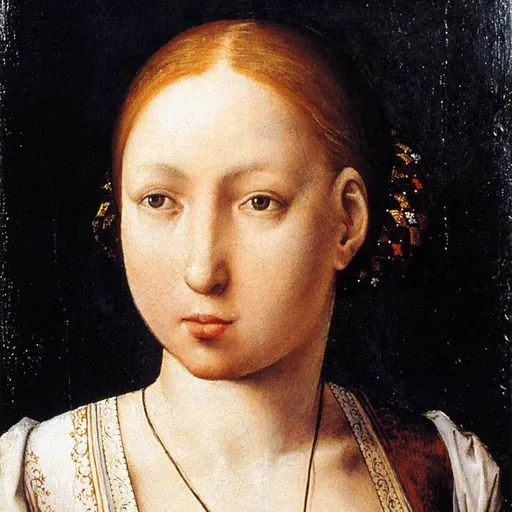
About Juana I of Castile
Lived 1479 – 1555 (aged 75). Juana I of Castile was a Spanish monarch.
Joanna or Joan (also known as Joanna the Mad or Joan the Mad Following the deaths of her elder brother John, elder sister Isabella, and nephew Miguel between 1497 and 1500, Joanna became the heir presumptive to the crowns of Castile and Aragon. When her mother died in 1504, she became queen of Castile. Her father proclaimed himself governor and administrator of Castile.
In 1506, Joanna's husband Philip became King of Castile jure uxoris as Philip I, initiating the rule of the Habsburgs in the Spanish kingdoms. Philip died that same year. Despite being the ruling Queen of Castile, Joanna had little effect on national policy during her reign as she was declared insane and confined in the Royal Palace in Tordesillas under the orders of her father, who ruled as regent until his death in 1516, when she inherited his kingdom as well. Her son Charles I became king, and during his reign Joanna was nominally co-monarch but remained confined until her death. Joanna died aged 75 in 1555. Historians have debated the authenticity of her alleged madness, and whether or not it was used to discredit her.
Early life
Joanna was born on 6 November 1479 in the city of Toledo in the Kingdom of Castile. She was the fourth but third surviving child and the second daughter of Isabella I of Castile and Ferdinand II of Aragon, both members of the House of Trastámara.
She had a fair complexion and brown eyes, and her hair colour was between strawberry-blonde and auburn, like her mother and her sister Catherine. Her siblings were Isabella, Queen of Portugal; John, Prince of Asturias; Maria, Queen of Portugal; and Catherine, Queen of England.
Education Joanna was educated and formally trained for a significant marriage that, as a royal family alliance, would extend the kingdom's power and security as well as its influence and peaceful relations with other ruling powers. As an Infanta (princess), she was not expected to be heiress to the throne of either Castile or Aragon, although through deaths she later inherited both thrones.
Joanna's academic education consisted of astromony, canon and civil law, genealogy and heraldry, geography, grammar, history, languages, mathematics, philosophy, reading, spelling and writing. Among the authors of classical literature she read were the Christian poets Juvencus and Prudentius, Church fathers Saint Ambrose, Saint Augustine, Saint Gregory, and Saint Jerome, and the Roman statesman Seneca.
In the Castilian court Joanna's main tutors were the Dominican priest Andrés de Miranda; educator Beatriz Galindo, who was a member of the queen's court; and her mother, the queen. Joanna's royal education included baking, chess, cooking, court etiquette, dancing, drawing, equestrian skills, good manners, music, the needle arts of embroidery, lace-making, needlepoint, sewing, spinning, and weaving, and singing . She studied the Iberian Romance languages of Castilian, Leonese, Galician-Portuguese and Catalan, and became fluent in French and Latin. She learned outdoor pursuits such as hawking and hunting. She was skilled at dancing and music; she played the clavichord, the guitar, the lute, and the monochord.
Marriage
In 1496, 16-year-old Joanna was betrothed to 18-year-old Philip of Austria, in the Low Countries. Philip's parents were Maximilian I, Holy Roman Emperor, and his first wife, Duchess Mary of Burgundy. The marriage was one of a set of family alliances between the Habsburgs and the Trastámaras designed to strengthen both against growing French power.
Joanna entered a proxy marriage at the Palacio de los Vivero in the city of Valladolid, Castile, where her parents had secretly married in 1469. In August 1496 Joanna left from the port of Laredo in northern Castile on the Atlantic's Bay of Biscay. Except for 1506, when she saw her younger sister Catherine, the then-Dowager Princess of Wales, she would never see her siblings again.
Joanna of Castile and Philip the Fair, stained glass, Basilica of the Holy Blood in Bruges.
Joanna began her journey to Brabant in the Low Countries, which consisted of parts of the present day Netherlands, Belgium, Luxembourg, France, and Germany, on 22 August 1496. The formal marriage took place on 20 October 1496 in Lier,
Princess of Asturias The death of Joanna's brother John, the stillbirth of John's daughter, and the deaths of Joanna's older sister Isabella and Isabella's son Miguel made Joanna heiress to the Spanish kingdoms. Her remaining siblings were Maria (1482–1517) and Catherine (1485–1536), younger than Joanna by three and six years respectively.
In 1502, the Castilian Cortes of Toro recognised Joanna as heiress to the Castilian throne and Philip as her consort. She was named Princess of Asturias, the title traditionally given to the heir of Castile. Also in 1502, the Aragonese Cortes gathered in Zaragoza to swear an oath to Joanna as heiress; however, the Archbishop of Zaragoza, Alonso de Aragón expressed firmly that this oath could only establish jurisprudence by way of a formal agreement on the succession between the Cortes and the king.
Ferdinand refused to accept this; he minted Castilian coins in the name of "Ferdinand and Joanna, King and Queen of Castile, León and Aragon", and, in early 1505, persuaded the Cortes that Joanna's "illness is such that the said Queen Doña Joanna our Lady cannot govern". The Cortes then appointed Ferdinand as Joanna's guardian and the kingdom's administrator and governor.
Joanna's husband, Philip, was unwilling to accept any threat to his chances of ruling Castile and also minted coins in the name of "Philip and Joanna, King and Queen of Castile, Léon and Archdukes of Austria, etc."
Ferdinand's remarriage merely strengthened support for Philip and Joanna in Castile, and in late 1505 the pair decided to travel to Castile. Before they boarded the ship, Joanna forbade a ship with female attendants to join the trip, fearing that Philip would have illicit relationships with them. This action played right into Philip's and Ferdinand's propaganda against her. Leaving Flanders on 10 January 1506, their ships were wrecked on the English coast and the couple were guests of Henry, Prince of Wales (later Henry VIII), and Joanna's sister Catherine of Aragon at Windsor Castle. They weren't able to leave until 21 April, by which time civil war was looming in Castile.
Philip apparently considered landing in Andalusia and summoning the nobles to take up arms against Ferdinand in Aragon. Instead, he and Joanna landed at A Coruña on 26 April, whereupon the Castilian nobility abandoned Ferdinand en masse. Ferdinand met Philip at Villafáfila on 27 June 1506 for a private interview in the village church. To the general surprise, Ferdinand had unexpectedly handed over the government of Castile to his "most beloved children", promising to retire to Aragon. Philip and Ferdinand then signed the Treaty of Villafáfila secretly, agreeing that Joanna's "infirmities and sufferings" made her incapable of ruling and promising to exclude her from government and deprive the Queen of crown and freedom.
Ferdinand promptly repudiated the second agreement the same afternoon, declaring that Joanna should never be deprived of her rights as Queen Proprietress of Castile. A fortnight later, having come to no fresh agreement with Philip, and thus effectively retaining his right to interfere if he considered his daughter's rights to have been infringed upon, he abandoned Castile for Aragon, leaving Philip to govern in Joanna's stead. but there were rumors that his father-in-law, Ferdinand II, had poisoned him. Joanna was pregnant with their sixth child, a daughter named Catherine (1507–1578), who later became Queen of Portugal. As Joanna had no midwife at the time, she was assisted during childbirth by her lady-in-waiting, María de Ulloa.
By 20 December 1506, Joanna was in the village of Torquemada in Castile, attempting to exercise her rights to rule alone in her own name as Queen of Castile. The country fell into disorder. Her son and heir-apparent Charles, later Charles I, was a six-year-old child being raised in his aunt's care in northern European Flanders; her father, Ferdinand II, remained in Aragon, allowing the crisis to grow.
A regency council under Archbishop Cisneros was set up, against the queen's orders, but it was unable to manage the growing public disorder; plague and famine devastated the kingdom with supposedly half the population perishing of one or the other. The queen was unable to secure the funds required to assist her to protect her power. In the face of this, Ferdinand II returned to Castile in July 1507. His arrival coincided with a remission of the plague and famine, a development which quieted the instability and left an impression that his return had restored the health of the kingdom. The Castilian Cortes, meeting in Valladolid, spited Charles by addressing him only as Su Alteza ("Your Highness") and reserving Majestad ("Majesty") for Joanna.
Revolt of the Comuneros In 1520, the Revolt of the Comuneros broke out in response to the perceived foreign Habsburg influence over Castile through Charles V. The rebel leaders demanded that Castile be governed in accordance with the supposed practices of the Catholic Monarchs. In an attempt to legitimise their rebellion, the Comuneros turned to Joanna. As the sovereign monarch, had she given written approval to the rebellion, it would have been legalised and would have triumphed.
In an attempt to prevent this, Don Antonio de Rojas Manrique, Bishop of Mallorca, led a delegation of royal councillors to Tordesillas, asking Joanna to sign a document denouncing the Comuneros. She demurred, requesting that he present her specific provisions. Before this could be done, the Comuneros in turn stormed the virtually undefended city and requested her support.
The request prompted Adrian of Utrecht, the regent appointed by Charles V, to declare that Charles would lose Castile if she granted her support. Although she was sympathetic to the Comuneros, she was persuaded by Ochoa de Landa and her confessor Fray John of Ávila that supporting the revolt would irreparably damage the country and her son's kingship, and she therefore refused to sign a document granting her support. The Battle of Villalar confirmed that Charles would prevail over the revolt.
Forced confinement
Charles ensured his domination and throne by having his mother confined for the rest of her life in the now-demolished Royal Palace in Tordesillas, Castile. Joanna's condition degenerated further. She apparently became convinced that some of the nuns that took care of her wanted to kill her. Reportedly it was difficult for her to eat, sleep, bathe, or change her clothes. Charles wrote to her caretakers: "It seems to me that the best and most suitable thing for you to do is to make sure that no person speaks with Her Majesty, for no good could come from it".
Her late mother's lady-in-waiting, Catalina de Medrano y Bravo de Lagunas, along with her husband, Hernando de Sandoval y Rojas, took part in the custody and care of Joanna in Tordesillas. Joanna also had her youngest daughter, Catherine of Austria, with her during Ferdinand II's time as regent, 1507–1516. Her older daughter, Eleanor of Austria, had created a semblance of a household within the palace rooms. In her final years, Joanna's physical state began to decline rapidly, with mobility ever more difficult.
Death
Joanna died from unknown causes on Good Friday, 12 April 1555, at the age of 75 in the Royal Palace at Tordesillas. It was only after her marriage that the first suspicions of mental illness arose. Some historians believe she may have had melancholia, a depressive disorder, a psychosis, or a case of inherited schizophrenia. She may also have been unjustly painted as "mad" as her husband Philip the Handsome and her father, Ferdinand, had a great deal to gain from Joanna being declared sick or incompetent to rule.
The narrative of her purported mental illness is perpetuated in stories of the mental illness of her maternal grandmother, Isabella of Portugal, Queen of Castile, who, in widowhood, was exiled by her stepson to the castle of Arévalo in Ávila, Castile.
Arms
Children
Ancestry
Don’t just read it —
keep it.
Full-length biographies made to live with: read them, listen on the way to work, watch them tonight.
- E-book
- Audio
- Video
Instant download · yours to keep · every purchase keeps this site free
Important facts
more
Joan the Mad, Joanna the Mad, Joanna of CastileFamily & relationships
People in Juana I of Castile's life
Named in this biography and alive at the same time



Related people
Same field, nearest in time
Contemporaries
People whose lives overlapped Juana I of Castile's

Frequently asked questions
Who was Juana I of Castile?
Queen of Castile from 1504 and of Aragon from 1516
When was Juana I of Castile born?
Juana I of Castile was born on 6 November 1479 in Toledo.
When did Juana I of Castile die?
Juana I of Castile died on 12 April 1555 in Tordesillas.
What was Juana I of Castile's occupation?
Juana I of Castile was a monarch.
What nationality was Juana I of Castile?
Juana I of Castile was Spanish.
Sources & further reading
· Wikipedia: Juana I of Castile
Cite this page
APA: Biography.guide. (2026). Juana I of Castile. https://biography.guide/juana-i-of-castile/
MLA: "Juana I of Castile." Biography.guide, https://biography.guide/juana-i-of-castile/.
Chicago: "Juana I of Castile." Biography.guide. https://biography.guide/juana-i-of-castile/.
Data last updated: 2026-09-21 · Spot an error? Report a correction.
Portrait: Wikimedia Commons · author & licence
Page generated 2026-09-27 05:00 UTC