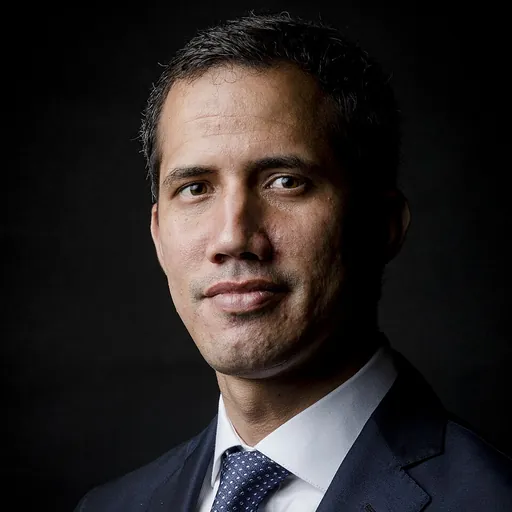
Juan Guaidó
Venezuelan politician and former President of the National Assembly (1983)
About Juan Guaidó
Born 1983. Juan Guaidó is a Venezuelan politician, industrial engineer and engineer.
National Assembly
In the 2010 Venezuelan parliamentary election, Guaidó was elected as an alternate national deputy. He was one of several politicians who went on a hunger strike to demand parliamentary elections in 2015 Vargas, an impoverished area, was home to many state-run companies that employed the majority of the population; until Guaidó's 2015 election, chavista candidates had run unchallenged. and he was shot with rubber bullets,
President of the National Assembly
A rotating presidency of the National Assembly of Venezuela agreement resulted with Popular Will attaining leadership and due to the party's head officials being imprisoned or exiled, Guaidó was chosen as president in December 2018 by the Assembly, and was sworn in on 5 January 2019. Relatives of imprisoned politicians were invited to the inauguration.
Two politicians were primarily responsible for the strategy that brought Guaidó to prominence: Julio Borges (in exile) and Leopoldo López (under house arrest). The plan was developed after the failed 2017 negotiations during the Venezuelan crisis between representatives of chavismo and the opposition, and that took more than a year to develop. Ricardo Hausmann and politicians from different political parties were also involved. Borges was involved in external efforts, such as with the Lima Group, along with Antonio Ledezma and Carlos Vecchio, who operated in the United States; María Corina Machado and López operated in Venezuela. stated that Guaidó's rise as a presidential figure began within Venezuela, not by foreign pressure. López and Guaidó contacted the United States Department of State, presenting a plan to declare Guaidó interim president and that the United States could lead other nations to support his recognition in order to remove Maduro; United States Secretary of State Mike Pompeo supported the plan. López and Guaidó promoted this initiative to the United States without the knowledge of the National Assembly, according to Neuman.
Upon taking office, Guaidó vowed to oppose Maduro, and elaborated an action plan. The plan, approved by the National Assembly, comprised three phases (end of usurpation, transitional government, and free elections), with eight key points.
Detention and release While on his way to a 13 January 2019 public assembly, Guaidó was briefly detained by members of the Bolivarian Intelligence Service (SEBIN), and released 45 minutes later. and the Secretary General of the Organization of American States (OAS), Luis Almagro, condemned the act. The Maduro government said the detention was carried out unilaterally by the SEBIN personnel, and twelve SEBIN officials were charged for their actions.
Guaidó declared that the events demonstrated that there was a break in the chain of command in the Armed Forces, and that Maduro was not in control.
Re-election
The 2020 Venezuelan National Assembly Delegated Committee election of 5 January, to elect the Board of Directors of the National Assembly, was disrupted; there were two claims for the presidency of the National Assembly, by Guaidó and Luis Parra, an independent legislator. Parra was formerly a member of Justice First, but was expelled from the party on 20 December 2019 based on corruption allegations, which he denied. Parra declared himself president of the National Assembly – a move that was welcomed by the Maduro administration. Police forces had blocked access to parliament to some opposition members, including Guaidó, and members of the media. Later in the day, a separate session was carried out at the headquarters of El Nacional newspaper, where 100 of the 167 deputies voted to re-elect Guaidó as president of the parliament.
Claim to presidency Swearing-in
After what he and critics of the Maduro administration described as the "illegitimate" inauguration of Maduro on 10 January 2019, Guaidó challenged Maduro's claim to the presidency. The National Assembly declared Guaidó was willing to assume the responsibilities of the presidency. the 61st anniversary of the overthrow of dictator Marcos Pérez Jiménez. Prior to Guaidó's declaration, Vice President of the United States Mike Pence called Guaidó on 22 January and told him that the United States would support his initiative.
On 23 January, Guaidó declared he assumed the functions as acting president and took the presidential oath at a rally in Caracas. Maduro accused the United States of backing a coup and said he would cut ties with the country. Guaidó denied the coup allegations, saying peaceful volunteers backed his movement. In December 2018, Guaidó had traveled to Washington, D.C., where he met with OAS Secretary General Luis Almagro, and then on 14 January to Colombia for a Lima Group meeting, in which Maduro's mandate was rejected. According to El País, the January Lima Group meeting and the stance taken by Canada, represented by Chrystia Freeland, were key factors leading Donald Trump, known for being an isolationist, to become involved in Venezuela.
The Supreme Tribunal of Justice (TSJ) rejected the National Assembly's decisions, while the Supreme Tribunal of Justice of Venezuela in exile welcomed Guaidó as acting president.
On 29 January 2019, the TSJ launched a probe of Guaidó, froze his assets, and prohibited him from leaving the country. According to Special Rapporteur on the Independence of Judges and Lawyers for the United Nations Diego García Sayán, the measures were "not adopted in accordance with constitutional requirements, normal legal procedures and international human rights standards."
As of 1 April 2021, Guaidó was no longer recognized as Venezuela's rightful President by the European Union's 27 member-states after he lost his position as head of parliament. Although the United States and the United Kingdom continued to recognize him as the legitimate leader of Venezuela in 2021, the United States stopped recognizing Guaidó in January 2023 when the opposition party vote to dissolve Guaidó's interim government took effect.
Personnel
According to El País, Guaidó had help, along with National Assembly vice-presidents Stalin González and Edgar Zambrano, from young representatives of several political parties: Miguel Pizarro for humanitarian aid, Carlos Paparoni heading a Finance Commission, and Marialbert Barrios working with embassies.
Carlos Vecchio was accepted by Pompeo as the Guaidó administration's diplomatic envoy to the US. Julio Borges was named to represent Venezuela in the Lima Group. The National Assembly made more than a dozen other diplomatic appointments, including Elisa Trotta Gamus to Argentina, María Teresa Belandria to Brazil, and Humberto Calderón Berti to Colombia. Diplomats to Europe and the Dominican Republic were named on 19 February.
Gustavo Tarre Briceño was named Venezuela's Permanent Representative to the Organization of American States (OAS) on 29 January 2019, and ratified by the National Assembly according to the constitution. On 9 April, the OAS voted 18 to 9, with six abstentions, to accept Tarre Briceño as the ambassador from Venezuela. Maduro's Foreign Ministry called Tarre a "political usurper." The nomination was accepted 20 days before the deadline on Venezuela leaving the union, after they triggered the process in 2017, suggesting that the nation will remain in the OAS against the wishes of the Maduro administration. Venezuela's previous ambassador voted against Tarre. According to The Washington Post, the OAS vote undermined Maduro's presence internationally and marked a step in the official recognition of Guaidó's government.
The National Assembly authorized Guaidó's appointment of a new ad hoc directors board of Petróleos de Venezuela (PDVSA), of Citgo, Pdvsa Holding Inc, Citgo Holding Inc. and Citgo Petroleum Corporation. The appointed members of PDVSA were Simón Antúnez, Gustavo J. Velasquez, Carlos José Balza, Ricardo Prada and David Smolansky. Likewise, the appointed members of Citgo Holding and Citgo Petroleum Corporation were Luisa Palacios, Edgar Rincón, Luis Urdaneta, Ángel Olmeta, Andrés Padilla and Rick Esser. With Citgo under the control of Guaidó's administration, the US Department of Treasury extended its license to operate in spite of US sanctions.
Guaidó named José Ignacio Hernández as special solicitor, making Hernández the first official named with state power. Ricardo Hausmann was named as Venezuela's representative to the Inter-American Development Bank, who recognized Hausmann as a replacement for Maduro's representative.
The Maduro administration's prosecutor general, Tarek William Saab, said the "appointments by Guaidó and his National Assembly are part of an illegal power grab backed by foreign governments"
Arrest attempt On 12 July 2021, Special Action Forces (FAES) officials went to Guaidó's residence and besieged him for twenty minutes in the building's garage, and used explosives against him as Guaidó took refuge in an armored vehicle. The intended arrest was foiled due to the vehicle and his neighbors and supporters, who opposed Guaidó's detention. Guaidó said that the officers did not identify themselves nor did they show any judicial order. On the same day, former deputy Freddy Guevara was detained while he was driving his vehicle.
Interim government dismissal After a preliminary vote on 22 December 2022 to remove the interim government, on 30 December 2022, three of the four main political parties (Justice First, Democratic Action and A New Era) backed a reform of the Statute Governing the Transition to Democracy to dissolve the interim government and create a commission of five members to manage foreign assets, He suggested that if Maduro gave up power, he may receive amnesty. He held a public assembly, asking supporters to disseminate the Amnesty Law throughout the country to military, police and other functionaries. On 30 January, demonstrators took to the streets across the country to encourage the military to allow humanitarian aid and reject Maduro.
In a 30 January editorial published by The New York Times, Guaidó explained that the law would only apply to individuals who were not found to have committed crimes against humanity.
According to Colombian immigration authorities, as of 24 April 2019, about 1,400 Venezuelan military personnel had broken ranks and crossed the border into Colombia since the border clashes began on 23 February, in addition to 60 that crossed into Brazil, according to the Brazilian Army. He did not state if he would run for president when elections occur,
The Statute Governing the Transition to Democracy to Re-establish the Validity of the Constitution of the Bolivarian Republic of Venezuela was approved on 5 February, and the National Assembly second vice-president Stalin González announced that a commission to set a route towards elections was established on 6 March 2019.
Finance and economy
Guaidó asked the Bank of England and British Prime Minister Theresa May not to return to the Maduro administration the £1.2 billion in gold reserves the UK holds for Venezuela, and to allow the opposition to access it instead. In the same week, the US Treasury levied sanctions against PDVSA and transferred control of some Venezuelan assets to Guaidó.
Guaidó said the Maduro administration was attempting to move some of the country's assets to Uruguay, "to keep stealing from the people of Venezuela." On 5 February, Paparoni announced that the transfer from Portugal to Uruguay had been stopped.
Guaidó sought to open up the economy by allowing foreign, private oil companies greater participation in ventures with PDVSA by dropping the requirement for 51% PDVSA ownership in joint ventures. Pledging to honor "legal" and "financial" debt, Carlos Vecchio said that agreements in which Venezuela pays debt with oil (signed by the Maduro administration) might not be honored. The day after assuming the acting presidency, Guaidó requested humanitarian aid for Venezuela from the US and from the United Nations. He said Venezuela's neighbors, in a "global coalition to send aid to Venezuela", would help get humanitarian aid and medicine into the country; products would be shipped to neighboring ports and brought overland via convoys. He said that the 250,000 people whose lives were in danger would be the recipients of the first phase of the effort. He traveled to Cúcuta on 22 February to be present as the aid entered Colombia; Maduro administration security forces clashed with demonstrators and blocked the aid from entering.
The International Federation of Red Cross and Red Crescent Societies announced in March 2019 that the Red Cross was preparing to bring humanitarian aid to the country in April to help ease both the chronic hunger and the medical crisis. The Wall Street Journal said that the acceptance of humanitarian shipments by Maduro was his first acknowledgement that Venezuela is "suffering from an economic collapse." and called on Venezuelans to "stay vigilant to make sure incoming aid is not diverted for 'corrupt' purposes". Following the joint report from Human Rights Watch and Johns Hopkins in April 2019, increasing announcements from the United Nations about the scale of the humanitarian crisis, and the softening of Maduro's position on receiving aid, the Red Cross tripled its budget for aid to Venezuela.
Media On 23 April 2019, Guaidó named Alberto Federico Ravell, former CEO and co-founder of the news channel Globovisión, as his spokesman and director of the National Center of Communications of Venezuela, Guaidó's information and media board. In January 2020, Guaidó announced the appointment of an ad hoc directors board of the National Commission of Telecommunications (CONATEL), saying that "Telesur will no longer be a propaganda tool of the regime."
Plan País Guaidó announced on 31 January at the Central University of Venezuela Called Plan País (Plan for the Country), it had been under elaboration for some time, and was initially developed through a series of public and private meetings in the US and Venezuela. According to Guaidó, the aims of the plan were to "stabilize the economy, attend to the humanitarian emergency immediately, rescue public services, and overcome poverty." It had provisions to revitalize PDVSA, restore the health sector, and offer assistance to the most poverty-stricken. Implementation of the plan required Maduro's exit. As part of the ongoing tour, he visited Petare, regarded as one of the world's largest slums, on 12 April.
In an open assembly celebrating the anniversary of the 19 April 1810 date when the Venezuelan Independence Movement began, Guaidó offered the example that organized protests in Sudan led to the replacement of Omar al-Bashir, and called for "the greatest march" in history on 1 May, to "once and for all end this tragedy". Coinciding with his speech, NetBlocks stated that state-run CANTV again blocked access to social media in Venezuela.
On 30 April, Guaidó live-streamed a video of himself beside opposition leader Leopoldo López, freed from house arrest after being imprisoned for five years, with the two flanked by members of the Venezuelan armed forces, announcing the "final phase" of Operation Freedom. He stated: "People of Venezuela, it is necessary that we go out together to the street, to support the democratic forces and to recover our freedom. Organized and together, mobilize the main military units. People of Caracas, all to La Carlota." The Associated Press reported that López "had been released from house arrest by security forces adhering to an order from Guaidó." Several dozen military personnel and civilians joined Guaidó in his call for an uprising. before going into hiding. Expected military defections did not happen. and at least 100 were injured; López was at the Spanish embassy, while 25 military personnel sought asylum in the Brazilian embassy in Caracas. On 1 May, Guaidó's call for the largest march in history did not materialize and his supporters were forced to retreat by security forces using tear gas. Guaidó acknowledged he had received insufficient military backing, Members of the Strategic Committee argued that the Venezuelan Constitution, the United Nations Convention against Transnational Organized Crime, and other treaties justified action against Maduro.
When interviewed by BBC Mundo, risk consultant Dimitris Pantoulas, and head of the Datanálisis consultant firm Luis Vicente León agreed that Guaidó's reputation was damaged due to the incident, with León stating "the opposition seems to have exhausted the routes". In an analysis for the Council on Hemispheric Affairs, Patricio Zamorano wrote that the event demonstrated that "Guaidó is politically immature and inept", that such scandals had "led to a significant withering of his support" and that Guaidó was willing to resort to violence to remove Maduro from power.
Dialogue with Maduro
In response to calls from Mexico, Uruguay, and CARICOM for negotiations, Guaidó said that the National Assembly would not participate in dialogue with Maduro, on the grounds that negotiations had already been attempted, "within and outside of Venezuela, in private and in public, alone and with international companions." Guaidó said that the result of all previous negotiations was more repression, with Maduro taking advantage of the process to strengthen his position. Guaidó characterized Uruguay as failing to defend democracy, saying that Uruguay's stance was surprising given Venezuela has 300,000 starving people at risk of dying. Guaidó said that Maduro did not respect conditions of 2016 negotiations, and suggested the Pope should encourage Maduro to allow an orderly transition of power. Corriere della Sera cited a 7 February 2019 reply from Pope Francis addressed to "Mr. Maduro," in which Pope Francis also stated that what had been agreed in earlier negotiations (open a channel for humanitarian aid, hold free elections, free political prisoners, and re-establish the constitutionally-elected National Assembly) had not been followed, and that he would back only constructive dialogue "when all conflicting parties put the common good above any other interest."
Following the failed uprising, representatives of Guaidó and Maduro began mediation, with the assistance of the Norwegian Centre for Conflict Resolution. Jorge Rodríguez and Héctor Rodríguez Castro served as representatives for Maduro while and Stalin González were representatives for Guaidó. Guaidó confirmed that there was an envoy in Norway, but said that the opposition would not take part in false negotiations.
On 9 July 2019 negotiations started in Barbados with representatives of Maduro and Guaidó. Several theories arose from the negotiations, including potential elections agreed upon between the government and the opposition, having Héctor Rodríguez as the main government candidate. On 15 September, Guaidó announced that the opposition concluded the dialogue after the absence of the government in the negotiations for forty days as a protest to the recent sanctions by the United States.
In February 2020, the coordinator of the Lima Group, Hugo de Zela, announced that Argentina, Canada and Peru were attempting to negotiate with the Cuban government to find a solution to the crisis.
In late March 2020, the United States relaxed its position and proposed a transitional government that would exclude both Maduro and Guaidó from the presidency. Secretary of State Mike Pompeo said that sanctions did not apply to humanitarian aid during the coronavirus pandemic health emergency and that the United States would lift all sanctions if Maduro agreed to organize elections that did not include himself in a period of six to twelve months. The deal would enforce a power-sharing scenario between the different government factions. Elections would have to be held within the year, and all foreign militaries would have to leave the country. The US was still seeking Maduro's arrest at the time of the announcement. Other aspects of the US deal would include releasing all political prisoners and setting up a five-person council to lead the country; two members each chosen by Maduro and Guaidó would sit on the council, with the last member selected by the four. The EU also agreed to remove sanctions if the deal went ahead.
Guaidó accepted the proposal, while Venezuela's foreign minister, Jorge Arreaza, rejected it and declared that only parliamentary elections would take place that year.
Reuters reported that during the COVID-19 pandemic, allies of both Maduro and Guaidó had secretly begun exploratory talks, according to sources on both sides. Guaidó and U.S. Special Representative for Venezuela Elliott Abrams denied that negotiations had taken place.
After the announcement of regional elections in 2021, Guaidó announced a "national salvation agreement" and proposed the negotiation with Maduro with a schedule for free and fair elections, with international support and observers, in exchange for lifting international sanctions.
Foreign affairs Juan Guaidó with Colombian president Ivan Duque and U.S. Vice President Mike Pence in February 2019
Guaidó said there was room for long-term Chávez/Maduro allies such as Russia and China in Venezuela, adding that legal security under a new plan for the country would benefit all businesses, including theirs. He approached China to establish diplomatic ties, stating "China's support will be very important in boosting our country's economy and future development." According to Euronews, he said he had been "working to convince China and Russia that it was in their economic interest to withdraw support from Maduro."
According to CNN, following a long history of Fidel Castro's interest in the country, "Venezuelan oil is the lifeblood of Cuban economy, under a barter system where Cuba receives billions of dollars of crude in exchange for Cuban doctors, teachers, sports trainers, and military and intelligence advisers." Referring to Cubans as "brothers," he said that Cuban individuals are welcome to stay in the country, but not in decision-making positions, and not in the armed forces. On 12 March 2019, the National Assembly voted to cut Venezuela's oil supply to Cuba, which would save about US$2.6 million daily, according to Guaidó, who asked other nations to help implement the measure.
Guaidó with U.S. President Donald Trump in Washington, D.C., February 2020 Guaidó with U.S. Ambassador to the United Nations Kelly Craft, February 2020 Guaidó sought restored relations with Israel; Chávez had severed relations with Israel more than ten years prior, favoring support for Palestine during Operation Cast Lead.
Guaidó has supported Venezuela's sovereignty claim in the Guyana–Venezuela territorial dispute throughout his political career.
In June 2019, the United Nations reported that four million Venezuelans had left the country, many without a valid passport. Associated Press has reported that getting an extension is an expensive and lengthy ordeal for many Venezuelans.
In September 2019, Guaidó announced the designation as terrorist organizations of Revolutionary Armed Forces of Colombia (FARC), National Liberation Army (ELN), Hamas, Hezbollah, and the Islamic State of Iraq and the Levant (ISIS/ISIL), ordering all state security forces to protect "our sovereignty and territorial integrity" against the threat posed by these groups.
Following an American airstrike that killed Iranian Quds Force Commander Qasem Soleimani in January 2020, Guaidó said that Soleimani "led a criminal and terrorist structure in Iran that for years caused pain to his people and destabilized the Middle East, just as Abu Mahdi al-Muhandis did with Hezbollah." Guaidó also accused Nicolás Maduro of allowing him and his Quds Forces to incorporate their sanctioned banks and their companies in Venezuela.
International trips 2019
Date Location Main purpose 22 FebruaryCúcuta Venezuela Aid Live. 23 FebruaryDelivery of humanitarian aid in Venezuela. Meeting with presidents Iván Duque of Colombia, Sebastián Piñera of Chile, and Mario Abdo Benítez of Paraguay, as well as Luis Almagro, secretary general of the Organization of American States. 24 FebruaryBogotá Meeting with U.S. Vice President Mike Pence. 25 FebruarySummit of the Lima Group. 28 FebruaryBrasília Meeting with Brazilian president Jair Bolsonaro. 1 MarchAsunción Meeting with Paraguayan president Mario Abdo Benítez. 2 MarchQuito Meeting with Ecuadorian president Lenín Moreno. 21 JanuaryLondon Meeting with Prime Minister Boris Johnson. 22 JanuaryBrussels Meeting with Margaritis Schinas and Josep Borrell. 23 JanuaryDavos Participation in the World Economic Forum. 25 JanuaryParis Meeting with President Emmanuel Macron. 27 JanuaryOttawa Meeting with Prime Minister Justin Trudeau. 4 FebruaryWashington, D.C. Attendance at the State of the Union address.
Diplomatic officials As of July 2019, the National Assembly had approved Juan Guaidó's appointment of 37 ambassadors and foreign representatives to international organizations and nations abroad.
Organization/countryOfficialGustavo Tarre BriceñoInter-American Development BankAlejandro PlazLima GroupJulio BorgesCarmen AlguindingueElisa Trotta Gamus (2019–2020) Alejandro MartínezMaría Teresa BelandriaOrlando Viera BlancoVacantMaría FaríaVacantEnrique Ser HorstEusebio CarlinoRené de SolaIsadora ZubillagaOtto GebauerEduardo Fernando MassieuClaudio SandovalEnrique AlvaradoPynchas BrenerAngelina JaffeFelipe ZoghbiJosé Ignacio GuédezGloria NotaroFabiola ZavarceDavid OlsenCarlos ScullAna MedinaJosé Rafael CotasMemo MazzoneLeón PobleteVanessa NeumannCarlos Vecchio On 9 April, the OAS voted 18 to 9, with six abstentions, to accept Guaidó's envoy, Gustavo Tarre Briceño, as the ambassador from Venezuela until new elections can be held. The permanent council approved a text stating that "Nicolas Maduro's presidential authority lacks legitimacy and his designations for government posts, therefore, lack the necessary legitimacy." Antigua and Barbuda, Bolivia, Dominica, Grenada, Mexico, Saint Vincent and the Grenadines, Suriname, Uruguay, and Venezuela voted against the change. Maduro's administration responded calling Tarre a "loud-mouth political usurper" and the decision a "criminal and rampant violation of international law and the OAS Charter," saying they do not intend to respect decisions made by Tarre. The nomination was accepted 20 days before the deadline on Venezuela leaving the organization, after they triggered the process in 2017. According to The Washington Post, this acceptance undermined Maduro's presence internationally and marked a step in the official recognition of Guaidó's government. An effort by some OAS member states to remove Guaidó's OAS envoy in October 2022 failed, obtaining a majority but falling short of the two-thirds supermajority required.
In January 2020, Guaidó announced that he would appoint diplomatic representatives to Bolivia, El Salvador, and Uruguay.
In January 2022, opposition parties voted to extend Guaidó's term as interim president for another year and to create a committee of opposition lawmakers to take over his management of foreign affairs, as well as to authorize the appointment of ambassadors in opposition allied countries. After the vote, Guaidó's role consisted in "defending democracy" and managing Venezuela's overseas assets, including oil refiner Citgo and $1 billion in gold lodged in the Bank of England. Guaidó required to keep the committee informed of how he had spent funds under his control. Guaidó criticized Petro's reversal of recognition from the policy of prior Colombian President Iván Duque, saying that Maduro "sheltered world terrorism in Venezuela".
Military involvement In an interview with Christiane Amanpour, Guaidó did not rule out accepting support from the US armed forces, but said that pressure was being applied in every other way possible to avoid armed conflict.
According to Giancarlo Fiorella, writing in Foreign Affairs, "calls for intervention" are coming from "some members of the Venezuelan opposition and from residents of the country desperate for a solution—any solution—to their years-long plight"; he adds that talk of foreign intervention "has become commonplace" in Venezuela, and that "the push for a military intervention in Venezuela is most intense not among hawks in Washington but inside the country itself." A March poll showed 87.5% support for foreign intervention. Constitutional lawyer Juan Manuel Raffalli said there is no breach to prosecute unless the National Assembly first approves one; he said the proceedings were intended to distract attention from the protests and collapse of public services, referencing the 2019 Venezuelan blackouts.
Bypassing the National Assembly, Votes were not counted, rather voting was by a show of hands. the ANC voted to remove Guaidó's immunity from prosecution. He said, "What if the regime intends to kidnap us? Well, of course, we know that they only have brute force left ... But we are left with audacity, intelligence, soul, strength of heart, hope and confidence in this country, in ourselves." Attorney general Tarek William Saab, announced that Guaidó would be prosecuted for "high treason" for the alleged negotiations to hand over the Esequibo. Since April, Norway mediated talks between Guaido and Maduro's commissions, but Maduro paused the discussion due to new US sanctions. In September, Maduro announced that his administration would not resume the talks due to the Esequibo investigation.
Masked men carrying rifles broke and into the Popular Will office in the eve of the return of rallies in November, demanding the party members to handover their phones. The group identified as part of the special police forces (FAES), according to a legislator.
On 4 June 2020, the Venezuelan Foreign minister Jorge Arreaza accused Juan Guaidó of hiding in the French Embassy in Caracas, demanding for him to be handed over to the "Venezuelan justice." However, the Foreign Ministry spokeswoman of France, Agnes von der Muhll denied the claims on 5 June that Guaido had taken refuge in any of the French diplomatic sites in Caracas.
After the Parliamentary Committee of Electoral Candidacies, in charge of appointing a new National Electoral Council of Venezuela (CNE), announced that it would suspend its meetings because of the COVID-19 pandemic, the Supreme Tribunal of Justice (TSJ), loyal to Nicolás Maduro, declared in June that the National Assembly had not named rectors for the CNE. The opposition to Maduro administration denounced it as attempt to obstruct the procedure for the elections. The TSJ decided on 12 June 2020 to name the electoral board that would oversee the parliamentary elections. Indira Alfonzo was declared as the new chief of the CNE through Facebook. Members of the National Assembly argue that the TSJ is not authorized to choose the board, according to the Venezuelan constitution. On 13 June 2020, Juan Guaidó said the opposition would not recognize a "false" electoral body named by the Supreme Tribunal, while his allies pledged to extend the term of the current legislature.
Exile Guaidó left Venezuela on 25 April 2023 for Colombia to attend a conference. The Colombian government considered deporting him, but he was eventually exiled to the United States. He has since lived in Miami, Florida, As a senior leadership fellow at the university's Adam Smith Center for Economic Freedom, Guaidó was paid $40,000 for one semester.
Arrest warrant On 6 October 2023, Maduro's Attorney General Tarek William Saab issued an arrest warrant against Guaidó in Venezuela, announcing charges of money laundering, treason and usurping public functions, and accusing him of profiting from the funds of and Citgo. Saab said Guaidó had used the resources of the state-owned oil company Petróleos de Venezuela and his actions cost Venezuela $19 billion.
The Maduro administration also requested that Interpol issue a red notice for the arrest of Guaidó, though the international police agency has not issued such notices against opposition officials in the past.
Personal life Guaidó is married to journalist Fabiana Rosales since 2013. They have two daughters: Miranda and Mérida Antonieta. Guaidó is also a Freemason.
Public perception
Prior to becoming the leader of the National Assembly, Guaidó was an unfamiliar figure to both the Venezuelan and international communities, Venezuelan lawyer and columnist , who was active with Guaidó in the early days of the student protests against Hugo Chávez, described Guaidó as one of the "conciliators" of the student movement, saying that Guaidó had been a force for conciliation in the defeat of Chávez's 2007 constitutional referendum and the 2015 Venezuelan parliamentary election in which the PSUV was defeated by the MUD, and that he was named acting president at a time when Venezuela needed conciliation.
According to a Bloomberg article, he is known for "building unity among fellow legislators." Former Colombian president Juan Manuel Santos wrote the profile for Time, which described Guaidó as "young, energetic, articulate, determined" and in possession of "the mother of all virtues: courage." Santos said that "by being in the right place at the right time, [Guaidó] was able to finally unite the opposition and become a beacon of hope for a country that is yearning for a rapid and peaceful change."
Polls Following the failed uprising on 30 April 2019, recognition and support for Guaidó declined while attendance at his demonstrations subsided. After plans to remove Maduro from power failed in May 2020, Guaidó saw his support decrease further. With Maduro retaining control of the country's security forces, Datanálisis surveys in October 2021 showed Guaidó's support within Venezuela had dropped to 16%, partly due to accusations of corruption against some of his representatives outside of the country.
Electoral history 2015 parliamentary vote 2015 Venezuelan parliamentary election, Deputy for Vargas (1st district).
2012 MUD primary 2012 Democratic Unity Roundtable presidential primary, pre-candidate for governor of Vargas.
2010 parliamentary vote 2010 Venezuelan parliamentary election, reserve deputy for Vargas.
Don’t just read it —
keep it.
Full-length biographies made to live with: read them, listen on the way to work, watch them tonight.
- E-book
- Audio
- Video
Instant download · yours to keep · every purchase keeps this site free
Important facts
Family & relationships
People in Juan Guaidó's life
Named in this biography and alive at the same time


Related people
Same field, nearest in time


Contemporaries
People whose lives overlapped Juan Guaidó's


Frequently asked questions
Who is Juan Guaidó?
Venezuelan politician and former President of the National Assembly (1983)
When was Juan Guaidó born?
Juan Guaidó was born on 28 July 1983 in La Guaira.
What is Juan Guaidó's occupation?
Juan Guaidó is a politician, industrial engineer and engineer.
What nationality is Juan Guaidó?
Juan Guaidó is Venezuelan.
Sources & further reading
Cite this page
APA: Biography.guide. (2026). Juan Guaidó. https://biography.guide/juan-guaido/
MLA: "Juan Guaidó." Biography.guide, https://biography.guide/juan-guaido/.
Chicago: "Juan Guaidó." Biography.guide. https://biography.guide/juan-guaido/.
Data last updated: 2026-09-22 · Spot an error? Report a correction.
Portrait: Wikimedia Commons · author & licence
Page generated 2026-09-27 05:02 UTC