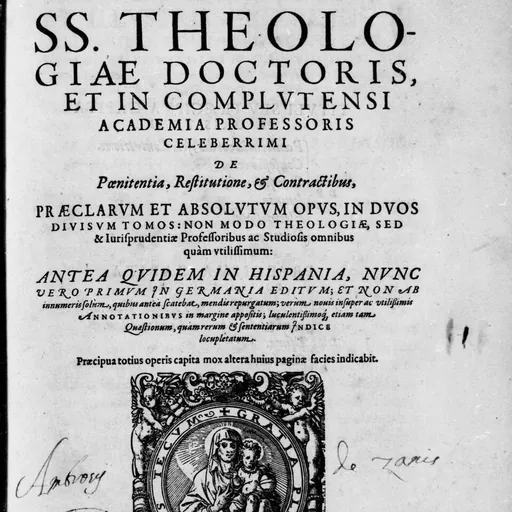
About Juan de Medina
Lived 1490 – 1547 (aged 56–57). Juan de Medina was a Spanish theologian and religious.
Juan de Medina (1490–1547) was a Spanish theologian and Spain's ambassador to Rome. Although he is repeatedly quoted and praised by several theologians of his time, little was written about his life.
Life
He was born at Medina de Pomar in the Province of Burgos (rather than Alcalá, as some writers state).
He entered the College of St. Ildefonsus at Alcalá, on 20 May 1516, took doctor's degrees in philosophy and theology, and soon after was made canon and master of theology at the university. He was selected as primary professor of theology in the College of St. Ildefonsus in succession to Michael Carasco, whom Cardinal Ximenes wished to be made perpetual Rector of the College. From about 1526 and for the space of twenty years, Medina filled this position.
Alvarez Gomez and Andrea Schott state that Medina was buried in the church of St. Ildefonsus. The first lines of the epitaph on his tomb are:
Complutense decus jacet hic, attente viator Ter tumultum lustra, ter pia thura crema Hoc moriente silet vox, qua non clarior unquam Compluti fulsit, nec fuit illa.
Works
Medina's works are principally on moral theology and ethics. Some of his opinions were not in accordance with the doctrine propounded at the Council of Trent. The "Diccionario Enciclop. Hispano Americano" says that his treatise "de Poenitientia" was put on the Index published in 1707; the edition of the Index printed in 1711 does not give Medina's work, nor does any of the subsequent editions. The Council of Trent declares that at the hour of death there is no "reservatio" and that all priests can absolve "in articulo mortis". Medina says "that absolution given by an excommunicated priest is invalid"; and again, "at a time of necessity (arliculo necessitatis) any priest, not suspended or excommunicated, can absolve any person". His opinions on the "materia" for sacramental absolution, and on the "Copia confessariorum" seem opposed to the teaching of the council on these points.
Many editions of Medina's works were printed in the fifteenth and sixteenth centuries. His brother John de Medina brought out the theological books at Alcalá in 1544 and sqq.; Salamanca, 1555; Ingolstadt, 1581; Brescia, 1590–1606; Cologne, 1607 etc.
Don’t just read it —
keep it.
Full-length biographies made to live with: read them, listen on the way to work, watch them tonight.
- E-book
- Audio
- Video
Instant download · yours to keep · every purchase keeps this site free
Important facts
Related people
Same field, nearest in time




Contemporaries
People whose lives overlapped Juan de Medina's






Frequently asked questions
Who was Juan de Medina?
Spanish theologian (1490-1547)
When was Juan de Medina born?
Juan de Medina was born in 1490 in Medina de Pomar.
When did Juan de Medina die?
Juan de Medina died in 1547 in Alcalá de Henares.
What was Juan de Medina's occupation?
Juan de Medina was a theologian and religious.
What nationality was Juan de Medina?
Juan de Medina was Spanish.
Sources & further reading
Cite this page
APA: Biography.guide. (2026). Juan de Medina. https://biography.guide/juan-de-medina/
MLA: "Juan de Medina." Biography.guide, https://biography.guide/juan-de-medina/.
Chicago: "Juan de Medina." Biography.guide. https://biography.guide/juan-de-medina/.
Data last updated: 2026-09-21 · Spot an error? Report a correction.
Portrait: Wikimedia Commons · author & licence
Page generated 2026-09-27 05:00 UTC