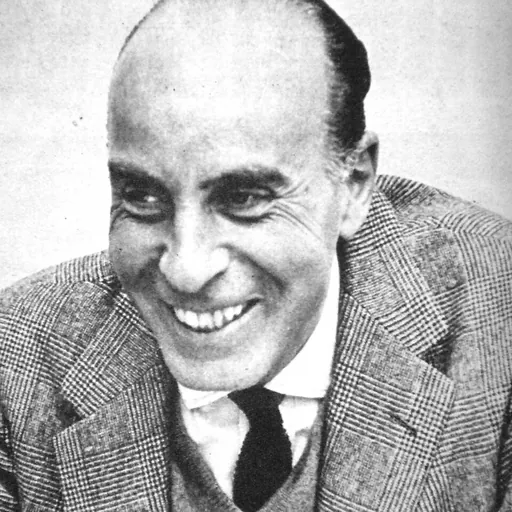
About Juan Carlos Colombres
Lived 1923 – 2017 (aged 94). Juan Carlos Colombres was an Argentine journalist, painter, caricaturist, editorial cartoonist, cartoonist and comics artist.
Juan Carlos Colombres (January 19, 1923 – July 6, 2017) was an Argentine caricaturist and humorist whose work has illustrated articles and editorials in a number of the nation's leading periodicals. His contributions appear under the byline of Landrú.
Biography Colombres was born in Buenos Aires in 1923. His father's family were prominent in Tucumán Province, where in 1821 Bishop José Colombres introduced sugarcane. He took an early interest in both drawing and irony, and in 1939, created Génesis Novísimo, his illustrated alternative to the Book of Genesis. He began his career in journalism in 1945 as a commentator and editorial cartoonist for Don Fulgencio, directed at the time by Lino Palacio. He also became a frequent contributor to other comic books, including Dante Quinterno's regionalist Patoruzú and Guillermo Divito's Rico Tipo ("Rich Guy"). Colombres married the former Margarita Miche in 1946, and they had two children.
Colombres joined Jorge Palacio (Lino Palacio's son) in a recently established satirical magazine, Cascabel ("Rattle"), in 1947. Cascabel became known for its daring political humor during an era of growing press censorship in Argentina, and in particular for Colombres' parodies of high-powered figures in business and government. Perhaps the best-known were his depictions of President Juan Perón, who was portrayed in full military regalia and a large pear for a head. The pun, which played on the similarity between the name Perón and the Spanish word pera, prompted Jorge Palacio (who wrote under the pen name of Faruk) to urge Colombres to also adopt a pseudonym. Asked for suggestions by Colombres, Palacio remarked that the satirist, who at the time wore a goatee, resembled the French serial killer Henri Désiré Landru ("Bluebeard," or as he is known in Argentina: "Landrú"). Extending his satirical reach beyond print, he also led Jacinto W. y sus Tururú Serenaders, a 1958 musical group created as a parody of the Doo-wop ensembles popular at the time. He established a satirical publication, Tía Vicenta, with fellow caricaturist Oski in 1957. The shuttered magazine returned in a less successful version as Tío Landrú from 1967 to 1969,
Don’t just read it —
keep it.
Full-length biographies made to live with: read them, listen on the way to work, watch them tonight.
- E-book
- Audio
- Video
Instant download · yours to keep · every purchase keeps this site free
Important facts
People in Juan Carlos Colombres's life
Named in this biography and alive at the same time




Related people
Same field, nearest in time




Contemporaries
People whose lives overlapped Juan Carlos Colombres's

Frequently asked questions
Who was Juan Carlos Colombres?
Argentine comics artist (1923-2017)
When was Juan Carlos Colombres born?
Juan Carlos Colombres was born on 19 January 1923 in Buenos Aires.
When did Juan Carlos Colombres die?
Juan Carlos Colombres died on 6 July 2017 in Buenos Aires.
What was Juan Carlos Colombres's occupation?
Juan Carlos Colombres was a journalist, painter, caricaturist, editorial cartoonist, cartoonist and comics artist.
What nationality was Juan Carlos Colombres?
Juan Carlos Colombres was Argentine.
Sources & further reading
· Wikipedia: Juan Carlos Colombres
Cite this page
APA: Biography.guide. (2026). Juan Carlos Colombres. https://biography.guide/juan-carlos-colombres/
MLA: "Juan Carlos Colombres." Biography.guide, https://biography.guide/juan-carlos-colombres/.
Chicago: "Juan Carlos Colombres." Biography.guide. https://biography.guide/juan-carlos-colombres/.
Data last updated: 2026-09-20 · Spot an error? Report a correction.
Portrait: Wikimedia Commons · author & licence
Page generated 2026-09-27 04:58 UTC