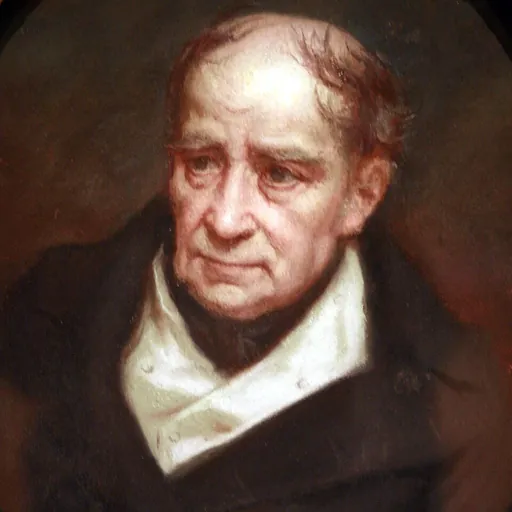
About Józef Maria Hoene-Wroński
Lived 1776 – 1853 (aged 76). Józef Maria Hoene-Wroński was a French, Russian and Polish mathematician, philosopher, economist and military personnel.
Józef Maria Hoene-Wroński (; ; ; 23 August 1776 – 9 August 1853) was a Polish messianist philosopher, mathematician, physicist, inventor, lawyer, occultist and economist. Trained as an officer in the army of the Polish-Lithuanian Commonwealth, he participated in the Polish–Russian War of 1792 and the Kościuszko Uprising.
In mathematics, he is known for introducing a novel series expansion for a function in response to Joseph Louis Lagrange's use of infinite series. The coefficients in Wroński's new series form the Wronskian, a determinant Thomas Muir named in 1882. As an inventor, he is credited with designing some of the first caterpillar vehicles.
Life and work He was born as Hoëné in 1776 but changed his name in 1815 to Józef Wroński. Later in life he changed his name to Józef Maria Hoene-Wroński,
In 1810, he published the results of his scientific research in a massive tome, which he advocated as a new foundation for all of science and mathematics. His theories were strongly Pythagorean, holding numbers and their properties to be the fundamental underpinning of essentially everything in the universe. His claims were met with little acceptance, and his research and theories were generally dismissed as grandiose rubbish. His earlier correspondence with major figures meant that his writings garnered more attention than a typical crackpot theory, even earning a review from the great mathematician Joseph Louis Lagrange (which turned out to be categorically unfavorable). In the ensuing controversy, he was forced to leave the observatory.
He immediately turned his focus towards applying philosophy to mathematics (his critics believed that this meant dispensing with mathematical rigor in favor of generalities). In 1812, he published a paper purporting to show that every equation has an algebraic solution, directly contradicting results which had been recently published by Paolo Ruffini; Ruffini turned out to be correct.
He later turned his attention to disparate and largely unsuccessful pursuits such as a fantastical design for caterpillar-like vehicles which he intended to replace railroad transportation, but did not manage to persuade anyone to give the design serious attention. In 1819, he travelled to England in an attempt to obtain financial backing from the Board of Longitude to build a device to determine longitude at sea. After initial difficulties, he was given an opportunity to address the Board, but his pretentious address, On the Longitude, contained much philosophizing and generalities, but no concrete plans for a working device, and thus failed to gain any support from the Board. He remained for several years in England and, in 1821, published an introductory text on mathematics in London, which moderately improved his financial situation.
In 1822, he returned to France, and again took up a combination of mathematics and far-fetched ideas, despite being in poverty and scorned by intellectual society. Along with his continuing Pythagorean obsession, he spent much time working on several notoriously futile endeavors, including attempts to build a perpetual motion machine, to square the circle and to build a machine to predict the future (which he dubbed the prognometre). In 1852, shortly before his death, he did find a willing audience for his ideas: the occultist Eliphas Levi who met Wroński and was greatly impressed and "attracted by his religious and scientific utopianism." Wroński was "a powerful catalyst" for Levi's occultism. 1803 - Philosophie critique découverte par Kant, fondée sur le dernier principe du savoir, par J. Hoehne 1811 - Introduction à la philosophie des mathématiques, et technie de l'algorithmie, par M. Hoëné de Wronski 1811 - Programme du cours de philosophie transcendantale, par M. Hoëné Wronski 1812 - Résolution générale des équations de tous les degrés], par Hoëné Wronski 1812 - Réfutation de la théorie des fonctions analytiques de Lagrange, par Hoëné Wronski 1814 - Philosophie de l'Infini, par Hoëné Wronski 1818 - Introduction à un ouvrage intitulé Le Sphinx, ou la Nomothétique séhélienne, par Hoëné Wronski 1821 - A Course of mathematics, by Höené Wronski. Translated from the original French under the inspection of the author. London, 1821. 1827 - Canons de logarithmes de H. W. 1828 - Loi téléologique du hasard. Deuxième aperçu. Signé : Hoëné Wronski. Paris, le 13 avril 1828. 1831 - Messianisme, union finale de la philosophie et de la religion constituant la philosophie absolue (1831-1839) 1831 - Prodrome du Messianisme; Révélation des destinées de l’humanité 1832 - Réflexions philosophiques sur un miroir parabolique 1833 - Loi téléologique du Hasard: réimpression de trois pièces rarissimes (1833); précédée d'une autobiographie et d'un inventaire de l'œuvre Hoëné Wronski 1833 - Resolution of equation polynomials of tous les degries (in anglishe) 1837 - Rails mobiles, ou chemins de fer mouvans, de Hoëné Wroński 1840 - Secret politique de Napoléon comme base de l'avenir moral du monde, par Hoëné Wronski 1844 - Urgente réforme des Chemins de fer et de toute la locomotion terrestre, par Hoëné Wronski 1853 - Secret politique de Napoléon, par Hoëné Wronski, comme introduction à sa récente "Philosophie de l'histoire". Nouvelle édition
Letters 1851 - Épître à Sa Majesté l'Empereur de Russie, pour compléter les "Cent pages décisives", et pour accomplir la réforme de la mécanique céleste". Signé : Hoëné Wroński. Metz, 1851 1851 - Épitre secrète a Son Altesse le prince Louis-Napoléon président de la République Française sur les destinées de la France
Don’t just read it —
keep it.
Full-length biographies made to live with: read them, listen on the way to work, watch them tonight.
- E-book
- Audio
- Video
Instant download · yours to keep · every purchase keeps this site free
Important facts
People in Józef Maria Hoene-Wroński's life
Named in this biography and alive at the same time


Related people
Same field, nearest in time




Contemporaries
People whose lives overlapped Józef Maria Hoene-Wroński's




Frequently asked questions
Who was Józef Maria Hoene-Wroński?
Polish philosopher
When was Józef Maria Hoene-Wroński born?
Józef Maria Hoene-Wroński was born on 23 August 1776 in Wolsztyn.
When did Józef Maria Hoene-Wroński die?
Józef Maria Hoene-Wroński died on 8 August 1853 in Paris.
What was Józef Maria Hoene-Wroński's occupation?
Józef Maria Hoene-Wroński was a mathematician, philosopher, economist and military personnel.
What nationality was Józef Maria Hoene-Wroński?
Józef Maria Hoene-Wroński was French, Russian and Polish.
Sources & further reading
· Wikipedia: Józef Maria Hoene-Wroński
· DBpedia: Józef Maria Hoene-Wroński
Cite this page
APA: Biography.guide. (2026). Józef Maria Hoene-Wroński. https://biography.guide/jozef-maria-hoene-wronski/
MLA: "Józef Maria Hoene-Wroński." Biography.guide, https://biography.guide/jozef-maria-hoene-wronski/.
Chicago: "Józef Maria Hoene-Wroński." Biography.guide. https://biography.guide/jozef-maria-hoene-wronski/.
Data last updated: 2026-09-22 · Spot an error? Report a correction.
Portrait: Wikimedia Commons · author & licence
Page generated 2026-09-27 05:03 UTC