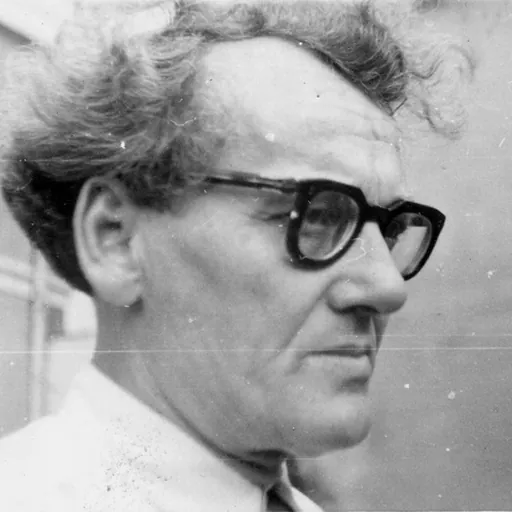
About Józef Gosławski
Lived 1908 – 1963 (aged 54). Józef Gosławski was a Polish caricaturist, sculptor, designer and medalist.
Józef Jan Gosławski (24 April 1908 – 23 January 1963) was a Polish sculptor and medallic artist. He was a designer of coins (e.g. 5 zł with fisherman), monuments (e.g. Frédéric Chopin in Żelazowa Wola) and medals (e.g. Year 1939). Laureate of many artistic competitions; decorated with the Silver Cross of Merit.
Biography
Józef Gosławski was born in Polanówka, in the Lublin Governorate of Congress Poland, but was brought up Wąwolnica with his parents, two brothers (including younger brother Stanisław Gosławski, who also became a sculptor) and two sisters. He began his artistic education in the Building Crafts School founded by Jan Koszczyc-Witkiewicz in Kazimierz Dolny. After finishing at this school, he passed an exam to the Academy of Fine Arts in Kraków, but he was too young to begin studies. He continued his education in the National Decorative Arts and Artistic Industry School in Kraków. He was influenced by Stanisław Szukalski, but he wasn't a member of the Horned Heart Tribe.
In 1932, he finally began studies at the Academy of Fine Arts in Kraków, where he was taught by professor Xawery Dunikowski. Then he moved to Warsaw, where he was taught by professor Tadeusz Breyer. He was awarded a scholarship to study in Rome, where he graduated from the Royal Academy of Fine Arts in 1937 (he was taught by Angelo Zanelli). During his stay in the Italy, which ended in 1939, he took part in exhibitions of the Kapitol – a society of Polish artists. He also served as the society's vice chairman.
He returned to Poland in July 1939 to become a conservator of the Royal Castle in Warsaw. He did not fill this position due to the beginning of the Second World War. He spent the occupation years in Wąwolnica. After the end of the war, he renovated, among others, a 17th-century house under St. Nicolaus in Kazimierz Dolny.
He held the Medal and Metal Sculpture Chair in the National Artistic School in Poznań from 1947, and was the chairman of Poznań district of the Association of Polish Artists and Designers (ZPAP) for two terms of office. Married to his student Wanda Mankin in 1948, he had two daughters: Bożena Stefania and Maria Anna. He moved with his family to Warsaw in 1956, where he became a chairman of Sculpture Department of ZPAP central board. He died suddenly in Warsaw in 1963 at the beginning of a new artistic phase.
Art
Józef Gosławski was the creator of numerous monuments and portrait sculptures, sculpture caricatures, medals, coins, renovations and drawings. His early works, generally not conserved, show some influence of cubism (Self-portrait - 1932–1933, Portrait of Witold Chomicz - 1927–1928), Szukalski's ideas (sculpture caricature of Henryk Uziembło), as well as forms similar to ideas of the Polish Applied Art Society (design of the St. Franciscus altar). His stay in Italy and a direct contact with its art changed Gosławski's point of view – the portraits of Robert, Maria Maro, and the Sicilian show a strong influence from his antique studies. This influence, combined with the Italian Renaissance impact, are also seen in the early medals and plaques created in Rome. The before-war works were nearly completely lost during their way back to Poland in August 1939 (there is a relation, whose author says about possibility of staying a part of works in Castello del Catajo ).
The years of Second World War were not lost in the terms of artistic activity. War conditions forced him to interest in small sculpture forms. The medals created in those years were mainly related to the martyrdom of the Polish nation.
After the war he continued his work in the field of medals. He was a precursor of the withdrawal from classic form and shape of medals. He became a lonely connection of the Konstanty Laszczka and Józef Aumiller generation with later medallists. His strong position in medallic arts is confirmed with numerous awards and purchases of his works to museums in Poland (e.g. Warsaw, Wrocław, Kraków, Lublin, Toruń) and in Europe (e.g. Prague, Athens, Budapest, Rome, Vatican City, Paris, The Hague, Moscow, Sankt Petersburg).
He returned to the monumental sculpture with the Adam Mickiewicz monument in Gorzów Wielkopolski, the Never war monument in Żabikowo (district of Luboń) near Poznań, a sculpture group called Music in Warsaw (MDM), and the Frédéric Chopin monument in Żelazowa Wola. He participated and won numerous contests for monument design, e.g. Heroes of Warsaw, Soldiers of I Army of People's Army of Poland and Bolesław Prus. He also created a monumental altar of the Transfiguration of Jesus in Masłów near Kielce.
Józef Gosławski's works are difficult to classify. Constant prospecting and an artistic anxiety lead him to create in the different forms and materials. But the main focus of his art was always a human being - as a hero and in everyday life. Gosławski was modest and friendly, even his caricatures, the art type very rare among sculptors, are featured with benignant sense of humour rather than malice.
He was honoured with 14 individual exhibitions, and his works were presented on over 60 domestic (in Poland) and over 20 abroad exhibitions.
Participation in artistic competitions Year Topic of competition Comments 1936 Bust of Józef Piłsudski First prize; sculpture created 1938–39, now at National Museum, Warsaw; a cast is at Turek Museum 1946/47 National emblem Second prize 1951 Sculptures for Constitution Square, Warsaw Three multi-figure sculptural groups including Music, on building at Koszykowa Street 34/50, Warsaw 1951 GKKF badge First prize 1951 State Award medal First prize 1953 Lublin monument to [World War II] partisans Model stored at unknown site 1953 Lublin triumphal arch Model stored at unknown site 1953 Medal commemorating 500th anniversary of return of Gdańsk to Poland In the holdings of Lublin Province Museum; National Museum, Poznań; Museum of Metal Engraving Arts; Royal Castle, Warsaw; Ossolineum; and private collections 1955 Adam Mickiewicz monument, Poznań Model, in private collections 1957 Monument to victims of Auschwitz concentration camp Model stored at unknown site 1958 Coins 10 złotych: Mieszko and Dobrawa; first prize. The coin was struck in 1966 as a 100-złotych silver commemorative coin for the millennium of Polish statehood
10 złotych: Nicolaus Copernicus. The coin was placed in circulation in 1959
5 zł - The Waryński Vessel - favouritism
5 zł - The Fisherman - favouritism. The coin was put into circulation in 1958
2 zł - The Cockerels - second prize
2 zł - The Elk - favouritism
2 zł - the reverse of coin with an image of eagle - second prize 1958 The monument of Heroes of Warsaw (I stage) Unknown place of storing the first model; the second one in collections of Historical Museum of Warsaw 1958 The medal of XV-anniversary of The People's Army of Poland First, second and third prize 1959 The monument of Heroes of Warsaw (II stage) First prize (one of six); the model was made in cooperation with Wanda Gosławska and Stanisław Gosławski; nowadays the model in collections of Historical Museum of Warsaw 1959/1960 The monument of First Army The model was made in cooperation with Wanda Gosławska and Stanisław Gosławski. Unknown place of storing the model 1961 Juliusz Słowacki monument in Warsaw The first model in collections of Museum of Metal Engraving Arts in Wrocław, the second one in private collections 1962 The monument of murdered Jews in Lublin The model of monument Flaming ghetto (Polish: Płonące getto) in private collections 1962 Bolesław Prus monument in Warsaw Two honorable mentions; one of models was made in cooperation with Wanda Gosławska; the first model in private collections, the second one in collections of Museum of Metal Engraving Arts in Wrocław
List of solo exhibits
Year City Institution Number of works 1933 Kraków Palace of Arts ? 1960 Budapest Ośrodek Kultury Polskiej 30 1963 Warsaw Dom Wojska Polskiego 49 1968 Wrocław Townhall 80 1973 Warsaw Centralne Biuro Wystaw Artystycznych 343 1974 Warsaw Galeria Wojskowa DWP 34 1974 Warka Muzeum im. Kazimierza Pułaskiego 56 1974 Bydgoszcz Regional Museum 18 1987 Lublin Regional Museum 76 1995 Kazimierz Dolny Muzeum Nadwiślańskie - Galeria Letnia 80 1996 Bolesławiec Bolesławiecki Ośrodek Kultury 70 1997 Chełmno Regional Museum 50 2000 Konin Regional Museum 84 2003 Warsaw Galeria Domu Artysty Plastyka 105 2014 Orońsko Polish Sculpture Center ? 2014/2015 Warsaw Sculpture Museum in Rabbitery ?
Selected group exhibits
Domestic Year City Title of exhibition 1946 Lublin The Festival of Arts 1947 Kraków The II Nationwide Winter Salon 1949 Warsaw Artists in the struggle for peace 1950 Warsaw The I Nationwide Exhibition of Plastic Arts 1951/1952 Warsaw The II Nationwide Exhibition of Plastic Arts 1953 Warsaw 10 years of People's Army of Poland 1953 Lublin The Exhibition of models of the triumphal arch for Lublin 1954 Warsaw The IV Nationwide exhibition of Plastic Arts 1955 Poznań The Exhibition of Poznań District of Association of Polish Artists and Designers 1955 Poznań The Autumn Exhibition of Poznań District of Association of Polish Artists and Designers 1958/1959 Warsaw The Warsaw Sculpture 1945–1958 1959 Warsaw Warsaw in contemporary art 1959 Warsaw The II Nationwide Exhibition of Maritime Art 1960 Warsaw The Polish Sculpture 1945–1960 1961/1962 Warsaw Polish Work of Art of 15-anniversary of People's Republic of Poland 1962 Lublin Martyrdom and struggle of Polish Nation 1939–45 1962 Poznań The Autumn Salon 1963 Warsaw The Nationwide Exhibition of 20-anniversary of People's Army of Poland in Plastic Arts 1963 Warsaw The I Nationwide Exhibition of Medallic Art 1963 Warsaw Warsaw in Art 1963 Warsaw The Exhibition in XVIII anniversary of liberation of Auschwitz 1963 Warsaw The Exhibition of Applied Art in XV-anniversary of People's Republic of Poland 1963 Warsaw The Exhibition of sculptures and textiles of Warsaw District of Association of Polish Artists and Designers 1964 Warsaw Warsaw in Art 1964 Warsaw The Nationwide Exhibition "Textile, ceramic, glass" 1965 Warsaw The Exhibition of old master print and sculpture in XX-anniversary of People's Republic of Poland 1965 Toruń Decorations, coins and medal of People's Republic of Poland 1966 Wrocław Medallic art in People's Poland 1945–1965 1969 Warsaw 25-anniversary of medallic art in Poland 1969 Wrocław The Exhibition of ceramic and glass in XXV-anniversary of People's Republic of Poland 1969/1970 Bydgoszcz The medals of People's Republic of Poland 1969/1970 Warsaw 25 years of Warsaw sculpture 1970 Poznań The war and peace in plastic art 1971 Wrocław Monuments and monumental sculpture in People's Republic of Poland 1971 Toruń Nicolaus Copernicus's topic in medallic art and numismatics 1971 Bydgoszcz Polish cities in the medals 1972 Wrocław Polish medical medals and badges 1972 Bydgoszcz The women in the medallic art 1972 Bydgoszcz Famous Poles on the medals 1974 Lublin Review of Polish sculpture 1944–74 1974 Radom Contemporary portrait sculpture 1974 Bydgoszcz The sports medals 1974 Bydgoszcz The medals of Polish museums 1974 Bydgoszcz Polish cities in the medals 1977 Bydgoszcz Coins of People's Republic of Poland 1977 Bydgoszcz The people of theatre in medallic art 1977 Częstochowa The exhibition of Polish postwar coins (Polish: Wystawa polskich monet powojennych) 1979 Wrocław Contemporary Polish medallic art 1944–1979 1979/1980 Bydgoszcz The Polish writers on the medals 1980 Bydgoszcz Traditions of the Polish army 1980 Bydgoszcz The women in the medallic art 1980 Warsaw The Polish science in the medals 1985/1986 Bydgoszcz Money of People's Poland 1944–1983 1986 Lublin Lublin plastic art 1986 Ostrołęka Commemorative medals of Polish museums 1987 Bydgoszcz The women on the medal 1988 Tuchola The jubilee medals of Polish cities 1990 Bydgoszcz Frédéric Chopin and the people of his epoch 1996 Bydgoszcz Remarkable Poles on the medals 1997 Warsaw Tadeusz Breyer and his students 1997 Wrocław The Polish sculpture 1998/1999 Warsaw The time tunnel. Warsaw sculpture of the end of the century 2002 Warsaw Polish science in medallic art 2007/2008 Bydgoszcz Pharmacy and medicine in medallic art 2008 Warsaw The present absent 2009 Toruń Nicolaus Copernicus in medallic art 2009 Bydgoszcz Polish museums in medallic art. From collections of the Leon Wyczółkowski District Museum in Bydgoszcz 2010 Wrocław 2010/2011 Warsaw 2011 Warsaw 2011 Warsaw 2012 Warsaw
External Year State City Title of exhibition Institution 1932 Vienna The International Exhibition of Caricatures (Polish: Międzynarodowa Wystawa Karykatury) Vienna Künstlerhaus 1936 22px Italy Rome The Exhibition of Association of Artists - "The Capitol" (Polish: Wystawa Koła Artystów Polskich "Kapitol") ? 1936 22px Italy Rome The Exhibition of Association of Artists - "The Capitol" (Polish: Wystawa Koła Artystów Polskich "Kapitol") ? 1950 Prague The World Exhibition of Medallic Art (Polish: Światowa Wystawa Medalierstwa) ? 1950 Rome The exhibition of sacred art (Polish: Wystawa sztuki sakralnej) ? 1959 Catania Circolo Artistico ? 1959 Vienna The International Exhibition of Contemporary Medals (Polish: Międzynarodowa Wystawa Medali Współczesnych) ? 1963/1964 Moscow-Minsk The International at the 20. anniversary of The Great Patriotic War (Polish: Wystawa w 20. rocznicę Wielkiej Wojny Ojczyźnianej) ? 1964 Arezzo The International Competition of Medallic Art (Polish: Międzynarodowy Konkurs Medalierstwa) ? 1965 Berlin-Erfurt-Leipzig The soldiers of the nation - the Polish army in the art (Polish: Żołnierze narodu - polska armia w sztuce) ? 1966 Kralupe The international exhibition of medals
(Polish: Wojsko polskie w służbie ludowej obronności) ? 1967 Travellingexhibition ? ? 1967 Paris The XXVII Salon of The Sacred Art (Polish: XXVII Salon Sztuki Sakralnej) ? 1968 Moscow The social-revolutionary topics in Polish fine arts
(Polish: Międzynarodowa Wojskowa Wystawa Plastyki) ? 1971 Paris The 50 years of the medallic art in Poland (Polish: 50 lat sztuki medalierskiej w Polsce) ? 1971 The Hague The exhibition of Polish medals (Polish: Wystawa medali polskich) ? 1972 Berlin The war and peace in the arts of People's Republic of Poland (Polish: Wojna i pokój w sztukach plastycznych PRL) ? 1985 Prague The Polish contemporary medallic art (Polish: Polskie medalierstwo współczesne) ? 2003 Vienna The New State. Polish Art between Experiment and Representation 1918–1939 (Polish: Nowe Państwo. Polska sztuka między eksperymentem a reprezentacją 1918–1939, German: Der neue Staat. Polnische Kunst zwischen Experiment und Repräsentation von 1918 bis 1939) Leopold Museum
Inspirations The memory of Józef Gosławski and his works, especially medals, is remembered not only on the occasion of exhibitions. In December 2008 Polish Mint emitted local currency of Lidzbark Warmiński. It was a ducat Four men (Polish: Czterech mężów) whose observe based on Gosławski's medal Lidzbark Warmiński - The City of Great Men (Polish: Lidzbark Warmiński - miasto mężów znakomitych). In 2009 The Polish Mint produced a medal series Famous Medallists dedicated to Józef Gosławski. In this set there was, among others, the medal based on project made during Second World war, entitled Year 1939 - it was the first public presentation of it. The second medal (by Hanna Jelonek) presented an image of the artist (obverse) and Chopin's monument by Gosławski (reverse). Moreover, there is the one street dedicated to Józef Gosławski - it is located in Wąwolnica - the village where the artists lived and created many works for years.
Gallery
Don’t just read it —
keep it.
Full-length biographies made to live with: read them, listen on the way to work, watch them tonight.
- E-book
- Audio
- Video
Instant download · yours to keep · every purchase keeps this site free
Important facts
People in Józef Gosławski's life
Named in this biography and alive at the same time

Related people
Same field, nearest in time
Contemporaries
People whose lives overlapped Józef Gosławski's


Frequently asked questions
Who was Józef Gosławski?
Polish sculptor and medallic artist (1908–1963)
When was Józef Gosławski born?
Józef Gosławski was born on 24 April 1908 in Polanówka.
When did Józef Gosławski die?
Józef Gosławski died on 23 January 1963 in Warsaw.
What was Józef Gosławski's occupation?
Józef Gosławski was a caricaturist, sculptor, designer and medalist.
What nationality was Józef Gosławski?
Józef Gosławski was Polish.
Sources & further reading
· DBpedia: Józef Gosławski (sculptor)
Cite this page
APA: Biography.guide. (2026). Józef Gosławski. https://biography.guide/jozef-goslawski-caricaturist/
MLA: "Józef Gosławski." Biography.guide, https://biography.guide/jozef-goslawski-caricaturist/.
Chicago: "Józef Gosławski." Biography.guide. https://biography.guide/jozef-goslawski-caricaturist/.
Data last updated: 2026-10-02 · Spot an error? Report a correction.
Portrait: Wikimedia Commons · author & licence
Page generated 2026-10-04 09:31 UTC