
Joshua Young
Abolitionist Congregational Unitarian minister
About Joshua Young
Lived 1823 – 1904 (aged 80).
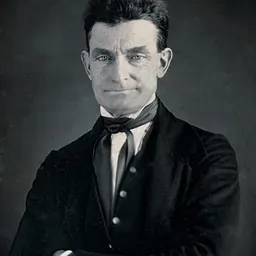
Joshua Young (September 23, 1823 – February 7, 1904) was an abolitionist Congregational Unitarian minister who crossed paths with many famous people of the mid-19th century. He received national publicity and lost his pulpit for presiding in 1859 over the funeral of John Brown, the first person executed for treason by a U.S. state. Contrary to his friends' expectations, his resignation under pressure in Burlington did not ruin his career; the church in Burlington later apologized and invited him back to speak
Young was also deaf. Abraham Willard Jackson, a contemporary Unitarian Preacher and deaf man said about Young, "In a Massachusetts village there toils a minister, and for more than a quarter of a century has toiled, though his deafness is so extreme that speech with him is scarcely possible, who once told me that in all these years no unpleasant reminder of his infirmity, either by act or word, had ever come to him from his people... I cannot think I need hesitate to say that my reference here is to Rev. Joshua Young, of Groton. With this testimony before them, all deaf people should pray for the prosperity of his church."
Life and career Young was born in 1823 in Randolph, near Pittston, Maine, the youngest of eleven children of Aaron Young and Mary Colburn Young. He described himself as a "Garrisonian abolitionist". Their children were: Mary Elizabeth Young Stevens (1849–1891), Lucy F. Young (1854–1922), Dr. Joshua Edson Young of Medford, Massachusetts (1856–1940), Henry Guy Young of Winchester, Massachusetts (1865–1936), and Mrs. Grace D. Patton of Bangor, Maine.
He held the following positions as minister:
1849–1852 New North Church, Boston. 1852–1862 First Congregational (Unitarian) Church, Burlington, Vermont. His salary was $1,000. He was also Superintendent of Common Schools in Burlington. He resigned these positions in 1862. There followed a year in Deerfield [Massachusetts]. another $1,500 . Between this position and the following one in Fall River he travelled to Egypt, the Holy Land, and Europe. 1868–1875 Unitarian Church, Fall River, Massachusetts. 1875–1904 First Parish Meeting House, Groton, Massachusetts.
Young died in 1904 in Winchester, Massachusetts, at the home of his son.
Young and slavery Young described himself as "bred in the Garrisonian school of abolitionists".
Young was also "a station-keeper on the Underground Railroad when the blow at Harper's Ferry shook the whole nation like an earthquake". Another source says that about 1850 fugitives appeared daily, and sometimes more than one a day, but then dropped to two or three a fortnight.
The John Brown funeral The most significant event of Young's life, in his own judgment, was his participation in the funeral of abolitionist John Brown, the consequences of which participation surprised and pained him. He often spoke about it and, as an old man, he wrote up his experience at length.
Brown was executed by the Commonwealth of Virginia on December 2, 1859, after his conviction for murder, treason, and inciting a slave insurrection. Young had never met Brown, but when his abolitionist friend Lucius G. Bigelow informed him that John Brown's body was passing through Rutland en route to be buried at his home in North Elba, New York, only away across Lake Champlain, they decided to attend. As the body was being lowered into the grave he felt moved to recite words of the apostle Paul: "I have fought a good fight. I have finished my course. I have kept the faith" (2 Timothy 4:7).
When he returned to Burlington, he found himself savagely attacked in the local paper. He was socially ostracized and snubbed and prominent members of his church resigned. Young said he was the victim of persecution.
He was told that he would never again be permitted to occupy a pulpit.
In a 2016 sermon on Young, Rev. Karen G. Johnston says, without explanation, "that there is dispute between Young's account, and that of the Burlington church, about what led to his leaving."
Reburials in 1899
Young presided over the 1899 ceremony in which ten of Brown's men, which had been buried elsewhere, eight of them thrown into two packing crates, were reburied next to John Brown's grave.
Publications
Legacy Folk singer Pete Sutherland based a 1997 song, "A Crown of Righteousness”, on a sermon by Young.
Don’t just read it —
keep it.
Full-length biographies made to live with: read them, listen on the way to work, watch them tonight.
- E-book
- Audio
- Video
Instant download · yours to keep · every purchase keeps this site free
Important facts
People in Joshua Young's life
Named in this biography and alive at the same time

Contemporaries
People whose lives overlapped Joshua Young's





Frequently asked questions
Who was Joshua Young?
abolitionist Congregational Unitarian minister
When was Joshua Young born?
Joshua Young was born on 23 September 1823.
When did Joshua Young die?
Joshua Young died on 7 February 1904.
What was Joshua Young known for?
Joshua Young was known for John Brown (abolitionist).
Sources & further reading
Cite this page
APA: Biography.guide. (2026). Joshua Young. https://biography.guide/joshua-young/
MLA: "Joshua Young." Biography.guide, https://biography.guide/joshua-young/.
Chicago: "Joshua Young." Biography.guide. https://biography.guide/joshua-young/.
Data last updated: 2026-09-22 · Spot an error? Report a correction.
Page generated 2026-09-27 05:01 UTC