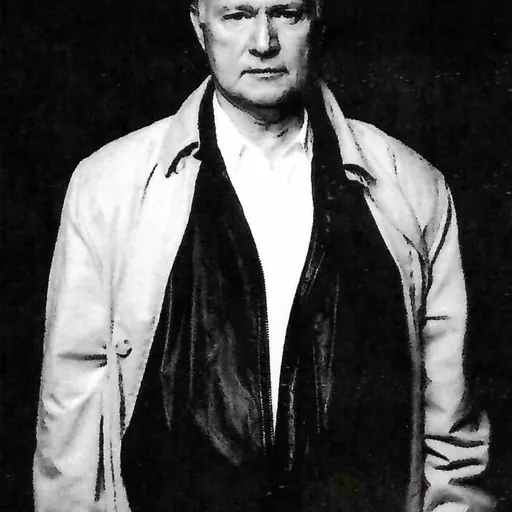
About Joseph Glasco
Lived 1925 – 1996 (aged 71). Joseph Glasco was an American painter, sculptor and painting.
Joseph Glasco (January 19, 1925 – May 31, 1996) was an American abstract expressionist painter, draftsman and sculptor. He is most known for his early figurative drawings and paintings and in later years for deconstructing the figure to develop his non-objective paintings building on abstraction of the 1950s.
Formative years (1925–1949) Joseph Glasco was born in Pauls Valley, Oklahoma in 1925 and grew up in Tyler, Texas. His parents were Lowell and Pauline Glasco. He had three brothers, Gregory, Gordon, Michael, and two sisters, Anne Brawley and Marion Chambers (married to oil executive C. Fred Chambers).
He was sent to boarding school in St. Louis where he pursued his interest in art and subsequently attended the University of Texas at Austin. Glasco became a decorated soldier from his service as a Private first class in Patton's 3rd Army in the Battle of the Bulge where he earned a Bronze Star Medal.
New York City (1949-1960) In 1949, Glasco arrived in New York City and attended the Art Students League of New York and the art theory of Hans Hofmann. His work "Big Sitting Cat" was purchased for the permanent collection of The Museum of Modern Art when the museum acquired his drawing in 1949. Another important collector of Glasco's paintings and sculptures was Joseph Hirshhorn. The Smithsonian Institution established the Joseph H. Hirshhorn Museum and Sculpture Garden in Washington, D.C., in 1966 to hold the collection of over 6,000 works including Glasco's paintings and sculptures. But while Pollock had been a critical influence on Glasco during his nascent years in New York, Glasco's early paintings stood apart from the Abstract Expressionist movement which was gaining momentum and attracting national and even international recognition. Instead, as Abstract Expressionism was exploding around him, Glasco's remained steadfast with work that was distinctly figurative, densely worked, and formal in style.
While his conversations with Pollock remained important to Glasco throughout his lifetime, it was, in fact, Ossorio and Dubuffet and not Pollock who likely provided the early catalyst for change in Glasco's work as it became more textural and abstract. and made the acquaintance of Frieda Lawrence (widow of D.H. Lawrence) who would be another pivotal influence on his life and work. and after a concentrated period creating sculpture in Taos, Glasco decamped again to the East Coast and England where he had made influential acquaintances among the London theater crowd.
It is believed that Glasco may have known gotten to know of Cy Twombly through the artist Afro Balsaldella while Glasco and Afro were in Mykonos in 1961. However, it's also possible they knew each other earlier through their connection with the Art Students League in New York. Later, Glasco said that he and Twombly saw each every summer in Mykonos for years.
Glasco's new and innovative approach to painting began to take precedence. As he advanced his unique approach to painting, he returned to New York and established a studio in Soho which allowed him to make more work and renew his involvement in the New York art world. This resulted in two exhibitions at Gimpel & Weitzenhoff Gallery on Madison Avenue in 1979 and 1983. After his second one-person show at Gimpel, Glasco returned to work in his Galveston loft with frequent forays to New York. In Galveston, Glasco became acquainted with Julian Schnabel, a young artist who graduated from the University of Houston, moved to New York, and returned to Houston temporarily. Schnabel visited an artist with a loft adjacent to Glasco's on The Strand, Galveston's bustling main street. After the two became acquainted, while decades apart in age, Schnabel and Glasco recognized their artistic and intellectual kindred spirits and became fast friends. Glasco often traveled with Schnabel and his family and they discussed each other's work, and advised on the installation of each other's exhibitions. It became an important relationship to both artists which continued until Glasco's death.
After the 1986 retrospective, Joseph Glasco continued to work in his loft on The Strand and in the 19th Century Victorian house he purchased on Sealy Street in Galveston's historic district. Glasco was often visited by an array of locals, family members, and many out-of-town visitors such as Schnabel and the artist George Condo with whom he had become friends and remained close in his later years. His visitors included friends from all over the world including museum professionals and gallery owners such as Leslie Waddington of Waddington Galleries and Betty Moody, both of whom he would have exhibitions with in the late 1980s and 1990s.
Glasco continued to paint, and show his work nationally and internationally while traveling frequently to Europe, India, Hong Kong, Japan, Malaysia, Nepal, Singapore and Thailand. in which, among others, Jasper Johns, Ellsworth Kelly, Joan Mitchell, Robert Rauschenberg, Julian Schnabel and Cy Twombly were also exhibited.
Several of Glasco's late works were purchased by leading museums including the Museum of Fine Arts, Houston, The Museum of Modern Art in New York, and other distinguished institutions.
Troubled by health issues late in his life, Glasco continued his work producing a significant body of paintings in the 1990s until his death in 1996. Glasco's final exhibition before his death, Joseph Glasco: A Celebration, took place in Galveston at the Galveston Arts Center. Glasco died on May 31, 1996, in Galveston, Texas.
Glasco's estate endowed the Joseph Glasco Charitable Foundation
Select museum collections At the time, Glasco was the youngest artist collected by The Museum of Modern Art in New York at the age of 25. Following this early success, Glasco's art was collected by many of the top museums in the United States including: Albright-Knox Art Gallery, Buffalo, New York; The Art Museum, Princeton University, Princeton, New Jersey; The Baltimore Museum of Art, Baltimore, Maryland; Brooklyn Museum, Brooklyn, New York; Corcoran Gallery of Art, Washington, D.C.; Dallas Museum of Art, Dallas, Texas; The Detroit Institute of Arts, Detroit, Michigan; Harvard Art Museums, Cambridge, Massachusetts; High Museum of Art, Atlanta, Georgia; Hirshhorn Museum and Sculpture Garden, Smithsonian Institution, Washington, D.C.; The Menil Collection; The Metropolitan Museum of Art, New York, New York; Museum of Fine Arts, Houston, Texas; The Museum of Modern Ar t, New York, New York; Solomon R. Guggenheim Museum, New York, New York; Whitney Museum of American Art, New York, New York; Yale University Art Gallery, New Haven, Connecticut.
Honors and awards
Mayor's Awards for Outstanding Contributions to the Arts, 1987, Houston Texas
Personal life Poet and poetry editor for The New Yorker, Howard Moss introduced Glasco to writer William Goyen and from 1952 to the early 1960s they were partners. In Clark Davis' biography of Goyen, It Starts With Trouble, Davis documents their relationship.
In addition to his many relationships with artists across several generations, Glasco's friendships and acquaintances extended to many other important figures of the time from art and art criticism, film, literature, music, opera, and theater including: Donald Baechler, Tallulah Bankhead, Samuel Barber, Paul Bowles, Jane Bowles, Dorothy Brett, Francesco Clemente, John Dexter, Mary Doyle, John Frankenheimer, Clement Greenberg, David Hockney, Margo Jones, Peter Lanyon, Frieda Lawrence, Giancarlo Menotti, Frank O'Hara, Vincent Price, Stephen Spender, Teresa Stratas, Elaine Stritch and Thornton Willis among many others.
Don’t just read it —
keep it.
Full-length biographies made to live with: read them, listen on the way to work, watch them tonight.
- E-book
- Audio
- Video
Instant download · yours to keep · every purchase keeps this site free
Important facts
People in Joseph Glasco's life
Named in this biography and alive at the same time








Related people
Same field, nearest in time

Contemporaries
People whose lives overlapped Joseph Glasco's



Frequently asked questions
Who was Joseph Glasco?
American abstract expressionist painter, draftsman and sculptor (1925–1996)
When was Joseph Glasco born?
Joseph Glasco was born on 19 January 1925 in Pauls Valley.
When did Joseph Glasco die?
Joseph Glasco died on 31 May 1996 in Galveston.
What was Joseph Glasco's occupation?
Joseph Glasco was a painter, sculptor and painting.
What nationality was Joseph Glasco?
Joseph Glasco was American.
Sources & further reading
Cite this page
APA: Biography.guide. (2026). Joseph Glasco. https://biography.guide/joseph-glasco/
MLA: "Joseph Glasco." Biography.guide, https://biography.guide/joseph-glasco/.
Chicago: "Joseph Glasco." Biography.guide. https://biography.guide/joseph-glasco/.
Data last updated: 2026-09-22 · Spot an error? Report a correction.
Portrait: Wikimedia Commons · author & licence
Page generated 2026-09-27 04:57 UTC