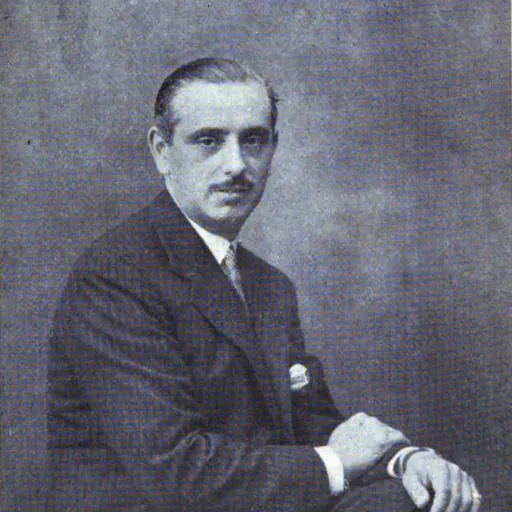
About José María Pemán
Lived 1897 – 1981 (aged 84). José María Pemán was a Spanish screenwriter, poet, journalist, writer, politician and lawyer.
José María Pemán y Pemartín (8 May 1897 – 19 July 1981) was a Spanish journalist, poet, playwright, novelist, essayist and monarchist intellectual. He was a member of Francisco Franco's Falange movement.
Biography José María Pemán y Pemartín was born on 8 May 1897 in Cádiz. His father, Juan Gualberto Pemán was an important deputy of the Conservative Party for El Puerto de Santa María, and his mother, María Pemartín, came from a wealthy family from Jerez. Originally a student of law, he received his doctorate on Plato from Madrid University. He had a brief spell as a criminal lawyer which he discontinued in 1924 following accusations of "a serious irregularity". In the 1930s he became a journalist. He was elected to seat i of the Real Academia Española on 7 December 1939, taking it on 20 December. He was the director of the royal academy from 1939 to 1940 and 1944 to 1947.
Pemán often blurred literary genres, and developed a unique style that may be described as equidistant between classicism and modernism, not unfamiliar to readers of ABC and El Alcázar.
As a dramatist, he wrote historical-religious verse (El divino impaciente and Cuando las Cortes de Cádiz y Cisneros), plays based on Andalusian themes (Noche de levante en calma), and comical costume dramas (Julieta y Romeo and El viento sobre la tierra).
Pemán adapted many classical works (including Antigone, Hamlet, and Oedipus). He displayed his narrative skill in a series of novels and short stories (including Historia del fantasma y doña Juanita, Cuentos sin importancia, and La novela de San Martín). He was also a noted essayist.
In 1955 he received the Mariano de Cavia prize for journalism. In 1957, he won the March de Literatura prize. He was the personal advisor to the Count of Barcelona from 1969 until the title's dissolution. In 1981, two months before his death, he was named Knight of the Order of the Golden Fleece by King Juan Carlos.
Pemán was one of the few prominent intellectuals to support Francisco Franco and the Falangist movement. Franco named Pemán as head of commission on education, during which time Pemán purged 16,000 teachers, many of whom were sent to prison and hundreds of whom were ordered to be executed.
Pemán's Poema de la bestia y el angel (1938), considered his most influential work, drew on the antisemitic Protocol of the Elders of Zion. Pemán vilified Margarita Nelken, an art critic and Socialist deputy whose parents were Jewish immigrants, writing:
Selected filmography Romeo and Juliet (1940) Lola Montes (1944) Madness for Love (1948) The Duchess of Benameji (1949) The Captain from Loyola (1949) Congress in Seville (1955)
Don’t just read it —
keep it.
Full-length biographies made to live with: read them, listen on the way to work, watch them tonight.
- E-book
- Audio
- Video
Instant download · yours to keep · every purchase keeps this site free
Important facts
People in José María Pemán's life
Named in this biography and alive at the same time



Related people
Same field, nearest in time



Contemporaries
People whose lives overlapped José María Pemán's



Frequently asked questions
Who was José María Pemán?
Spanish writer (1897-1981)
When was José María Pemán born?
José María Pemán was born on 8 May 1897 in Cádiz.
When did José María Pemán die?
José María Pemán died on 19 July 1981 in Cádiz.
What was José María Pemán's occupation?
José María Pemán was a screenwriter, poet, journalist, writer, politician and lawyer.
What nationality was José María Pemán?
José María Pemán was Spanish.
Sources & further reading
Cite this page
APA: Biography.guide. (2026). José María Pemán. https://biography.guide/jose-maria-peman/
MLA: "José María Pemán." Biography.guide, https://biography.guide/jose-maria-peman/.
Chicago: "José María Pemán." Biography.guide. https://biography.guide/jose-maria-peman/.
Data last updated: 2026-09-23 · Spot an error? Report a correction.
Portrait: Wikimedia Commons · author & licence
Page generated 2026-09-27 05:07 UTC