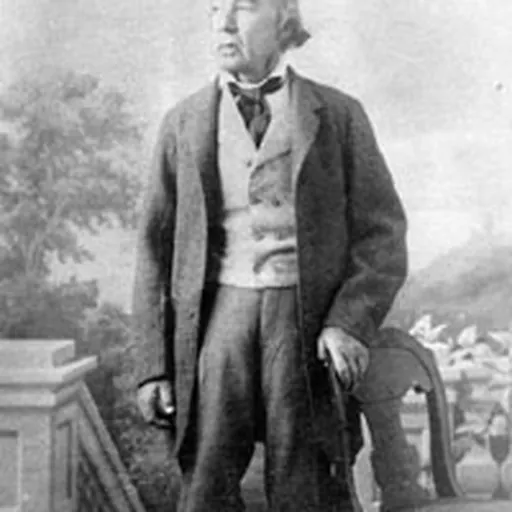
José Antonio Navarro
Texas statesman, revolutionary, politician, and merchant
About José Antonio Navarro
Lived 1795 – 1871 (aged 75). José Antonio Navarro was an American and Mexican politician and merchant.
Inscription on base of statue depicts Navarro as a "Lover of Liberty" and a "Foe of Despotism."
José Antonio Navarro (February 27, 1795 – January 13, 1871) was a Texas statesman, revolutionary, rancher, and merchant. The son of Ángel Navarro and Josefa María Ruiz y Peña, he was born into a distinguished noble family at San Antonio de Béxar in the Viceroyalty of New Spain (now the American city of San Antonio, Texas). His uncle was José Francisco Ruiz and his brother-in-law was Juan Martín de Veramendi.
Navarro County, Texas, established in 1846, is named in his honor, as is the small town of Navarro, Texas.
Early life and career Navarro was proficient in the laws of Mexico and Spain, although he was mainly self-educated. and worked together to find the new state of Texas. An early proponent of Texas independence, he took part in the 1812–1813 Magee, Gutiérrez, and Toledo resistance movement.
Working with the empresarios of the period, he helped Austin obtain his contracts to bring settlers into the area.
During the early 1830s, Navarro represented Texas both in the legislature of the state of Coahuila y Tejas and in the federal Congress in Mexico City. Always a champion of democratic ideas, Navarro, collaborating with Austin, worked to pass legislation that would best benefit the people of Texas. He was at the Convention for Texas Independence, when he received the news from Juan Seguin of the Alamo's fall. With the death of James Bowie (his nephew by marriage), Navarro had to secure the release of the surviving Navarros, two women and a child, who were being held by the Mexicans at the Músquiz house. They were removed to the Navarro family home. The surviving noncombatants thereby avoided humiliation or death from General Antonio López de Santa Anna. He later signed the Constitution of the Republic of Texas.
In 1841, Navarro reluctantly participated in the ill-conceived Texan Santa Fe Expedition sent by President Mirabeau B. Lamar, when he tried to persuade the residents of New Mexico to secede from Mexico and join with Texas. He was captured, put on trial, sentenced to death, and imprisoned for years. He escaped with the help of sympathetic Mexican Army officials, sailing back to Texas.
In 1835, Navarro built the Celso-Navarro House, relocated to the Witte Museum in San Antonio, where it houses some administrative offices.
José Antonio Navarro became a representative in the Republic of Texas Congress from Bexar County, Texas. Attempting to keep a balance of power, he worked closely with Senator Juan Seguin to promote legislation favorable to the Tejano citizenry, who were quickly becoming the political minority. Education was one such priority, working to bring academic institutions into the San Antonio area. He supported the annexation of Texas by the United States. In 1845, Navarro was instrumental in drafting the first state Constitution of Texas, ensuring future political rights for all people. He served two terms in the Texas Senate before retiring from politics in 1849.
Later life In his retirement, Navarro wrote several historical and political essays about Texas and San Antonio's role in the Mexican Independence movement for the San Antonio Ledger.
Ranching occupied much of his time in later years, and he spent most of each spring, summer, and fall on the San Geronimo Ranch, rich grasslands near Seguin, Texas, about 35 miles east of San Antonio.
Navarro's ranch on Geronimo Creek, near Geronimo, Texas, and north of Seguin, Texas. An early concrete house, it has been demolished.
Navarro later sold his ranch and lived full-time in San Antonio, where he died in 1871.
Legacy In 1846, the Texas Legislature named Navarro County south of Dallas to honor his service. In 1848, Navarro County's seat of government was founded, and José Navarro selected the name, Corsicana, for the town.
A state historical marker identifies his Geronimo Creek Ranch in South Texas. Navarro Street in downtown San Antonio is also named for him.
Casa Navarro State Historic Site in San Antonio is the original residence complex of José Antonio Navarro. He first bought the property, about 1.5 acres, in 1832 (during the Mexican Texas period. The structures of limestone, caliche block, and adobe were built over the next 20 years or so. The site is situated in the heart of old San Antonio. The buildings were acquired and restored by the San Antonio Conservation Society, and the complex, including his one-story limestone home, kitchen, and a two-story store and offices, was opened to the public in October 1997.
Tejanos who served under Juan Seguín
Don’t just read it —
keep it.
Full-length biographies made to live with: read them, listen on the way to work, watch them tonight.
- E-book
- Audio
- Video
Instant download · yours to keep · every purchase keeps this site free
Important facts
People in José Antonio Navarro's life
Named in this biography and alive at the same time



Related people
Same field, nearest in time


Contemporaries
People whose lives overlapped José Antonio Navarro's




Frequently asked questions
Who was José Antonio Navarro?
Texas statesman, revolutionary, politician, and merchant
When was José Antonio Navarro born?
José Antonio Navarro was born on 27 February 1795 in San Antonio.
When did José Antonio Navarro die?
José Antonio Navarro died on 13 January 1871 in San Antonio.
What was José Antonio Navarro's occupation?
José Antonio Navarro was a politician and merchant.
What nationality was José Antonio Navarro?
José Antonio Navarro was American and Mexican.
Sources & further reading
· Wikipedia: José Antonio Navarro
· DBpedia: José Antonio Navarro
Cite this page
APA: Biography.guide. (2026). José Antonio Navarro. https://biography.guide/jose-antonio-navarro/
MLA: "José Antonio Navarro." Biography.guide, https://biography.guide/jose-antonio-navarro/.
Chicago: "José Antonio Navarro." Biography.guide. https://biography.guide/jose-antonio-navarro/.
Data last updated: 2026-09-23 · Spot an error? Report a correction.
Portrait: Wikimedia Commons · author & licence
Page generated 2026-09-27 05:08 UTC