
About Jörmundur Ingi Hansen
Born 1940. Jörmundur Ingi Hansen is an Icelandic religious leader and allsherjargoði.
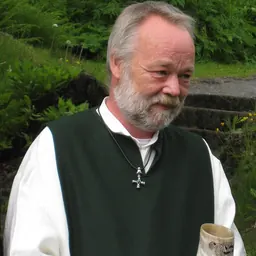
Jörmundur Ingi Hansen (born 14 August 1940) is an Icelandic neopagan leader, designer, businessman and clothing retailer. Trained as a sculptor and known as a prominent member of Reykjavík's hippie scene, he co-founded the Icelandic neopagan organization Ásatrúarfélagið in 1972, co-creating its rituals, liturgy and clothing. From 1994 to 2002, he led the organization, holding the title allsherjargoði; during his time in office, Ásatrúarfélagið experienced significant membership growth, acquired a building in Reykjavík and constructed a pagan burial ground designed by Jörmundur. An internal conflict led to his removal from the position, and in 2004 he left and became the leader of a small splinter group.
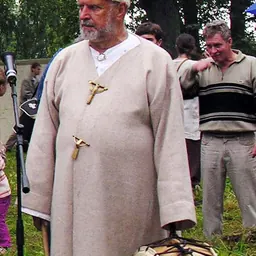
In his professional life, Jörmundur has worked making architectural drawings, as a salesman and as a designer. He is interested in men's fashion and sells vintage clothes in Reykjavík.
Early life and education Born in Reykjavík, Iceland, on 14 August 1940 as Jörgen Ingi Hansen, he changed his Danish first name early on to the Icelandic Jörmundur. His parents were the merchant Jörgen F. F. Hansen (1916–1991), who was of Danish descent and Helga Eiríksdóttir Hansen (1917–2008). After graduating from the trade school in Reykjavík in 1957, he went to Copenhagen to study civil engineering and architecture at the Technical University of Denmark, but returned to Iceland after two years. From 1975 to 1978, he studied Hungarian, Greek, Sanskrit and Indo-European comparative linguistics at the University of Iceland.
Ásatrúarfélagið's first decades (1972–1993)
Jörmundur contacted the farmer and poet Sveinbjörn Beinteinsson when he heard that Sveinbjörn had also tried to find people for a pagan organization. The theological views of Ásatrúarfélagið's members may vary and representatives, including Jörmundur, have elaborated their personal views independently.
Jörmundur and other key people in Ásatrúarfélagið's history have been artistically inclined. This has created a strong emphasis on literary, artistic and cultural interests. According to the religious studies scholar Michael Strmiska, this makes Ásatrúarfélagið different from many Norse-derived neopagan organizations in other countries, such as the United States, where more focus has been on the martial and masculine image of the Vikings. Jörmundur represented a faction that wanted to maintain old traditions, whereas Haukur wished to change Ásatrúarfélagið's practices in ways he thought would make them more appealing to contemporary people.
Increased mainstream acceptance for Ásatrúarfélagið and significant membership growth marked Jörmundur's time as leader. The group acquired a building in Reykjavík, and in 1999 established an official pagan burial ground which Jörmundur designed. The burial ground is part of the in Reykjavík. At the turn of the millennium, Jörmundur pursued international collaboration between neopagan groups through the World Pagan Congress, an initiative created by the Lithuanian Jonas Trinkūnas. before Hilmar Örn Hilmarsson, a composer, musician and long-time member of Ásatrúarfélagið, was elected to the position in 2003. Jörmundur initially refused to accept his removal, but he did not want to hurt the organization and endorsed the election of Hilmar.
After Ásatrúarfélagið (2004–) In 2004, Jörmundur and a group of loyalists left Ásatrúarfélagið, making the Reykjavíkurgoðorð independent again as a registered religious organization under his leadership. According to Jörmundur, the disagreement between him and Ásatrúarfélagið had much to do with money; other members did not like his approach to financial matters, and he was critical of Ásatrúarfélagið's decision to sell its building in Reykjavík after his removal from office. Jörmundur retains the rights to perform marriages and burials through the organization. The film won the award for best Icelandic short film at the 2018 Reykjavík International Film Festival; the jury called it "a beautiful, reverent ode to an interesting subject".
Religious views An important early influence on Jörmundur's conception of Old Norse religion was the 19th-century scholar Finnur Magnússon. Jörmundur has maintained a great interest in the history of religions and comparative religion, stressing the relationship between old traditions in Iceland and places such as Ossetia and Lithuania. All the clothes he sells have been part of his personal wardrobe. He initially bought and sold clothes at the Kolaportið flea market. In the early 2010s, he opened his own store at Laugavegur, but he left the location due to a lack of people moving in the area. As of 2020, he operated five booths at a bazaar in the shopping mall Kringlan.
Don’t just read it —
keep it.
Full-length biographies made to live with: read them, listen on the way to work, watch them tonight.
- E-book
- Audio
- Video
Instant download · yours to keep · every purchase keeps this site free
Important facts
People in Jörmundur Ingi Hansen's life
Named in this biography and alive at the same time

Related people
Same field, nearest in time



Contemporaries
People whose lives overlapped Jörmundur Ingi Hansen's


Frequently asked questions
Who is Jörmundur Ingi Hansen?
Icelandic neopagan leader
When was Jörmundur Ingi Hansen born?
Jörmundur Ingi Hansen was born on 14 August 1940 in Reykjavík.
What is Jörmundur Ingi Hansen's occupation?
Jörmundur Ingi Hansen is a religious leader and allsherjargoði.
What nationality is Jörmundur Ingi Hansen?
Jörmundur Ingi Hansen is Icelandic.
Sources & further reading
· Wikipedia: Jörmundur Ingi Hansen
· DBpedia: Jörmundur Ingi Hansen
Cite this page
APA: Biography.guide. (2026). Jörmundur Ingi Hansen. https://biography.guide/jormundur-ingi-hansen/
MLA: "Jörmundur Ingi Hansen." Biography.guide, https://biography.guide/jormundur-ingi-hansen/.
Chicago: "Jörmundur Ingi Hansen." Biography.guide. https://biography.guide/jormundur-ingi-hansen/.
Data last updated: 2026-09-25 · Spot an error? Report a correction.
Page generated 2026-09-27 05:12 UTC