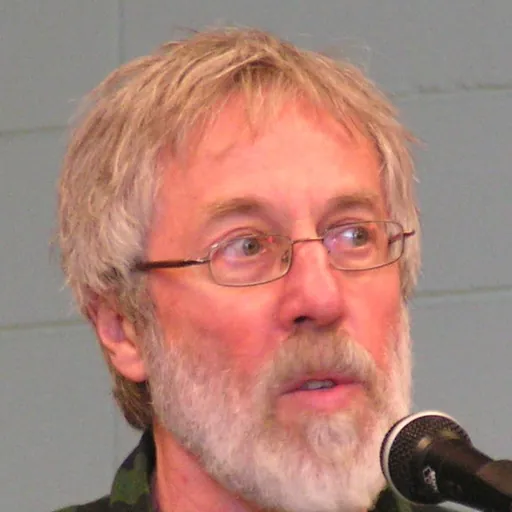
John Zerzan
American anarchist and primitivist philosopher and author
About John Zerzan
Born 1943. John Zerzan is an American writer, new media artist, philosopher, anarchist and historian.
John Edward Zerzan ( ; born August 10, 1943) is an American philosopher, author and radio host who founded the political philosophy of anarcho-primitivism. His works criticize agricultural civilization as inherently oppressive and advocate drawing upon the ways of life of hunter-gatherers as an inspiration for what a free society should look like. Subjects of his criticism include domestication and symbolic thought, such as language, numbers, art and the concept of time.
He has written numerous essays and books discussing his philosophy, including his 1994 collection Future Primitive and Other Essays, which is considered a classic among anarcho-primitivists and garnered some mainstream attention in the aftermath of Ted Kaczynski's trial.
Early life and education John Edward Zerzan was born on August 10, 1943, in Salem, Oregon, and is of Czech and Slovak descent. He received his bachelor's degree in political science from Stanford University in 1966. From 1967 to 1970, Zerzan worked as a union organizer for the Social Service Employees' Union in San Francisco. Zerzan returned to school and received a master's degree in history from San Francisco State University in 1972. He completed his coursework towards a PhD at the University of Southern California but dropped out in 1975 before completing his dissertation.
Activism In 1966, Zerzan was arrested while performing civil disobedience at a Berkeley anti-Vietnam War march and spent two weeks in the Contra Costa County Jail. He vowed after his release never again to be willingly arrested. He attended events organized by Ken Kesey and the Merry Pranksters and was involved with the psychedelic drug and music scene in San Francisco's Haight-Ashbury neighborhood.
In the late 1960s he worked as a social worker for the city of San Francisco welfare department. He helped organize a social workers’ union, the SSEU, and was elected vice president in 1968, and president in 1969. The local Situationist group Contradiction denounced him as a "leftist bureaucrat".
In 1974, Black and Red Press published Unions Against Revolution by Spanish ultra-left theorist Grandizo Munis that included an essay by Zerzan which previously appeared in the journal Telos. Over the next 20 years, Zerzan became intimately involved with the Fifth Estate, Anarchy: A Journal of Desire Armed, Demolition Derby and other anarchist periodicals. He began to question civilization in the early 80s, after having sought to confront issues around the neutrality of technology and division of labour, at the time when Fredy Perlman was making similar conclusions. He saw civilization itself as the root of the problems of the world and that a hunter-gatherer form of society presented the most egalitarian model for human relations with themselves and the natural world.
Zerzan became more widely known during the trial of Ted Kaczynski. After reading the Unabomber Manifesto, Zerzan went to Colorado to experience the trial and meet with Kaczynski in-between proceedings. The New York Times reporter Kenneth B. Noble took interest in Zerzan's sympathies and published an interview titled "Prominent Anarchist Finds Unsought Ally in Serial Bomber" that raised his national profile. Kaczynski eventually split from Zerzan and the anarcho-primitivists with the belief that leftist causes were a distraction.
Although there are similarities in the views of Zerzan and Kaczynski's Unabomber Manifesto, they are apparently entirely coincidental. A 2021 study by Sean Fleming shows that Kaczynski had not read Zerzan's work until after he submitted the Unabomber Manifesto to New York Times and the Washington Post.
In a 2014 interview, Zerzan stated that he and Kaczynski were "not on terms anymore." He criticized his former friend's 2008 essay "The Truth About Primitive Life: A Critique of Anarchoprimitivism" and expressed disapproval of Individuals Tending Towards the Wild, a Mexican group influenced by the Unabomber's bombing campaign.
In 2014, Zerzan engaged in a public debate against Zoltan Istvan at Stanford University. Zerzan and Istvan hold differing views on technology, with Istvan stating on HuffPost that their views on the subject are polar opposites of each-other.
Radio show One method Zerzan uses to promote his Anarcho-primitivist ideas is with his radio show AnarchyRadio on KWVA at 88.1 FM in Eugene, Oregon and live-streamed worldwide by the station's website with archive recordings of full shows available on John Zerzan's own website. Zerzan's website states that he started the show in 2000 although the recorded archive of shows on the site only goes back to 2006. Zerzan's show airs live on Tuesdays on KWVA at 7pm PST and lasts an hour. Lanza called during the December 20, 2011 show. The caller gave his name as "Greg" while calling Zerzan. During the call, Greg said that he was a fan of Zerzan's work and stated that Travis was not "an untamed monster" but was actually "civilized. He was able to integrate into society."
Zerzan has accused linguist and activist Noam Chomsky of not being a real anarchist, saying that he is instead "a liberal-leftist politically, and downright reactionary in his academic specialty, linguistic theory. Chomsky is also, by all accounts, a generous, sincere, tireless activist -- which does not, unfortunately, ensure his thinking has liberatory value."
Although Zerzan is usually anti-technology, he did make an exception to his typical denunciation of technology for vaccines and more specifically, COVID-19 vaccines. In 2022 in an article for Eugene Weekly, Zerzan noted that he does not believe the conspiracy theories about the COVID-19 mRNA vaccines which claim that they were introduced to force new levels of control and restrictions on the general population and also to spy on them with a microchip in the vaccine. It specifically rejects the claim that primitivism is a form of anarchism.
Some authors such as Andrew Flood have argued that destroying civilization would lead to the death of a significant majority of the population, mainly in poor countries. John Zerzan responded to such claims by suggesting a gradual decrease in population size, with the possibility of people having the need to seek means of sustainability more close to nature.
Flood suggests this contradicts Zerzan's claims elsewhere, and adds that, since it is certain that most people will strongly reject Zerzan's supposed utopia, it can only be implemented by authoritarian means, against the will of billions.
In an essay called "Anarchism = Zerzan?", socialist economist Michael Albert critiques Zerzan's perspectives on concepts such as language, division of labor, and technology, instead saying that Zerzan's argument rests on these concepts being inherently wrong, instead of, as Albert argues, being neutral concepts that can be utilized morally or immorally.
Noam Chomsky criticized the anarcho-primitivist viewpoint, saying that to end civilization essentially means killing billions of people.
Selected works Books and pamphlets The Education of an Anarchist: A Memoir. Feral House, 2024. When We Are Human: Notes From The Age Of Pandemics, July 2021. A People's History of Civilization, April 20, 2018 Time and Time Again. Detritus Books, 2018. Why hope? The Stand Against Civilization. Feral House, 2015. Future Primitive Revisited. Feral House, May 2012. Origins of the 1%: The Bronze Age pamphlet. Left Bank Books, 2012. Origins: A John Zerzan Reader. Joint publication of FC Press and Black and Green Press, 2010. Twilight of the Machines. Feral House, 2008. Running On Emptiness. Feral House, 2002. Against Civilization (editor). Uncivilized Books, 1999; Expanded edition, Feral House, 2005. Future Primitive and Other Essays. Autonomedia, 1994. Questioning Technology (co-edited with Alice Carnes). Freedom Press, 1988; 2d edition, New Society, 1991, Elements of Refusal. Left Bank Books, 1988; 2d edition, C.A.L. Press, 1999.
Articles Telos 141, Second-Best Life: Real Virtuality. New York: Telos Press Ltd., Winter 2007. Telos 137, Breaking the Spell: A Civilization Critique Perspective. New York: Telos Press Ltd., Winter 2006. Telos 124, Why Primitivism?. New York: Telos Press Ltd., Summer 2002. Telos 60, Taylorism and Unionism: The Origins of a Partnership. New York: Telos Press Ltd., Summer 1984. Telos 50, Anti-Work and the Struggle for Control. New York: Telos Press Ltd., Winter 1981–1982. Telos 49, Origins and Meaning of World War I. New York: Telos Press Ltd., Fall 1981. Telos 28, Unionism and the Labor Front. New York: Telos Press Ltd., Summer 1978. Telos 27, Unionization in America. New York: Telos Press Ltd., Spring 1976. Telos 21, Organized Labor versus The Revolt Against Work: The Critical Contest. New York: Telos Press Ltd., Fall 1974.
Don’t just read it —
keep it.
Full-length biographies made to live with: read them, listen on the way to work, watch them tonight.
- E-book
- Audio
- Video
Instant download · yours to keep · every purchase keeps this site free
Important facts
People in John Zerzan's life
Named in this biography and alive at the same time






Related people
Same field, nearest in time

Contemporaries
People whose lives overlapped John Zerzan's


Frequently asked questions
Who is John Zerzan?
American anarchist and primitivist philosopher and author
When was John Zerzan born?
John Zerzan was born on 10 August 1943 in Salem.
What is John Zerzan's occupation?
John Zerzan is a writer, new media artist, philosopher, anarchist and historian.
What nationality is John Zerzan?
John Zerzan is American.
Sources & further reading
Cite this page
APA: Biography.guide. (2026). John Zerzan. https://biography.guide/john-zerzan/
MLA: "John Zerzan." Biography.guide, https://biography.guide/john-zerzan/.
Chicago: "John Zerzan." Biography.guide. https://biography.guide/john-zerzan/.
Data last updated: 2026-09-20 · Spot an error? Report a correction.
Portrait: Wikimedia Commons · author & licence
Page generated 2026-09-27 04:57 UTC