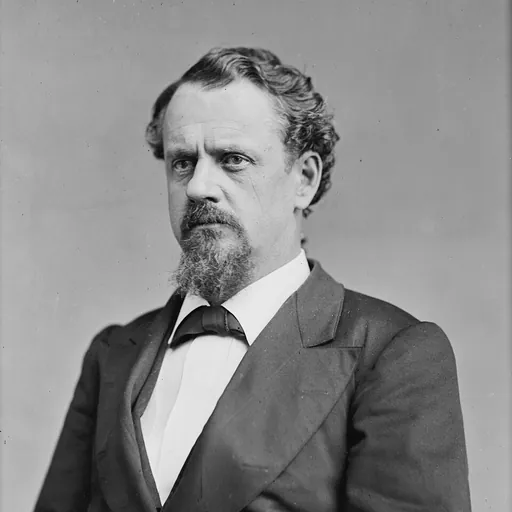
About John Young Brown
Lived 1835 – 1904 (aged 68). John Young Brown was an American politician and lawyer.
John Young Brown (June 28, 1835 – January 11, 1904) was an American politician from the U.S. Commonwealth of Kentucky who represented the state in the United States House of Representatives and served as its 31st governor of Kentucky. Brown was elected to the House of Representatives for three non-consecutive terms, each of which was marred by controversy. He was first elected in 1859, despite his own protests that he was not yet twenty-five years old, the minimum age set by the Constitution for serving in the legislature. The voters of his district elected him anyway, but he was not allowed to take his seat until the Congress' second session, after he was of legal age to serve. After moving to Henderson, Kentucky, Brown was elected from that district in 1866. On this occasion, he was denied his seat because of alleged disloyalty to the Union during the Civil War. Voters in his district refused to elect another representative, and the seat remained vacant throughout the term to which Brown was elected. After an unsuccessful gubernatorial bid in 1871, Brown was again elected to the House in 1872 and served three consecutive terms. During his final term, he was officially censured for delivering a speech excoriating Massachusetts Representative Benjamin F. Butler. The censure was later expunged from the congressional record.
After his service in the House, Brown took a break from politics but re-entered the political arena as a candidate for governor of Kentucky in 1891. He secured the Democratic nomination in a four-way primary election, then convincingly won the general election over his Republican challenger, Andrew T. Wood. Brown's administration, and the state Democratic Party, were split between gold standard supporters (including Brown) and supporters of the free coinage of silver. Brown's was also the first administration to operate under the Kentucky Constitution of 1891, and most of the legislature's time was spent adapting the state's code of laws to the new constitution. Consequently, little of significance was accomplished during Brown's term.
Brown hoped the legislature would elect him to the U.S. Senate following his term as governor. Having already alienated the free silver faction of his party, he backed "Goldbug" candidate Cassius M. Clay Jr. for the Democratic nomination in the upcoming gubernatorial election. However, the deaths of two of Brown's children ended his interest in the gubernatorial race and his own senatorial ambitions. At the Democratic nominating convention of 1899, candidate William Goebel used questionable tactics to secure the gubernatorial nomination, and a disgruntled faction of the party held a separate nominating convention, choosing Brown to oppose Goebel in the general election. Goebel was eventually declared the winner of the election, but was assassinated. Brown became the legal counsel for former Kentucky Secretary of State Caleb Powers, an accused conspirator in the assassination. Brown died in Henderson on January 11, 1904.
Early life John Young Brown was born on June 27, 1835, in Claysville (near Elizabethtown), Hardin County, Kentucky. He was the son of Thomas Dudley and Elizabeth (Young) Brown. Two of his uncles, Bryan Rust Young and William Singleton Young, served as U.S. Representatives. Brown spent much time with his father at the state capitol, which sparked his early interest in politics.
Brown received his early education in the schools of Elizabethtown, and in 1851, at the age of sixteen, matriculated at Centre College in Danville, Kentucky. In 1855, he graduated from Centre and returned to Hardin County to read law.
Brown married Lucie Barbee in 1857, but she died the following year. In September 1860, he married Rebecca Hart Dixon, the daughter of former U.S. Senator Archibald Dixon. His sympathies during the war were decidedly with the Confederacy. The following year, Brown was re-elected to the House of Representatives by an overwhelming vote of 10,888 to 457 and was allowed to assume his seat. Brown continued by referencing notorious Scottish murderer William Burke, whose method of murdering his victims became known as "Burking." At this point in the speech, Speaker of the House James G. Blaine interrupted Brown, asking if he was referring to a member of the House; Brown gave an ambiguous response before continuing: "If I wished to describe all that was pusillanimous in war, inhuman in peace, forbidden in morals, and infamous in politics, I should call it 'Butlerizing'." The other candidates included Cassius Marcellus Clay Jr., son of former Congressman Brutus J. Clay and nephew of abolitionist Cassius Marcellus Clay; Dr. John Daniel Clardy, later to be elected a U.S. Representative; and Attorney General Parker Watkins Hardin. Agrarian voters were about equally split between Clay and Clardy, while Free Silver Democrats were about equally split between Hardin and Clardy. Bourbon Democrats were also pleased with his sound money stand. Brown also frequently clashed with the legislature and vetoed several of the bills it passed; none of his vetoes were ever overridden. He also announced that the state's present budget deficit was $229,000 and was expected to reach almost half a million dollars by the end of 1893. The length of the session earned it a derisive nickname – the "Long Parliament". Fearing that these bills would be challenged in court, Brown vetoed them. Among the measures not specifically advocated by Brown that were enacted by the General Assembly was a measure racially segregating the state's railroad cars, called the "separate coach law".
Brown won acclaim from the railroad companies for vetoing a proposed railroad tax increase, but soon drew their ire for preventing the merger of the state's two largest railways, the Louisville and Nashville Railroad and the Chesapeake and Ohio Railway. Other measures passed during the session included a basic coal safety measure, a common school statute, a measure prohibiting collusive bidding on tobacco, new regulations on grain warehouses, and a law providing free turnpikes. Measures advocated by Brown but not enacted by the Assembly included broadening the powers of the state railroad commission, establishing the offices of state bank inspector and superintendent of public printing, and reforming prison management, including separate detention of adolescent criminals.
Later life and death It was widely known that Brown desired election to the U.S. Senate when his gubernatorial term expired in 1896. The leading Democratic candidates to succeed Brown as governor were his old rivals, Cassius M. Clay Jr. and Parker Watkins Hardin, and Brown believed he would need his eventual successor's support to secure the Senate seat. Having already alienated Hardin and his free silver allies, Brown threw his support to Clay. Family tragedy would soon remove his interest in the race, however. On October 30, 1894, Brown's teenage daughter Susan died of tuberculosis. Despite Brown's proclaimed lack of interest in the Senate seat, he received one vote during the tumultuous 1896 Senate election to replace Senator J. C. S. Blackburn.
William Goebel's nomination drew Brown into the 1899 gubernatorial race. After his term as governor, Brown again returned to his legal practice in Louisville. Prior to the 1899 Democratic nominating convention, Brown was mentioned as a possible gubernatorial nominee, but he declined to become a candidate. When the convention began, he was mentioned as a candidate for convention chairman, but he also refused to serve in this capacity.
Despite his proclaimed lack of interest in the gubernatorial nomination, Brown's name was entered as a candidate on the first ballot, along with Parker Watkins Hardin, former Congressman William J. Stone, and William Goebel, President Pro Tempore of the state senate. The convention was thrown into chaos when a widely known agreement between Stone and Goebel – designed to get Hardin out of the race – broke down. As balloting continued over the next four days (Sunday excepted) with no candidate receiving a majority, Brown continued to receive a few votes on each ballot. Finally, the convention delegates decided to drop the candidate with the lowest vote total until one candidate received a majority; this resulted in the nomination of Goebel a few ballots later.
Following the convention, disgruntled Democrats began to talk about rejecting their party's nominee and holding another nominating convention. Brown became the leader of this group, styled the "Honest Election League". Plans for the new convention were made at a meeting held August 2, 1899, in Lexington, Kentucky. The nomination was made official at a convention held in that city on August 16. In addition to Brown, the Honest Election League nominated a full slate of candidates for the other state offices.
Brown opened his campaign with a speech at Bowling Green on August 26, 1899. He answered many allegations that had been made about him, including claims that he had secretly been seeking the Democratic gubernatorial nomination all along, that he had ambitions of succeeding Senator William Joseph Deboe, and that following the nominating convention, he had agreed to speak on behalf of the Goebel ticket. Brown conceded that he desired Senator Deboe's senate seat and that he had agreed to accept the gubernatorial nomination if it had been offered to him, but he denied that he had ever agreed to speak on Goebel's behalf. Outgoing Senator Blackburn also charged that Brown was bolting the party again, just as he had in supporting Stephen Douglas over John C. Breckinridge for president in 1860. Brown replied by quoting an article by William Jennings Bryan's Omaha World-Herald that asserted the right of an individual to vote against the nominee of his party if the individual deemed the nominee unfit.
Due to his age and ill health, Brown was able to speak only once per week. At a campaign event in Madisonville, he challenged Goebel to a debate, but Goebel ignored the challenge. Brown, and other speakers enlisted on behalf of his campaign, frequently called attention to Goebel's refusal to acknowledge the challenge or agree to a debate. When William Jennings Bryan came to the state to campaign with Goebel, Brown sent him a letter challenging him to repudiate Goebel's nomination because of the broken agreement between Goebel and Stone. Bryan refused to comment on the events of the convention and stressed the importance of party loyalty. He denounced the Honest Election League's convention as irregular and invalid.
Brown's campaign faltered as the race drew to a close. Two weeks prior to the election, Brown was injured in a fall at Leitchfield; as a result of the injury, he was confined to his home and unable to deliver campaign speeches, despite several attempts to allow him to speak from a chair or wheelchair. The final vote count gave Republican William S. Taylor a small plurality with 193,714 votes to Goebel's 191,331; Brown garnered only 12,140 votes.
Goebel challenged the vote returns in several counties. While the challenges were being adjudicated, Goebel was shot by an unknown assassin; Goebel was ultimately declared the winner of the election, but died of his wounds two days after being sworn into office.
Don’t just read it —
keep it.
Full-length biographies made to live with: read them, listen on the way to work, watch them tonight.
- E-book
- Audio
- Video
Instant download · yours to keep · every purchase keeps this site free
Important facts
People in John Young Brown's life
Named in this biography and alive at the same time




Related people
Same field, nearest in time





Contemporaries
People whose lives overlapped John Young Brown's





Frequently asked questions
Who was John Young Brown?
19th-century American politician in Kentucky (1835-1904)
When was John Young Brown born?
John Young Brown was born on 28 June 1835 in Claysville.
When did John Young Brown die?
John Young Brown died on 11 January 1904 in Henderson.
What was John Young Brown's occupation?
John Young Brown was a politician and lawyer.
What nationality was John Young Brown?
John Young Brown was American.
Sources & further reading
· DBpedia: John Y. Brown (politician, born 1835)
Cite this page
APA: Biography.guide. (2026). John Young Brown. https://biography.guide/john-young-brown/
MLA: "John Young Brown." Biography.guide, https://biography.guide/john-young-brown/.
Chicago: "John Young Brown." Biography.guide. https://biography.guide/john-young-brown/.
Data last updated: 2026-09-22 · Spot an error? Report a correction.
Portrait: Wikimedia Commons · author & licence
Page generated 2026-09-27 05:03 UTC