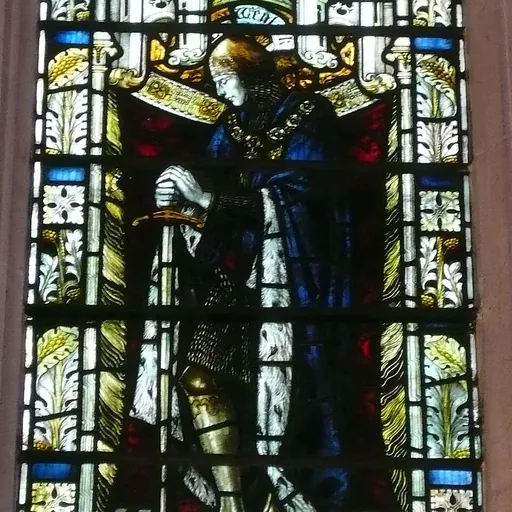
About John Wenlock, 1st Baron Wenlock
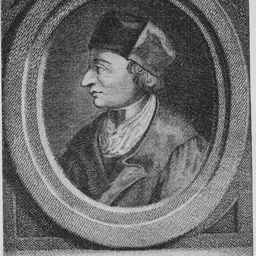
Lived 1401 – 1471 (aged 69–70). John Wenlock, 1st Baron Wenlock was an English chamberlain and politician.
Sir John Wenlock, as portrayed in stained glass window in the Wenlock chapel at St. Mary's Church, Luton.
John Wenlock, 1st Baron Wenlock (c.1400/04 – 4 May 1471) was an English politician, diplomat, soldier and courtier. He fought on the sides of both the Yorkists and the Lancastrians in the Wars of the Roses. He has been called "the prince of turncoats", although some historians suggest the label may not be fair as this behavior was commonplace during the Wars of the Roses. Others contend that even when Wenlock was not actually changing sides, he was engaged in "fence sitting par excellence." He was escheator for Buckinghamshire and Bedfordshire in 1438–9, and he early entered the service of Margaret of Anjou, being first usher of the chamber, and about 1450 chamberlain to her. In this capacity he laid the first stone of Queens' College, Cambridge, on 15 April 1448.
He served also in 1444 as High Sheriff of Bedfordshire and Buckinghamshire. Wenlock's seat was at Luton, his property there, Someries Castle, coming through inheritance. In 1462 he acquired Hertfordshire property forfeited by the former Chief Justice, Sir John Fortescue.
His service to the Crown is also reflected in his employment as a member of some 18 embassies in the 1440s and 1450s. He was knighted in 1449. It appears to have been at one such embassy that he came into contact with the Duke of York and the Earl of Warwick (the "Kingmaker"), and he became a supporter of the latter.
In the Wars of the Roses During the Wars of the Roses, Wenlock initially fought for the House of Lancaster in the First Battle of St Albans on 22 May 1455, but his relationship with Warwick subsequently led him to change sides, and it was as a Yorkist that he served as Speaker of the House of Commons later that year in the parliament of 1455. By the Battle of Blore Heath in 1459 Wenlock fought for the House of York. He also fought under the Yorkist banner in the Battle of Mortimer's Cross, the Second Battle of St Albans and the Battle of Towton, all in what is referred to as the first phase of the Wars of the Roses.
Having successfully besieged the Tower of London for Edward of York, he was part of the latter's triumphal entry into London in 1461 and was elected a Knight of the Garter a few days after. Later in the year he received appointment as Chief Butler of England and was made Baron Wenlock. In 1464 he helped Lord Hastings capture Dunstanburgh Castle. This story is likely a legend as it does not appear in any contemporary source. The Duke of Somerset had led the right flank of the Lancastrian line forward, and expected Wenlock to support him, but Wenlock held back (some suggest deliberately) and the Duke's men were slaughtered. Some sources suggest that Wenlock was committed to the cause, but that Somerset had bungled the planned manoeuvre, coming out of the woods too early, and emerging in front of the enemy instead of behind, thereby preventing Wenlock's men from shooting at them. Another possibility is that the Yorkist archers made Somerset's position untenable and the duke was forced to abandon his defensive position and engage the enemy.
Family Wenlock married twice in his life. His first wife, Elizabeth Drayton (who was the widow of Christopher Preston) died in the early 1460s after being married to him for over 30 years. In 1467 Wenlock then remarried Agnes Fray (herself a widow; her maiden name was Agnes Danvers and she had previously been married to Thomas Baldington; after Wenlock's death she married a 4th time to Sir John Say). At the time of this second marriage both spouses would have been in their 60s.
Wenlock died without issue, and his title died with him.
Don’t just read it —
keep it.
Full-length biographies made to live with: read them, listen on the way to work, watch them tonight.
- E-book
- Audio
- Video
Instant download · yours to keep · every purchase keeps this site free
Important facts
People in John Wenlock, 1st Baron Wenlock's life
Named in this biography and alive at the same time

Related people
Same field, nearest in time



Contemporaries
People whose lives overlapped John Wenlock, 1st Baron Wenlock's



Frequently asked questions
Who was John Wenlock, 1st Baron Wenlock?
English politician and Baron
When was John Wenlock, 1st Baron Wenlock born?
John Wenlock, 1st Baron Wenlock was born in 1401.
When did John Wenlock, 1st Baron Wenlock die?
John Wenlock, 1st Baron Wenlock died in 1471 in Tewkesbury.
What was John Wenlock, 1st Baron Wenlock's occupation?
John Wenlock, 1st Baron Wenlock was a chamberlain and politician.
What nationality was John Wenlock, 1st Baron Wenlock?
John Wenlock, 1st Baron Wenlock was English.
Sources & further reading
· Wikipedia: John Wenlock, 1st Baron Wenlock
· DBpedia: John Wenlock, 1st Baron Wenlock
Cite this page
APA: Biography.guide. (2026). John Wenlock, 1st Baron Wenlock. https://biography.guide/john-wenlock-1st-baron-wenlock/
MLA: "John Wenlock, 1st Baron Wenlock." Biography.guide, https://biography.guide/john-wenlock-1st-baron-wenlock/.
Chicago: "John Wenlock, 1st Baron Wenlock." Biography.guide. https://biography.guide/john-wenlock-1st-baron-wenlock/.
Data last updated: 2026-09-23 · Spot an error? Report a correction.
Portrait: Wikimedia Commons · author & licence
Page generated 2026-09-27 05:05 UTC