About John Tohabi
Lived 1100 – 1101. John Tohabi was a priest, hieromonk and painter.
John Tohabi (; fl. late 11th – early 12th century) was a medieval Georgian ordained priest, hieromonachos and icon painter whose works were donated in the High Middle Ages to the Saint Catherine's Monastery on Mount Sinai and its monastic community, originally all displayed together for the decoration of the entire church.
Life Little is known about early life of John. He calls himself in Georgian texts, "humble John", "wretched old man", "pitiable old man" and "miserable among monks" in Greek. He declares his adherence to the Chalcedonian Christianity and is extremely concerned for his personal salvation. John extensively used Georgian inscriptions on his icons. Such combination of Greek and Georgian languages in the inscriptions of the icons indicates that John belonged to Byzantine culture, but at the same time he underlined his nationality. He was most probably active and educated in one of the monasteries of Constantinople, and would later move to live at the Saint Catherine's monastery. The meaning behind his family name or nickname Tohabi remains unknown. It is not recorded in any other sources.
Icons
John left an extensive tradition and legacy of icon painting. His Christological cycle, the Miracles and the Passion of Jesus, alongside Life of the Virgin, is one of six icons or hexaptych by John preserved on Sinai. Four of them constitute a menologium (calendar icons), and the fifth depicts the Second Coming.
Each of John's calendar icons is divided into nine horizontal stripes, each usually displaying ten small scenes on the tetraptych. Each icon depicts the lives of three months of the year and represents all martyrs at the instant of their cruel death, while other saints are depicted frontally, standing full-size. Each saint is accompanied by a caption bearing their name and specifying either their martyrdom or peaceful death. John's icon of the Last Judgement is now damaged, but its constituent motifs may still be determined.
The reverse of all six icons has a Greek epigram written in dodecasyllable meter style. Individual figures and compositions on the menologium and the Last Judgment panels have bilingual Georgian-Greek inscriptions. Georgian is written in medieval monastic Nuskhuri script, characteristic of the eleventh century.
The icon includes the Blachernitissa, representing the Virgin with the caressing standing Child, and Hodegetria, which was a palladium of the Byzantine capital. All inscriptions reveal that John was also the donor of the icons. John, with his complex panel, wanted to explicitly demonstrate that, together with Christian dogmas and theological ideas, the icons manifest the identities of people. Some of the images created by John are similar to the depictions from the Timotesubani monastery.
Some of his figures are depicted wearing turbans in hell. He used sophisticated and poetic words on his icons.
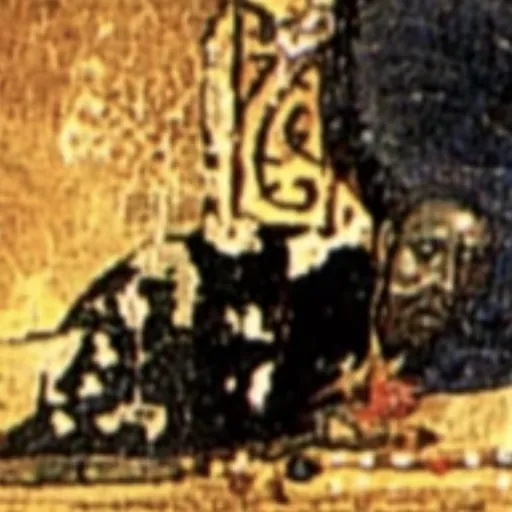
It has been suggested that John might have painted the Crucifixion of Jesus, which is missing from his Passion of Jesus icon. John has two self-portraits on his icons depicting himself prostrated and praying. His prayer, written in the Georgian Nuskhuri script in seven lines, is placed below the enthroned Christ in Majesty and above the Hetoimasia on the Last Judgment icon.
Taking into account the accompanying Georgian and Greek inscriptions, it could be supposed that the icons were intended either for the bilingual monastic brethren or a Georgian monastery outside of the Kingdom of Georgia. It is unknown when these icons appeared on Sinai, or who donated them to St. Catherine's Monastery, but it is highly probable that this very monastery was an original “destination” for the icons, for a large Georgian colony that had been active there, well-documented since late antiquity.
Increasing the presence of the Georgians on Mount Sinai seems to have been important in the tenth and eleventh centuries when improvements were made to the St George chapel, which was the primary sanctuary of their community. The very donation of John's icons served to enhance the standing of their group at the monastery. A polyptych by John might have influenced the commissioning of the Khakhuli triptych by King David IV the Builder, which was later reinforced or completed by his heir, King Demetre I.
Don’t just read it —
keep it.
Full-length biographies made to live with: read them, listen on the way to work, watch them tonight.
- E-book
- Audio
- Video
Instant download · yours to keep · every purchase keeps this site free
Important facts
Related people
Same field, nearest in time




Frequently asked questions
Who was John Tohabi?
medieval Georgian priest, hieromonk and icon painter
When was John Tohabi born?
John Tohabi was born in 1100.
When did John Tohabi die?
John Tohabi died in 1101.
What was John Tohabi's occupation?
John Tohabi was a priest, hieromonk and painter.
What nationality was John Tohabi?
John Tohabi's recorded nationality: Kingdom of Georgia.
Sources & further reading
Cite this page
APA: Biography.guide. (2026). John Tohabi. https://biography.guide/john-tohabi/
MLA: "John Tohabi." Biography.guide, https://biography.guide/john-tohabi/.
Chicago: "John Tohabi." Biography.guide. https://biography.guide/john-tohabi/.
Data last updated: 2026-09-21 · Spot an error? Report a correction.
Portrait: Wikimedia Commons · author & licence
Page generated 2026-09-27 05:00 UTC