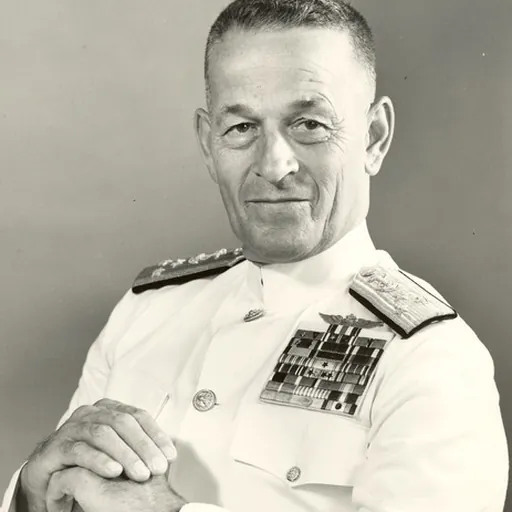
About John T. Hayward
Lived 1908 – 1999 (aged 90). John T. Hayward was an American military officer.
John Tucker "Chick" Hayward (15 November 1908 – 23 May 1999) was an American naval aviator during World War II. He helped develop one of the two atomic bombs that was dropped on Japan in the closing days of the war. Later, he was a pioneer in the development of nuclear propulsion, nuclear weapons, guidance systems for ground- and air-launched rockets, and underwater anti-submarine weapons. A former batboy for the New York Yankees, Hayward dropped out of high school and lied about his age to enlist in the United States Navy at age 16. He was subsequently admitted to the United States Naval Academy at Annapolis, from which he graduated 51st in his class of 1930. He volunteered for naval aviation.
During World War II, he served at the Naval Aircraft Factory in Philadelphia, where he was involved in an effort to improve aircraft instrumentation, notably the compass and altimeter. He attended the University of Pennsylvania's Moore School of Electrical Engineering, and studied nuclear physics. In June 1942, he assumed command of a new patrol bomber squadron, VB-106, equipped with PB4Y-1 Liberators, which he led in a daring raid on Wake Island, in the Solomon Islands campaign, and in the Southwest Pacific Area. Returning to the United States in 1944, he was posted to the Naval Ordnance Test Station at Inyokern, California, where he joined the Manhattan Project, participating in Project Camel, the development of the non-nuclear components of the Fat Man bomb, and in its drop testing.
After the war ended, he travelled to Hiroshima and Nagasaki as part of the team investigating the bomb damage, and during Operation Crossroads, he led the effort to photograph the nuclear explosion at the Bikini Atoll. In 1949, he assumed command of VC-5, the first naval nuclear bomber squadron. In March 1949, he took off from the carrier in the Atlantic in a Lockheed P2V Neptune bomber carrying a dummy Little Boy pumpkin bomb, flew across the United States to make a simulated attack on a test site in California., and flew back to Patuxent River, where he landed after a total of 23 hours flying. In August 1950, he was at the controls of the first carrier landing and takeoff of an AJ-1 Savage heavy attack bomber.
From June 1951 to May 1953, Hayward was head of the Military Applications Division of the Atomic Energy Commission, where he conducted atomic weapons laboratory work at Los Alamos National Laboratory. In June 1953, he assumed command of the escort carrier , and was involved in the rescue of a baby who was found abandoned in the trash at a U.S. Army depot. In June 1954, he became the first naval aviator to command the Naval Ordnance Laboratory, where he was involved with the development of the Mark 52 naval mine and the Mark 90 nuclear bomb, a nuclear depth charge. He was Assistant Chief of Naval Operations for Research and Development, and then Deputy Chief of Naval Operations for Development. In 1962 he assumed command of a carrier task force which included the nuclear-powered aircraft carrier . He commanded the Antisubmarine Warfare Force, Pacific Fleet, from 1963 to 1966, and then was president of the Naval War College from 1966 until 1968.
Early life Hayward was born in New York City on 15 November 1908 one of eight children of Charles Brian and Rosa Hayward (née Valdetaro) As a youngster, he was a batboy for the New York Yankees. In May 1925, he dropped out of high school at Loyola School and enlisted in the United States Navy by lying about his age, which at the time he believed to be only 15, and forging his father's signature on the papers. He soon acquired the nickname "Chick" from a bosun who asked "And how in did a little chick like you get in here amongst all these grown men?" The nickname would remain with him for the rest of his naval career.
Hayward did his initial naval training at the Naval Station Newport at Newport, Rhode Island. He was encouraged by the Chaplain, Father John J. Brady, to try for admission to United States Naval Academy at Annapolis. Brady arranged for Hayward to be sent to the Naval Academy Preparatory School in Norfolk, Virginia, to study for the entrance exams. During World War I, some one-hundred presidential appointments to Annapolis had been set aside for enlisted sailors, but few had applied, and fewer still had passed the entrance exams. Of the 119 sailors who sat the exams in 1926, only 19 passed, one of whom was Hayward. He entered Annapolis in August 1926, and was commissioned as an ensign on graduation in June 1930, ranking 51st in his class of 406.
After graduation, Hayward volunteered for naval aviation, and learned to fly in a Consolidated NY seaplane at Naval Air Station Hampton Roads. A tour of sea duty on the cruiser followed, after which he was posted to the Naval Air Station Pensacola to complete his flight training. He received his aviator's wings in July 1932. While there he met a local woman, Leila Marion (Lili) Hyer, and the two were married at St John's Church in Warrington, Florida, on 15 October 1932. Their marriage would produce five children.
Hayward was awarded a second Distinguished Flying Cross on the recommendation of Captain Arleigh Burke for leading his squadron in the South Pacific Area. His citation read:For extraordinary achievement while participating in aerial flight against the enemy as commanding officer of a navy bombing squadron operating in the South Pacific area from 8 November 1943 to 24 February 1944. During this period, Commander Hayward completed many combat and search missions over Japanese territory, frequently encountering heavy anti-aircraft fire. Several of the missions were made, despite adverse weather conditions. On 8 November while on a routine search, he bombed Kapingimarangi Island, scoring four direct hits on an enemy bivouac area. On 20 and 31 December and 8 January he bombed, strafed and sank enemy supply barges on each occasion. On 24 February, his efficient spotting enabled our destroyers to destroy three Japanese cargo vessels in Kavieng Harbor. His superior airmanship and outstanding leadership contributed materially to the success of the squadron in inflicting severe damage on the Japanese forces in the area. His courageous conduct was in keeping with the highest traditions of the United States Naval Service. On 1 January 1948, he was reduced in rank to commander again. The Air Force offered a commission as a brigadier general, and Convair offered a job working on the SM-65 Atlas missile, but Hayward elected to stay in the navy. He participated in the Operation Sandstone nuclear tests in the Pacific in April 1948.
After World War II, the US Navy sought to acquire a nuclear strike capability, and the Deputy Chief of Naval Operations for Air, Rear Admiral Arthur W. Radford wanted them to operate from aircraft carriers. There were practical problems with this. Nuclear weapons at that time were bulky and required a large aircraft to carry them. After Operation Crossroads, Radford asked Hayward if the Navy had such an aircraft, and Hayward suggested modifying the Lockheed P2V Neptune for carrier operations using jet-assisted takeoff (JATO) rocket boosters. It was an interim solution, as it a could not carry a Fat Man, but only the smaller Little Boy bomb; it could only be operated by the large Midway class aircraft carriers, which still had to be modified for the task; and initially had no tailhook, so it was unable to land on a carrier, and a mission would have to end with it either landing at a land base or ditching at sea.
On 28 April 1948, two P2Vs were launched from a carrier, the , for the first time. Hayward intended that Ashworth would take command of the next squadron, VC-6, when it was formed.
Hayward was promoted to captain again on 19 February 1949. On 7 March, he took off Coral Sea in the Atlantic in a P2V carrying a dummy Little Boy pumpkin bomb, and flew across the United States to make a simulated attack on the Salton Sea test site near El Centro, California. He then flew to Patuxent River, where he landed after a total of 23 hours flying. Hayward had tailhooks fitted to a pair of P2Vs, and made practice landings on a carrier deck painted on the ground at NAS Patuxent River, Maryland, He made some touch and go passes at the , but a carrier landing was considered too dangerous for regular crews to attempt.
The P2Vs would be first augmented, and then replaced, by the more capable North American AJ Savage as they became available. These could take off and land on a carrier, carrying a Fat Man. On 21 August 1950, Hayward was at the controls of the first carrier landing and takeoff of an AJ-1 Savage heavy attack bomber, on the Coral Sea with the commander of Naval Air Forces Atlantic Fleet (COMAIRLANT), Vice Admiral Felix Stump, in the back seat. However, by mid-December VC-5 still only had six AJ-1s.
From June 1951 to May 1953, Hayward was head of the Military Applications Division of the Atomic Energy Commission, where he conducted atomic weapons laboratory work at Los Alamos National Laboratory. He also worked on the foundation of the Lawrence Livermore National Laboratory program in 1952 in close collaboration with Edward Teller. The culmination of this was working on the Ivy Mike nuclear test.
Point Cruz In June 1953, Hayward took command of the escort carrier . He confessed to the crew that he did not know what he was doing, and urged any crewman who felt he was doing something wrong to tell him so at once. At the end of the Korean War, the carrier was deployed at Inchon, where a baby was found abandoned in the trash at a U.S. Army depot. The baby was brought to an orphanage, and Hayward sent Point Cruz'''s chaplain in response to a request for assistance. The nun running the orphanage felt the blue-eyed baby would not be safe if he remained in Korea. Hayward is said to have told the chaplain: "You are not to return to this vessel until you have procured that baby."
Hayward is credited with putting his naval career "on the line" by bringing the baby on the ship, which was against regulations, and he subsequently received orders to get the baby off the ship.
Later career
Hayward assumed command of the Naval Ordnance Laboratory at White Oak, Maryland, in June 1954. He was the first naval aviator to do so, all the previous commanders having been naval ordnance officers. Under his guidance, the Naval Ordnance Laboratory developed the Mark 52 naval mine, an air-delivered weapon with acoustic, magnetic and pressure sensors. Hayward encountered some resistance with this project, as mine warfare was a neglected field in the Navy. The Naval Ordnance Laboratory also developed the Mark 90 nuclear bomb, a nuclear depth charge, which was tested during Operation Wigwam in May 1955.
From a naval career point of view, Hayward's most notable drawback was his lack of time in command of a ship at sea. Admiral Arleigh Burke, now Chief of naval Operations, arranged for Hayward to be given command of the aircraft carrier Franklin D. Roosevelt in February 1956. This would normally be the climax of naval aviator's career, but that year he was selected for promotion to rear admiral. His record of 13,200 flight hours was the highest ever achieved by a flag officer. He pushed the development of a number of new weapons systems, including the Lockheed P-3 Orion and the nuclear-powered aircraft carrier . Between 1959 and 1961, Defense expenditure on research and development grew from $525 million (roughly equivalent to $ in 20) to $4 billion (roughly equivalent to $ in 20).
In 1962, President John F. Kennedy offered Hayward four stars and the job of Deputy Director of the Central Intelligence Agency. Hayward turned it down, accepting a demotion to rear admiral on 9 March 1962 to take command of Carrier Division 2, which included the nuclear-powered Enterprise'', , and . In October 1962, his ships participated in the Cuban Missile Crisis. In June 1963, he was restored to the rank of vice admiral, which was backdated to 25 April 1959, the day he had first been promoted. He commanded the Antisubmarine Warfare Force, Pacific Fleet, from 13 June 1963 to 12 January 1966, for which he was awarded the Navy Distinguished Service Medal for his "leadership, judgment and foresight in research and development associated with antisubmarine warfare and the training of Antisubmarine Warfare Groups during his tenure of command." and was inducted into the Naval Aviation Hall of Honor in 2004.
Hayward died of cancer on 23 May 1999 in Atlantic Beach, Florida, and was buried in Arlington National Cemetery. His papers are in the Naval History & Heritage Command at the Washington Navy Yard.
Don’t just read it —
keep it.
Full-length biographies made to live with: read them, listen on the way to work, watch them tonight.
- E-book
- Audio
- Video
Instant download · yours to keep · every purchase keeps this site free
Important facts
People in John T. Hayward's life
Named in this biography and alive at the same time



Related people
Same field, nearest in time



Contemporaries
People whose lives overlapped John T. Hayward's

Frequently asked questions
Who was John T. Hayward?
American admiral
When was John T. Hayward born?
John T. Hayward was born on 15 November 1908 in New York.
When did John T. Hayward die?
John T. Hayward died on 23 May 1999 in Atlantic Beach.
What was John T. Hayward's occupation?
John T. Hayward was a military officer.
What nationality was John T. Hayward?
John T. Hayward was American.
Sources & further reading
Cite this page
APA: Biography.guide. (2026). John T. Hayward. https://biography.guide/john-t-hayward/
MLA: "John T. Hayward." Biography.guide, https://biography.guide/john-t-hayward/.
Chicago: "John T. Hayward." Biography.guide. https://biography.guide/john-t-hayward/.
Data last updated: 2026-09-22 · Spot an error? Report a correction.
Portrait: Wikimedia Commons · author & licence
Page generated 2026-09-27 05:03 UTC