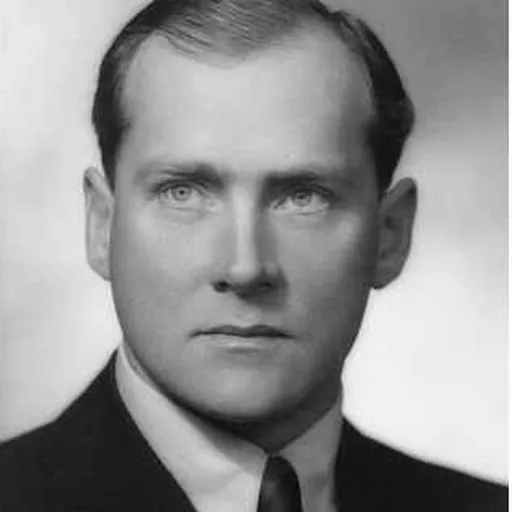
About John Rymill
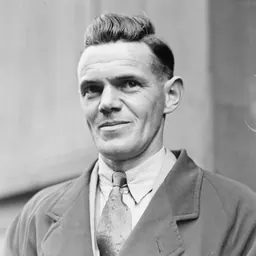
Lived 1905 – 1968 (aged 63). John Rymill was an Australian explorer.
John Riddoch Rymill (13 March 1905 – 7 September 1968) was an Australian polar explorer, who had the rare second clasp added to his Polar Medal.
Early life Rymill was born at Penola, South Australia, the second son of Robert Rymill (7 July 1869 – 14 May 1906) and Mary Edith Rymill (née Riddoch), owners of Penola Station, and grandson of Frank Rymill. He was educated at Melbourne Grammar School, where he first developed his love of polar literature, and at the Royal Geographical Society in London, where he studied surveying and navigation.
Polar career Rymill prepared himself for polar exploration with alpine experience in Europe, flying lessons at the de Havilland Aircraft Co. Ltd, Hendon and courses at the Scott Polar Research Institute, Cambridge, under Professor Frank Debenham. In 1931 he was appointed to the British Arctic Air Route Expedition to Greenland (1930–31) as surveyor and pilot. He also joined the subsequent 1932-33 East Greenland Expedition led by Gino Watkins and which he led after Watkins' death in Tuttilik Fjord.
As a result of these Arctic experiences, Rymill determined to mount an Antarctic expedition to South Graham Land and the Weddell Sea south of Cape Horn, South America. After some difficulties securing sponsorship, he purchased an old sail training ship which he renamed Penola and with volunteer staff from Cambridge University and nine crew supplied by the Royal Navy, sailed to the South Atlantic, where their first base was South Georgia. His British Graham Land Expedition (1934–37) discovered a southern, permanently frozen channel, later named George VI Sound, extending to the Bellingshausen Sea. and Rymill served as a district councillor. During World War II he was commissioned in the Royal Australian Naval Volunteer Reserve. He died on 7 September 1968, like his father, as the result of a car accident, survived by his wife and their two sons and was buried at New Penola cemetery.
Don’t just read it —
keep it.
Full-length biographies made to live with: read them, listen on the way to work, watch them tonight.
- E-book
- Audio
- Video
Instant download · yours to keep · every purchase keeps this site free
Important facts
People in John Rymill's life
Named in this biography and alive at the same time


Related people
Same field, nearest in time



Contemporaries
People whose lives overlapped John Rymill's




Frequently asked questions
Who was John Rymill?
Australian explorer (1905–1968)
When was John Rymill born?
John Rymill was born on 13 March 1905 in Penola.
When did John Rymill die?
John Rymill died on 7 September 1968 in Penola.
What was John Rymill's occupation?
John Rymill was an explorer.
What nationality was John Rymill?
John Rymill was Australian.
Sources & further reading
Cite this page
APA: Biography.guide. (2026). John Rymill. https://biography.guide/john-rymill/
MLA: "John Rymill." Biography.guide, https://biography.guide/john-rymill/.
Chicago: "John Rymill." Biography.guide. https://biography.guide/john-rymill/.
Data last updated: 2026-09-20 · Spot an error? Report a correction.
Portrait: Wikimedia Commons · author & licence
Page generated 2026-09-27 04:57 UTC