
About John of Scotland
Lived 1249 – 1314 (aged 64–65). John of Scotland was a Scottish sovereign.
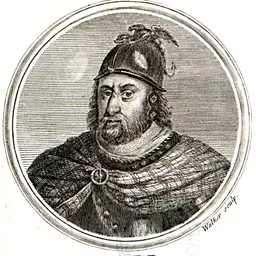
John (de) Balliol ( – late 1314), known derisively as Toom Tabard (meaning 'empty coat'), was King of Scots from 1292 to 1296. Little is known of his early life. After the death of Margaret, Maid of Norway, Scotland entered an interregnum during which several competitors for the Crown of Scotland put forward claims. Balliol was chosen from among them as the new King of Scotland by a group of selected noblemen headed by King Edward I of England.
Edward used his influence over the process to subjugate Scotland and undermined Balliol's personal reign by treating Scotland as a vassal of England. Under pressure from the Scottish nobility, Balliol signed a treaty with France known as the "Auld Alliance" and renounced his fealty to Edward.
In retaliation, Edward invaded Scotland, starting the Wars of Scottish Independence. After a Scottish defeat in 1296, Balliol abdicated and was imprisoned in the Tower of London. Eventually, Balliol was sent to his estates in France and retired into obscurity, taking no more part in politics. Scotland was then left without a monarch until the accession of Robert the Bruce in 1306. John Balliol's son Edward Balliol would later exert a claim to the Scottish throne against the Bruce claim during the minority of Robert's son David.
Name
In Norman French his name was Johan de Bailliol; in Middle Scots it was Jhon Ballioun, and in Scottish Gaelic, Iain Bailiol. In Scots he was also known by the nickname Toom Tabard, usually understood to mean "empty coat" in the sense that he was an ineffective king. Alternatively the word coat may refer to a coat of arms; either to the Balliol arms which are a plain shield with an orle, also known as an inescutcheon voided or because his arms were stripped from his tabard in public.
Early life Little of Balliol's early life is known. He was born between 1248 and 1250 at an unknown location; possibilities include Galloway, Picardy, and Barnard Castle, County Durham. He was the son of John, 5th Baron Balliol, Lord of Barnard Castle (and founder of Balliol College, Oxford), and his wife Dervorguilla of Galloway, daughter of Alan, Lord of Galloway and granddaughter of David, Earl of Huntingdon — the brother of William the Lion. From his mother he inherited significant lands in Galloway and claim to lordship over the Gallovidians, as well as various English and Scottish estates of the Huntingdon inheritance; from his father he inherited large estates in England and France, such as Hitchin, in Hertfordshire.
Accession as King of Scots
In 1284 Balliol had attended a parliament at Scone, which had recognised Margaret, Maid of Norway, as heir presumptive to her grandfather, King Alexander III. Following the deaths of Alexander III in 1286 and Margaret in 1290, John Balliol was a competitor for the Scottish crown in the Great Cause, The Scottish auditors' decision in favour of Balliol was pronounced in the Great Hall of Berwick Castle on 17 November 1292, Assisted by the council, Balliol went on to conclude a treaty of mutual assistance with Philip IV of France on 23 October 1295, known in later years as the "Auld Alliance". By the terms of the alliance, Balliol's son Edward was betrothed to Philip's niece, Joan of Valois.
Abdication In retaliation for Scotland's treaty with France, Edward I invaded, commencing the Wars of Scottish Independence. The Scots were defeated at Dunbar and the English took Dunbar Castle on 27 April 1296. Balliol was released into the custody of Pope Boniface VIII on condition that he remain at a papal residence. He was released around the summer of 1301 and lived the rest of his life on his family's ancestral estates at Hélicourt, Picardy.
Over the next few years, there were several Scottish rebellions against Edward (for example, in 1297 under William Wallace and Andrew Moray). When Wallace was chosen as commander, he claimed to act in the name of his king, John Balliol. This claim came to look increasingly tenuous, as Balliol's position under nominal house-arrest meant that he could not return to Scotland nor campaign for his release, despite the Scots' diplomatic attempts in Paris and Rome. After 1302, he made no further attempts to extend his personal support to the Scots. and requested the fealty and homage of Edward Balliol to be given by proxy.
Marriage and children
Balliol married around 9 February 1281 to Isabella de Warenne, daughter of John de Warenne, 6th Earl of Surrey. Agnes (or Maud or Anne) Balliol (who might actually have been his sister), who married Bryan FitzAlan, Lord FitzAlan, and Margaret Balliol who married Sir John St Clere, knight, of East Grinsted, Sussex.
Fictional portrayals John Balliol, An Historical Drama. In Five Acts (1825), play based on his life by William Tennant.
Don’t just read it —
keep it.
Full-length biographies made to live with: read them, listen on the way to work, watch them tonight.
- E-book
- Audio
- Video
Instant download · yours to keep · every purchase keeps this site free
Important facts
Family & relationships
People in John of Scotland's life
Named in this biography and alive at the same time


Related people
Same field, nearest in time
Contemporaries
People whose lives overlapped John of Scotland's




Frequently asked questions
Who was John of Scotland?
King of Scots
When was John of Scotland born?
John of Scotland was born in 1249.
When did John of Scotland die?
John of Scotland died on 25 November 1314 in Châteaux de Hélicourt.
What was John of Scotland's occupation?
John of Scotland was a sovereign.
What nationality was John of Scotland?
John of Scotland was Scottish.
Sources & further reading
Cite this page
APA: Biography.guide. (2026). John of Scotland. https://biography.guide/john-of-scotland/
MLA: "John of Scotland." Biography.guide, https://biography.guide/john-of-scotland/.
Chicago: "John of Scotland." Biography.guide. https://biography.guide/john-of-scotland/.
Data last updated: 2026-09-20 · Spot an error? Report a correction.
Page generated 2026-09-27 05:30 UTC