
About John Michael Klineberg
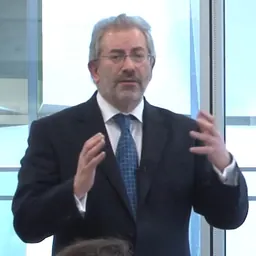
Lived 1938 – 2022 (aged 84). John Michael Klineberg was an American civil servant, military flight engineer, scientist and engineer.
John Michael Klineberg (October 16, 1938 – December 31, 2022) was an American aerospace engineer and NASA official who directed two of the agency's field centers. He began his NASA career as a research engineer at the Ames Research Center in 1970 before moving to NASA Headquarters, where he helped develop the Aircraft Energy Efficiency Program, a federal effort to reduce aviation fuel consumption after the 1973 oil crisis.
He became deputy director of NASA's Lewis Research Center in 1979 and served as its sixth director from 1987 to 1990. Under Klineberg, the center expanded its space portfolio, reactivated test facilities at Plum Brook Station, and helped establish the Ohio Aerospace Institute. In 1990, he was appointed the seventh director of Goddard Space Flight Center, arriving just as the newly launched Hubble Space Telescope was found to have a flawed primary mirror. He oversaw the recovery effort that led to the telescope's repair during the 1993 STS-61 servicing mission, which was awarded the Collier Trophy, and later managed the Cosmic Background Explorer. Klineberg retired from NASA in 1995 and received the NASA Distinguished Service Medal, the agency's highest honor.
After leaving NASA, Klineberg joined Space Systems/Loral, where he led the development and deployment of the Globalstar satellite telephone constellation and served as company president from 1999 to 2001. He later became CEO of Swales Aerospace and advised the federal government through the National Research Council, chairing a panel on NASA's aeronautics research and serving on a committee that studied options for extending the life of the Hubble Space Telescope.
Early life and education Klineberg was born in Scarsdale, New York in 1938 as the middle child of Selma and Otto Klineberg, who were Jewish. In 1954, Otto presented evidence against scientific racism as an expert witness for the Supreme Court, helping to sway the landmark Brown v. Board of Education case that struck down racial segregation in American schools. Otto's work shaped Klineberg's interest in the relationship between science and public life, and he later pursued graduate study in both aeronautics and political science. and was funded by the Air Force Office of Scientific Research.
Career
Early years After leaving Caltech, Klineberg joined NASA's Ames Research Center as a research engineer in aeronautics in 1970. He cited President John F. Kennedy's 1962 "We choose to go to the Moon" speech at Rice University as an inspiration. Four years later, he joined NASA Headquarters to head the Low-Speed Aircraft Branch
In early 1975, Klineberg was a "key member" of a program that represented one of the largest coordinated fuel conservation efforts ever attempted in the United States. a 15-member NASA body established by Associate Administrator Alan M. Lovelace in response to the 1973 oil crisis.
Directed by James J. Kramer, a colleague at OAST, Klineberg later "recalled how closely it listened to the needs of industry".
Lewis Research Center Andrew J. Stofan (left) and Klineberg (right) with an Advanced Turboprop model at NASA's Lewis Research Center (1983) On July 1, 1979, Klineberg moved to Lewis Research Center in Cleveland, Ohio, becoming deputy director under John F. McCarthy Jr. He restructured the center that November to match its growing share of space projects, launched a strategic planning effort building on a 1982 predecessor, and obtained funding to build the Power Systems Facility for the center's space power work.
Under Klineberg, Lewis also brought several inactive test facilities at Plum Brook Station back into service. but a 1985 multi-agency commission recommended reviving four of its facilities; the Space Power Facility, the Space Propulsion Research Facility, and the Cryogenic Tank Facility returned to operation between 1987 and 1990, with the Hypersonic Tunnel Facility following in 1996. Conceived as a public–private consortium, the OAI brought together nine Ohio universities, Lewis, the Wright Laboratory, and private firms and was opened in 1992.
Goddard Space Flight Center NASA announced in April 1990 that Klineberg would depart on June 30, 1990, to lead Goddard Space Flight Center as its seventh director. Upon arriving at Goddard, Klineberg immediately faced two crises in parallel. The Hubble Space Telescope, deployed in April 1990, had been found within weeks to carry a severe flaw in its primary mirror: a spherical aberration that left the instrument unable to produce sharp images and drew widespread public ridicule of NASA. Simultaneously, the center's Geostationary Operational Environmental Satellite (GOES) program was in serious trouble after engineers discovered another flaw in the newest GOES instrument package, leaving the United States dependent on a single aging satellite for weather coverage while a replacement remained grounded. thumb Klineberg accepts the Collier Trophy for NASA in 1988To address the GOES program's difficulties, Klineberg recruited Rick Obenschain, a project manager with limited seniority, to take charge of the troubled program; Obenschain stabilized it and delivered the next-generation satellites successfully. On the Hubble front, Klineberg appointed Joseph H. Rothenberg as associate director for flight projects for the telescope. Rothenberg and project scientist Al Boggess then drew up a phased recovery strategy in which Goddard's teams would maximize what science could be done with the degraded instrument while developing the Corrective Optics Space Telescope Axial Replacement for installation during a planned 1993 servicing mission.
During his tenure, Goddard also served as managing center for the Cosmic Background Explorer (COBE), a project whose science team announced the detection of anisotropies in the cosmic microwave background radiation in April 1992, a finding that confirmed predictions of the Big Bang model and later formed the basis of the 2006 Nobel Prize in Physics. Klineberg retired from NASA on April 29, 1995.
Later life and legacy He selected Lawrence J. Ross as his successor, having named him deputy director in 1987. In 1999, he became president of the company and a vice president of its parent, Loral Space & Communications, and he remained on Space Systems/Loral's board of directors after retiring in 2001. He was also an honorary board member of the National Space Club and a member of the International Astronautical Federation. NASA Outstanding Leadership Medal Fellow of the American Astronautical Society
Gallery
Don’t just read it —
keep it.
Full-length biographies made to live with: read them, listen on the way to work, watch them tonight.
- E-book
- Audio
- Video
Instant download · yours to keep · every purchase keeps this site free
Important facts
People in John Michael Klineberg's life
Named in this biography and alive at the same time



Related people
Same field, nearest in time


Contemporaries
People whose lives overlapped John Michael Klineberg's




Frequently asked questions
Who was John Michael Klineberg?
Director at NASA (1938-2022)
When was John Michael Klineberg born?
John Michael Klineberg was born on 16 October 1938 in Scarsdale.
When did John Michael Klineberg die?
John Michael Klineberg died on 31 December 2022 in Davis.
What was John Michael Klineberg's occupation?
John Michael Klineberg was a civil servant, military flight engineer, scientist and engineer.
What nationality was John Michael Klineberg?
John Michael Klineberg was American.
Sources & further reading
· Wikipedia: John Michael Klineberg
Cite this page
APA: Biography.guide. (2026). John Michael Klineberg. https://biography.guide/john-michael-klineberg/
MLA: "John Michael Klineberg." Biography.guide, https://biography.guide/john-michael-klineberg/.
Chicago: "John Michael Klineberg." Biography.guide. https://biography.guide/john-michael-klineberg/.
Data last updated: 2026-09-20 · Spot an error? Report a correction.
Page generated 2026-09-27 05:23 UTC