
About John Mason
Lived 1586 – 1635 (aged 48–49). John Mason was a British politician and explorer.
Captain John Mason (1586–1635) was an English sailor and colonist who was instrumental to the establishment of various settlements in colonial America and is considered to be the 'Founder of New Hampshire'.
Mason was born in 1586 at King's Lynn, Norfolk, and educated at Peterhouse, Cambridge.
Early career
In 1610, he was appointed by James I to help reclaim the Hebrides for English-speaking rule, from Gaelic-speaking clan chiefs. He served as Captain of the expedition consisting of two ships of war and two pinnaces. As a reward, he was granted exclusive fishing rights in the North Sea. This was ignored by the Dutch and he was treated as a pirate by the Scots. In 1615, he was arrested, but soon released after the seizure of his ship.
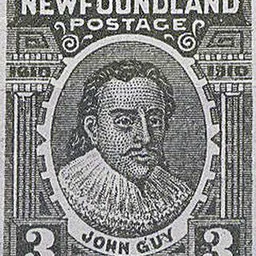
Newfoundland He was appointed the second Proprietary Governor of Newfoundland's Cuper's Cove colony in 1615, succeeding John Guy of Bristol, who had resigned. Mason arrived on the island in 1616 and explored much of the territory. He compiled a map of the island and wrote and published a short tract (or "Discourse") of his findings.
Mason drew up a map of the island of Newfoundland. Published in William Vaughan's Cambrensium Caroleia in 1625, the map included previously established placenames as well as new ones such as Bristol's Hope and Butter Pots, near Renews. His tract entitled , was published in 1620 by Mason while in England.
In 1620 King James I's Privy Council issued Mason a commission and provided him with a ship to suppress piracy in Newfoundland. Mason ceased to be Cuper's Cove governor in 1621 and apparently he was not replaced, although the settlement continued to be occupied throughout the seventeenth century.
Nova Scotia Upon returning to England in 1621, Mason consulted with Sir William Alexander about the possibility of establishing settlements on Nova Scotia. Alexander obtained a charter for Nova Scotia in September 1621.
New England
Captain Mason was granted several land grants describing land in present day New Hampshire and Maine in the years from 1621 - 1631. In 1629 they divided the grant along the Piscataqua River, with Mason receiving the southern portion.
Although Mason never set foot in New England, he was appointed first vice-admiral of New England in 1635. His brother-in-law, John Wollaston of London had an interest in New Hampshire, which he transferred to Mason in the summer of 1635. He died that same year while preparing for his first voyage to the new colony.
Don’t just read it —
keep it.
Full-length biographies made to live with: read them, listen on the way to work, watch them tonight.
- E-book
- Audio
- Video
Instant download · yours to keep · every purchase keeps this site free
Important facts
People in John Mason's life
Named in this biography and alive at the same time


Related people
Same field, nearest in time

Contemporaries
People whose lives overlapped John Mason's




Frequently asked questions
Who was John Mason?
Governor of Newfoundland, born 1586
When was John Mason born?
John Mason was born in 1586 in King's Lynn.
When did John Mason die?
John Mason died in 1635 in London.
What was John Mason's occupation?
John Mason was a politician and explorer.
What nationality was John Mason?
John Mason was British.
Sources & further reading
· DBpedia: John Mason (governor)
Cite this page
APA: Biography.guide. (2026). John Mason. https://biography.guide/john-mason/
MLA: "John Mason." Biography.guide, https://biography.guide/john-mason/.
Chicago: "John Mason." Biography.guide. https://biography.guide/john-mason/.
Data last updated: 2026-09-20 · Spot an error? Report a correction.
Page generated 2026-09-27 04:58 UTC