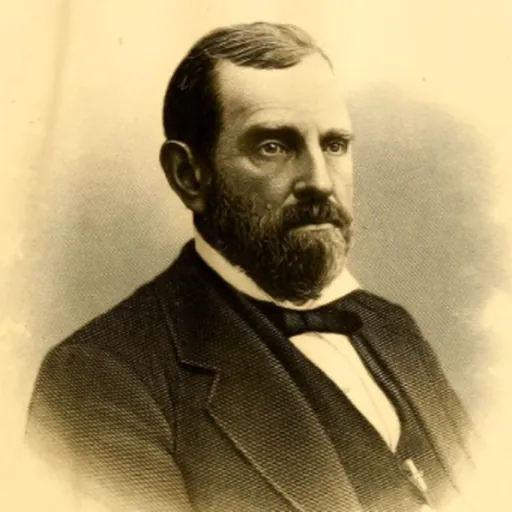
About John Love
Lived 1820 – 1881 (aged 61). John Love was a military personnel.
John Love (January 9, 1820 – January 29, 1881) was a United States Army officer during and after the Mexican-American War, a railroad contractor, an officer in the Union Army during the American Civil War and a major general in the Indiana Legion, also referred to as the Indiana militia or home guard or state defense force, during the American Civil War. After resigning on January 1, 1863, he was called back into service in July 1863 and commanded an Indiana militia force which pursued Confederate Brigadier General John Hunt Morgan's raiders in Indiana. On July 11, 1863, about 100 militia men held off Morgan's raiders at Vernon, Indiana, forcing them to withdraw when Love arrived with reinforcements arrived. After his service he was a real estate broker and representative of the Gatling Gun Company in Europe. In 1880, Congress appointed Love to be a manager of the National Home for Disabled Volunteer Soldiers.
Early life and education John Love was born in Culpeper County, Virginia on January 9, 1820 to the former Eliza Matilda Lee (1790-1875) and her husband Richard Hendley Love (1786-1832). His ancestors, William Love and his wife Judith had emigrated to Maryland in the 1630s. His great-great grandfather Samuel Love Sr. (1686-1772) had deeded his approximately 300 acres in Charles County, Maryland to his two eldest sons during the Revolutionary War and moved the rest of his family was then the Virginia frontier. Previously, the carpenter had been gaining social status in Maryland, achieving status as a vestryman and justice of the peace and even on the earliest Committee of Correspondence, but his eldest son had with his father's assistance purchased land in Loudoun County Virginia in 1769 and had begun his own social ascent as vestryman and justice of the peace, only to enlist in the Third Virginia Regiment as a sergeant for a two year enlistment, as would his younger half brother John (but as a private and for an initial three year term in the First Virginia Regiment, which led to promotions to after re-enlistment for the duration of the war. Meanwhile about 1774, two years after the death of greatgrandfather Samuel, the two younger Samuel Loves established a mill and farm at Buckland on what became the border of Prince William and Fauquier Counties long before this man was born. His great-grandfather had named the community after William Buckland, an English emigrant today best known as the architect and master carpenter behind Gunston Hall in Fairfax County. Not long after the Revolutionary War, the four sons of that middle Samuel Love (1720-1787) (at least two of whom had actively fought in the Patriot armies) owned about 12,000 acres in northern Virginia in what had once been the Northern Neck Proprietary. His grandfather was Samuel Love Jr.(1745-1800), whose brother, also John Love, represented that northern Virginia area for several years in the U.S. House of Representatives and the Virginia Senate before his wife died and he sold the decades-long family homestead and moved to Tennessee. Through his mother, a daughter of Ludwell Lee, this John Love was a third cousin of Robert E. Lee. Love had an elder brother Richard Love (1816-1855, who joined the U.S. Navy and died in Florida), and two sisters, one of whom married a Rev. Johnson and moved to South Carolina, and Cecelia Lee (Matilda) Love Armistead (1823-1853; whose widower husband Lewis Armistead, also a career U.S. Army officer, would resign his commission and rise to the rank of CSA Major General before dying at the Battle of Gettysburg in 1862). His father died in Leesburg, Virginia when this boy was 11 years old.
Early military career
Love secured an appointment as a cadet at the United States Military Academy at West Point, New York from Tennessee on September 1, 1837. Upon graduation from the U.S. Military Academy on July 1, 1841, Love was appointed brevet second lieutenant in the First Regiment of Dragoons, re-designated the 4th Cavalry Regiment (United States) in 1861, now the 1st Cavalry Regiment (United States).
Love was promoted to first lieutenant, 1st Regiment of Dragoons, on June 30, 1846. He led 300 men from his Army of the West at the Battle of Santa Cruz de Rosales on March 16, 1848, defeating a Mexican force three times his size. This was the last battle of the war, taking place days after the Treaty of Guadalupe Hidalgo had been ratified by the United States Congress on March 10. Although reprimanded by Secretary of War William L. Marcy and ordered to return with his army to New Mexico, Price was not punished.
Company B of the 1st Regiment of Dragoons had been trained as an artillery regiment after the beginning of the war. First Lieutenant John Love was in command of the artillery battalion at the Battle of Santa Cruz de Rosales. Love was appointed brevet captain for gallantry at the Battle of Santa Cruz de Rosales, Mexico, March 16, 1848.
Assignments 1849–1853 Love served as quartermaster of the 1st Regiment of Dragoons from March 12, 1849, to December 1850. He was with Morris during skirmishing starting July 7, 1861 at Laurel Hill, from which the Confederates withdrew on July 11 after the Union Army victory at the Battle of Rich Mountain. Republican Governor of Indiana Oliver P. Morton had asked Love, as a War Democrat, to help him with his administration. Union Army Major General Orlando B. Willcox was in command of the District of Indiana and Michigan.
On July 11, 1863, Morgan's men approached Vernon, Indiana after sending parties toward Mitchell, Salem and Seymour. A detachment of Indiana militia and a small number of new U.S. volunteer troops sent by Willcox from Michigan held Vernon and, Love having discerned Morgan's next target, sent Colonel C. V. DeLand, a couple of artillery pieces and two Indiana militia regiments to Vernon. Love quickly followed with the rest of his militia force, which resulted in more than 1,000 Union defenders at Vernon when Morgan's main force arrived about 4:00 p.m. Morgan sent two flags of truce demanding the Union force surrender to him. Love defied the demand and in turn demanded that Morgan surrender. Love also began his connection with the Gatling Gun Company before the end of the American Civil War. After Richard J. Gatling set up his factory in Indianapolis in 1862, Love bought stock in the company, and also represented the company as it presented the gun for sale to the United States, China, Japan, Turkey, and throughout Europe in 1867. Death and legacy
John Love died of heart disease on January 29, 1881, at Indianapolis, Indiana. He is buried at Crown Hill National Cemetery.
Don’t just read it —
keep it.
Full-length biographies made to live with: read them, listen on the way to work, watch them tonight.
- E-book
- Audio
- Video
Instant download · yours to keep · every purchase keeps this site free
Important facts
People in John Love's life
Named in this biography and alive at the same time


Related people
Same field, nearest in time
Contemporaries
People whose lives overlapped John Love's

Frequently asked questions
Who was John Love?
United States Army officer 1820–1881
When was John Love born?
John Love was born on 9 January 1820 in Culpeper County.
When did John Love die?
John Love died on 29 January 1881 in Indianapolis.
What was John Love's occupation?
John Love was a military personnel.
Sources & further reading
· DBpedia: John Love (general)
Cite this page
APA: Biography.guide. (2026). John Love. https://biography.guide/john-love-military-personnel/
MLA: "John Love." Biography.guide, https://biography.guide/john-love-military-personnel/.
Chicago: "John Love." Biography.guide. https://biography.guide/john-love-military-personnel/.
Data last updated: 2026-09-25 · Spot an error? Report a correction.
Portrait: Wikimedia Commons · author & licence
Page generated 2026-10-04 09:41 UTC