
About John Leland
Lived 1502 – 1552 (aged 49). John Leland was an English librarian, historian, archaeologist and topographer.
Early life and education Most evidence for Leland's life and career comes from his own writings, especially his poetry. He was born in London on 13 September, most probably in about 1503, and had an older brother, also named John. Having lost both his parents at an early age, he and his brother were raised by Thomas Myles. Leland was educated at St Paul's School, London, under its first headmaster, William Lily. graduating in 1522 (BA). While in France, Leland kept in touch with his friends and sponsors in England, probably including Thomas Wolsey (d. 1530), Cardinal and Lord Chancellor, who made him rector at Laverstoke, Hampshire.
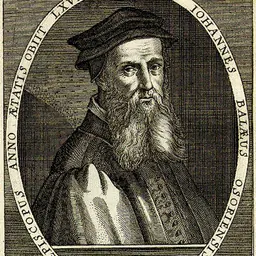
Leland and Nicholas Udall composed verses to be read or recited at the pageant of Anne Boleyn's arrival in London in 1533, which was staged for the occasion of her coronation. Leland spent the next few years travelling from house to house, for the most part shortly before they were dissolved, compiling numerous lists of significant or unusual books in their libraries. About 1535, he met the ex-Carmelite churchman and fellow antiquary John Bale, who much admired his work and offered his assistance. He complained that The Germans perceive our desidiousness, and do send daily young scholars hither that spoileth [books], and cutteth them out of libraries, returning home and putting them abroad as monuments of their own country. There is no evidence that he personally oversaw the relocation of the books to their new home or received a librarian's wages. What he did do was to compile his lists of important volumes, and to take measures to encourage their preservation.
Itineraries, c. 1538–43 Even after the Dissolution of the Monasteries, Leland did not abandon his hunt for books. For instance, he obtained official permission to avail himself of the library belonging to the defunct monastery of Bury St Edmunds. He subsequently made a number of journeys in England: the exact sequence and their dates are again uncertain, but there seem to have been five major English itineraries, taken over the summers of the years 1539 to 1543. His one firmly dated itinerary is that of 1542, which took him to the West Country. By that date he had been on a tour to the north-west, which went via the Welsh marches to Cheshire, Lancashire and Cumberland; while other itineraries took him to the west Midlands, the north-east (reaching Yorkshire and County Durham), and the Bristol region. He probably explored the south-east in shorter excursions. He is not known to have toured East Anglia, for which only a few fragmentary notes survive.
Leland kept notebooks on his travels, in which he entered and assessed information from personal observation, and from books, charters and oral sources. It is this material which we now know as his 'Itinerary'.
In the 1906–10 edition, the Itinerary runs to five printed volumes. It comprises rough notes and very early drafts, the raw materials for a more digested description of England and Wales – Leland would not have envisaged publishing it in anything like its present form. The county on which he appears to have made greatest progress in organising his material was Kent. "Let this be the firste chapitre of the booke", he wrote; "The King hymself was borne yn Kent. Kent is the key of al Englande." John Bale later listed an Itinerarium Cantiae (Itinerary of Kent) among Leland's writings.
Although Leland's Itinerary notes remained unpublished until the eighteenth century, they provided a significant quarry of data and descriptions for William Camden's Britannia (first edition, 1586), and many other antiquarian works. It was subsequently published by John Bale in 1549 (with Bale's own additional commentary) under the title . The letter has traditionally (following Bale) been regarded as a "New Year's gift" to the King for January 1546, but James Carley has shown that it must have been composed in late 1543 or early 1544 (so that if it was presented at the new year, which is not certain, it would have been in 1544).
In the letter, Leland reported on his endeavours to preserve books, and the extent and thoroughness of his travels through England and Wales:
He also described what use he intended to make of the information he had accumulated. He noted four projects: De uiris illustribus, a biographical encyclopedia of British writers in four books, arranged chronologically. A detailed map of the realm engraved on a silver table, to be presented to the King (inspired by a set of table-maps once possessed by the Emperor Charlemagne), accompanied by a written description, the Liber de topographia Britanniae, and a key to identifying the British place-names given in ancient texts. A history of England and Wales, entitled De Antiquitate Britannica, or Civilis Historia. This work was to be divided into "so many bookes as there be shires yn England, and sheres and greate dominions yn Wales", i.e. about fifty: a further six books would deal with Britain's offshore islands. De nobilitate Britannica, a catalogue of royalty, nobility, and "capitaines and rulers", divided chronologically into three books.
Of these projects, De uiris illustribus was already largely complete (it was written in two phases, in –36 and –46), but the others would never come to fruition. Polydore Vergil appears to have suggested that Leland had been unrealistically over-ambitious: he was "a vaynegloryouse persone, whyche woulde promyse more, than ever he was able or intended to perfourme".
Leland and archaeology Leland was concerned to record evidence for the history of England and Wales as it was visible in the landscape, and he therefore took pains to note all kinds of archaeological remains, including megaliths, hillforts, and Roman and medieval ruins. He came across several Roman inscriptions, though he was unable to read most of them, complaining of one that it was made up of "letters for whole words, and 2. or 3. letters conveid in one". He often reported finds of coins, writing of Richborough, Kent, for example, that more Roman money had been discovered there "then in any place els of England". He investigated and recorded building materials in some detail.
He was sometimes able to make astute and informed deductions from what he saw. At Lincoln, for example, he identified three phases of urban development, beginning with a British settlement at the top of the hill (close to which "much Romaine mony is found"), the Saxon and medieval town further south, and a more recent riverside development at Wigford. He was able to judge that the existing fabric of Ripon Minster "indubitately was made sins the Conquest". He correctly distinguished what he called "Briton brykes" (actually Roman bricks) at several geographically dispersed sites, including Verulamium, Richborough, Lympne, Dover Castle, Canterbury, and Bewcastle.
He was normally content to record surface remains and recovered artefacts, but on one occasion he adopted a more interventionist approach. At the hillfort at Burrough Hill, Leicestershire, he pulled some stones from the gateway to establish whether it had been walled or not: they were mortared with lime, which persuaded him that it had been. The account included in Leland's Itinerary may be regarded as the earliest archaeological field report.
Leland and King Arthur Leland was a staunch patriot, and believed firmly in the historical veracity of King Arthur. He therefore took offence when the Italian scholar Polydore Vergil cast doubts on certain elements in the Arthurian legend in his Anglica Historia (published in 1534). Leland's first response was an unpublished tract, written perhaps in 1536, the Codrus sive Laus et Defensio Gallofridi Arturii contra Polydorum Vergilium. ("Codrus", a pseudonym for Vergil, was a type-name drawn from Juvenal for a wretched and dreary hack-poet.) He followed this with a longer published work, the Assertio inclytissimi Arturii regis Britannia (1544). In both texts, Leland drew on a wide range of literary, etymological, archaeological and oral sources to defend the historicity of Arthur. Although his central belief was flawed, his work preserved much evidence for the Arthurian tradition that might otherwise have been lost.
Leland's material provides invaluable evidence for reconstructing the lost "tomb monument" of Arthur (thought to be a fabrication of the twelfth century) at Glastonbury Abbey. He was probably also responsible for making a drawing of the lead cross that identified the grave as Arthur's, afterwards published as a woodcut in the 1607 edition of Camden's Britannia.
On his itinerary of 1542, Leland was the first to record the tradition (possibly influenced by the proximity of the villages of Queen Camel and West Camel) identifying the hillfort of Cadbury Castle in Somerset as Arthur's Camelot:
Final years and death In 1542, Henry presented Leland with the valuable rectory of Great Haseley, Oxfordshire. and Archbishop Matthew Parker.
Leland's own manuscript notebooks were inherited by Cheke's son, Henry, and in 1576 they were borrowed and transcribed by John Stow, allowing their contents to begin to circulate in antiquarian circles. Antiquaries who gained access to them through Stow included William Camden, William Harrison, Robert Glover and Francis Thynne. The original notebooks passed from Henry Cheke to Humphrey Purefoy, and so (following his death in 1598) to Humphrey's son Thomas, who divided many of them between his two cousins John Hales and the antiquary, William Burton. Burton subsequently managed to recover several of the items given to Hales, and in 1632 and 1642–3 donated most of the collection—comprising the Collectanea, De scriptoribus and several of the Itinerary notebooks—to the Bodleian Library, Oxford, where the volumes remain.
The Leland Trail The Leland Trail is a footpath, which follows the footsteps of John Leland as he traversed South Somerset between 1535 and 1543 in the course of his investigation of the region's antiquities. The Leland Trail begins at King Alfred's Tower on the Wiltshire/Somerset border and finishes at Ham Hill Country Park.
Works
Latin poetry Naeniae in mortem Thomæ Viati, equitis incomparabilis (1542). An elegy in praise of Sir Thomas Wyatt, written on his death. Genethliacon illustrissimi Eaduerdi principis Cambriae (1543). A poem inspired by the birth of Prince Edward (the future Edward VI) in 1537, and focusing on his titular dominions of Wales, Cornwall and Cheshire. A prose "Syllabus" (appendix) provides a commentary on its many topographical allusions. Three poems in celebration of the king's military achievements in France: Fatum Bononiae Morinorum (1544), on the First Siege of Boulogne in 1544. Bononia Gallo-mastix in laudem felicissimi victoris Henrici VIII (1545), also on the First Siege of Boulogne. Laudatio pacis (1546). Naenia in mortem splendidissimi equitis Henrici Duddelegi (1545). An elegy in praise of Sir Henry Dudley. Κυκνειον άσμα: Cygnea cantio (1545). A long "river poem", which praises Henry VIII through the voice of a swan as it swims down the Thames from Oxford to Greenwich. An extensive prose "Commentarii" elucidates the poem's many place-name and topographical references. Principum, ac illustrium aliquot & eruditorum in Anglia virorum, encomia, trophæa, genethliaca, & epithalamia (1589), ed. Thomas Newton. Generally known as the Encomia, this is a collection of over 250 short poems in honour of Leland's contemporaries.
Antiquarian prose writings Leland's prose writings, published and unpublished, include: Assertio inclytissimi Arturii regis Britanniae (1544). Leland's prose treatise on the historicity of King Arthur. Also published in English translation by Richard Robinson as A learned and true assertion of the original, life, actes, and death of the most noble, valiant, and renoumed Prince Arthure, King of great Brittaine (1582). "Antiphilarchia" (completed in 1541, unpublished). A religious dialogue, written in response to Albert Pighius' "Hierarchiæ ecclesiasticæ assertio" (Cologne, 1538). Leland's manuscript survives as Cambridge University Library MS Ee.5.14. His annotated copy of the Pighius work can be found in the collection of Worcester Cathedral now administered by the University of Birmingham. The "New Year's Gift" . A letter addressed to Henry VIII. Published by John Bale (with additional commentary) as The Laboryouse Journey (1549). "De uiris illustribus" (written –36 and –46). A biographical dictionary of famous British authors in chronological order. Leland did not live to complete the work. The manuscript is Bodleian Library MS Top. gen. c.4. It was published as Commentarii de scriptoribus Britannicis by Anthony Hall in 1709; and more authoritatively (and under its original title) by James Carley in 2010. "Antiquitates Britanniae". A compendium of extracts from classical and medieval texts relating to Britain. Now British Library Cotton MS Julius C.vi. The "Collectanea" (now Bodleian Library, MSS Top. gen. c.1–3; British Library Add. MS 38132). Leland's many notes and transcripts from his visits to monastic libraries, including most of his book-lists, compiled 1533–36. The three principal volumes were donated to the Bodleian by William Burton. First published in six volumes by Thomas Hearne in 1715, with revised editions appearing in 1770 and 1774. The third volume includes a copy of Ælfric's Glossary. Leland reports that at Malmesbury, he found a copy of a now lost work which he ascribed to William of Malmesbury, verses in 15 books on the four Evangelists. "Itinerary" notebooks (now Bodleian Library, MSS Top. gen. e.8–15; other fragments in British Library, or surviving only as later transcripts). Leland's topographical notes, compiled –43. Of the Bodleian material, the first seven volumes were donated to the library by Burton, and the eighth and final one (a compilation of fragments) by Charles King . First published by Thomas Hearne in 1710–12 (second edition 1744–45); and more authoritatively by Lucy Toulmin Smith in 1906–10.
Leland's writings are an invaluable primary source, not only for the local history and the geography of England, but also for literary history, archaeology, social history, and economic history.
Editions of Leland's works
Collectanea
Commentarii de Scriptoribus Britannicis
De uiris illustribus: On Famous Men
This is a new and authoritative edition (with English translation) of the work previously published by Hall as Commentarii de Scriptoribus Britannicis.
Itinerary (ed. Thomas Hearne, 9 vols.)
Vol. 1 Vol. 2 Vol. 3 Vol. 4 Vol. 5 Vol. 6 Vol. 7 Vol. 8 Vol. 9
Itinerary (ed. Lucy Toulmin Smith, 5 vols.) Toulmin Smith, Lucy (ed.), The Itinerary of John Leland in or about the years 1535–1543, Vol. 1, Containing Parts 1–3, with General Introduction, Portrait, and 2 Maps, London, 1907 Toulmin Smith, Lucy (ed.), The Itinerary of John Leland in or about the years 1535–1543, Vol. 2, Containing Parts 4 & 5, with an Appendix of Extracts from Leland's Collectanea, and a Map, London, 1908. Toulmin Smith, Lucy (ed.), The Itinerary in Wales of John Leland in or about the years 1536–1539, Vol. 3 Containing Part 6 (The Itinerary in Wales), with a Map, London, 1906. Toulmin Smith, Lucy (ed.), The Itinerary of John Leland in or about the years 1535–1543, Vol. 4, Containing Parts 7 & 8 with Appendices including Extracts from Leland's Collectanea & 3 Maps, London, 1909. Toulmin Smith, Lucy (ed.), The Itinerary of John Leland in or about the years 1535–1543, Vol. 5, Containing Parts 9–11, Two Appendices, a Glossary and General Index, London, 1910.
Itinerary (ed. John Chandler) Chandler, John (ed.), John Leland's Itinerary: Travels in Tudor England, Gloucester: Sutton, 1993; revised edn. 1998; 2nd edn. Gloucester: Hobnob Press, 2022 This edition, based on Toulmin Smith's, rearranges Leland's topographical descriptions of England (with Wales added in the second edition) in county chapters, and renders them in modern English. It is less authoritative for scholarly purposes, but considerably more accessible and easier to navigate. It also corrects a small number of errors by Toulmin Smith.
Latin poetry Naeniae in Mortem Thomae Viati. Published by Dana F. Sutton with English translation in the Philological Museum as Naeniae in Mortem Thomae Viati. Genethliacon. Published by Dana F. Sutton with English translation in the Philological Museum under the title Pompa Nympharum. Bononia Gallo-mastix and Laudatio pacis. Published by Dana F. Sutton with English translation in the Philological Museum as Two Poems on the French War. Naenia in mortem splendidissimi equitis Henrici Duddelegi. Published by Dana F. Sutton with English translation in the Philological Museum as Naenia in mortem splendidissimi equitis Henrici Duddelegi. Cygnea Cantio. Published by Dana F. Sutton with English translation in the Philological Museum as Cygnea Cantio. Encomia. 28 of Leland's short poems from this collection are published with English translations by James Carley in "Leland in Paris" (1986). All 282 short poems are published by Dana F. Sutton with English translations in the Philological Museum under the title Epigrammata. Sutton publishes two longer masques from the collection separately as Two Latin Masques.
Don’t just read it —
keep it.
Full-length biographies made to live with: read them, listen on the way to work, watch them tonight.
- E-book
- Audio
- Video
Instant download · yours to keep · every purchase keeps this site free
Important facts
People in John Leland's life
Named in this biography and alive at the same time




Related people
Same field, nearest in time


Contemporaries
People whose lives overlapped John Leland's





Frequently asked questions
Who was John Leland?
English poet and antiquary
When was John Leland born?
John Leland was born on 13 September 1502 in London.
When did John Leland die?
John Leland died on 18 April 1552 in London.
What was John Leland's occupation?
John Leland was a librarian, historian, archaeologist and topographer.
What nationality was John Leland?
John Leland was English.
Sources & further reading
· DBpedia: John Leland (antiquary)
Cite this page
APA: Biography.guide. (2026). John Leland. https://biography.guide/john-leland-librarian/
MLA: "John Leland." Biography.guide, https://biography.guide/john-leland-librarian/.
Chicago: "John Leland." Biography.guide. https://biography.guide/john-leland-librarian/.
Data last updated: 2026-09-20 · Spot an error? Report a correction.
Page generated 2026-09-27 05:19 UTC