About John Lambe
Lived 1545 – 1628 (aged 82–83). John Lambe was an astrologer.
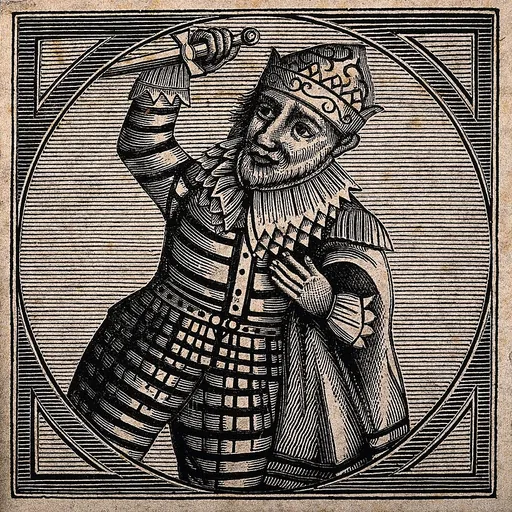
1628 woodcut of Lambe's death from A Brief Description of the Notorious Life of John Lambe.
John Lambe (or Lamb) (c. 1545 – 13 June 1628) was an English astrologer and quack physician who, by around 1625, served George Villiers, 1st Duke of Buckingham as his personal advisor.
Accused of black magic and rape, he was stoned to death by an unruly mob in London. Sometime after about 1600, Lambe established a reputation as a "cunning man" – that is, someone well-versed in astrology and magic. Calling himself "Doctor Lambe" (though he was not a licensed physician), he claimed that he could read fortunes, identify diseases, repel witchcraft, and locate missing or stolen items with his crystal ball. Rumors also emerged that he was skilled in the dark art of conjuration. Records indicate that he charged approximately 40 to 50 pounds for his services, and he was active in the London-area from approximately 1608 to 1628.
Sometime before 1625, Lambe attracted the attention of George Villiers, a favourite of King Charles I, and he eventually became the Duke's personal adviser. Public opinion of Lambe was roughly split into two camps: those who thought the “doctor” was a nothing more than a quack, and those who believed he actually had magical abilities. The latter referred to Lambe as "the Duke's Devil," and they suspected he was exerting a supernatural influence over Villiers, who in turn influenced King Charles. At the time, Charles was particularly unpopular for his questionable military campaigns and absolutist policies, and a popular chant went as follows:
Who rules the Kingdom? The King. Who rules the King? The Duke. Who rules the Duke? The Devil! Sceptics continued to scoff at such accounts, dismissing Lambe as “a notable mountebank and impostor",
Lambe in literature Lambe's life and death inspired literary works. An anonymous biography of the astrologer, A Brief Description of the Notorious Life of John Lambe, was published in 1628, and a play, Doctor Lamb and the Witches was released in 1634. In addition, multiple songs and poems were produced about the astrologer, such as "An Epitaph on Dr. Lambe":
Here Dr Lambe, the conjurer lyes, Against his will untimely dies The Divell did show himselfe a Glutton In taking this Lambe before he was a mutton The Divell in Hell will rost him there Whom the prentises basted here. In Hell they wondred when he came To see among the Goats a Lambe.
Accounts of Lambe's life would also appear in later writings, such as Isaac D'Israeli's Curiosities of Literature and Sir Walter Scott's Letters on Demonology and Witchcraft.
Don’t just read it —
keep it.
Full-length biographies made to live with: read them, listen on the way to work, watch them tonight.
- E-book
- Audio
- Video
Instant download · yours to keep · every purchase keeps this site free
Important facts
People in John Lambe's life
Named in this biography and alive at the same time
Related people
Same field, nearest in time





Contemporaries
People whose lives overlapped John Lambe's

Frequently asked questions
Who was John Lambe?
English astrologer
When was John Lambe born?
John Lambe was born in 1545.
When did John Lambe die?
John Lambe died in 1628 in London.
What was John Lambe's occupation?
John Lambe was an astrologer.
Sources & further reading
Cite this page
APA: Biography.guide. (2026). John Lambe. https://biography.guide/john-lambe-astrologer/
MLA: "John Lambe." Biography.guide, https://biography.guide/john-lambe-astrologer/.
Chicago: "John Lambe." Biography.guide. https://biography.guide/john-lambe-astrologer/.
Data last updated: 2026-09-21 · Spot an error? Report a correction.
Portrait: Wikimedia Commons · author & licence
Page generated 2026-09-27 05:00 UTC