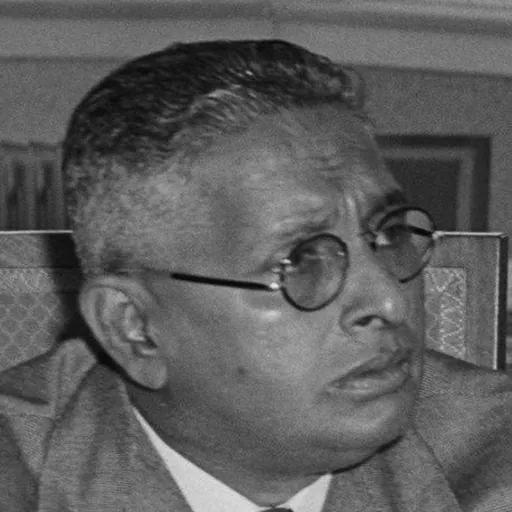
About John Kotelawala
Lived 1897 – 1980 (aged 83). John Kotelawala was a Sri Lankan diplomat and politician.
General Sir John Lionel Kotelawala (; 4 April 1897 – 2 October 1980) was a Sri Lankan statesman, who served as the third Prime Minister of Ceylon (Sri Lanka) from 1953 to 1956.
Born to a wealthy landholding and mining family, Kotelawala had a difficult childhood with the suicide of his father and the financial difficulties that followed. He was educated at Royal College, Colombo, and Christ's College, Cambridge, before returning to become a planter and run the family estates and mines. Kotelawala joined the Ceylon Defense Force as a volunteer officer in 1922. Being from a politically active family, he entered mainstream politics in 1931 having been elected to the State Council of Ceylon. He went on to serve as Minister of Communications and Works in the Second Board of Ministers of Ceylon. Having served as the commanding officer of the Ceylon Light Infantry, he transferred to the reserve with the rank of colonel in 1942.
With Ceylon gaining independence in 1948, he was elected to Parliament and became a member of the first Cabinet as Minister of Transport and Works. He was overlooked for the post of prime minister when his uncle, the first prime minister of Ceylon, D. S. Senanayake, died suddenly. A year later he succeeded his cousin, Dudley Senanayake, as the third Prime Minister of Ceylon, serving until his party lost the general election in 1956. Kotelawala retired from politics thereafter, going to self-imposed exile in Kent. Having donated his home, Kandawala, to the state to form a defense university, he was granted the rank of general on his deathbed.
Early life and education
Kotelawala was born on 4 April 1897 to John Kotelawala Snr, a police inspector, who later turned businessman and Alice Elisabeth Kotelawala (née Attygalle), daughter of Mudaliyar Don Charles Gemoris Attygalle, a wealthy land and mine owner. He had a younger brother Justin Kotelawala and a sister Freda, who later married C. V. S. Corea.
The Kotelawalas lived in considerable comfort owing to the considerable land and mine holdings of his grandfather Mudaliyar Attygalle, which his father managed following the death of his grandfather. After he was forced out of the management of the Attygalle estates by the family, Kotelawala Snr started his own business ventures including the Ceylon-Japan Trading Company. In 1907, he was arrested and found guilty of conspiring to murder his brother-in-law, Francis Attygalle. While the murder trial was underway, Kotelawala Snr committed suicide by poisoning himself.
Kotelawala was eleven years old when his father died and with this, the family fortunes declined after much funds were spent in the legal defence of his father. Alice Kotelawala who had converted to Christianity slowly built up the family wealth through careful management of their remaining land holdings and the share of the Kahatagaha graphite mine, which she received from her younger sister Ellen and brother-in-law, Fredrick Richard Senanayake. She was reputed for her social work and was later awarded an MBE in the 1939 Birthday Honours and a CBE in the 1951 Birthday Honours.
Young Kotelawala attended Royal College, Colombo, representing the school in cricket, tennis, boxing and football. He played in the Royal–Thomian. He had to leave owing to involvements in the riots in 1915, embarking on a tour of Europe, with World War I raging. He remained in Europe for five years, spending most of that time in England and France, and attended Christ's College, Cambridge to study agriculture. Kotelawala was known as an aggressive and outspoken man who loved sports, horseback riding and cricket and, particularly as a young man, got into physical fights when he was insulted. He was fluent in Sinhala, English and French. After returning to Ceylon, he became a planter, running his family plantation estates and mines, which included the Kahatagaha Graphite Mine in Dodangaslanda. He served as a Justice of the Peace.
Military service In a time when serving in the volunteer forces was prestigious and a gentlemanly pursuit, Kotelawala gained a commission as a second lieutenant in the Ceylon Light Infantry on 15 September 1922. That year the regiment received colours from the Prince of Wales. He progressed with promotions to lieutenant on 27 October 1924, captain on 23 August 1929 and major on 1 October 1933. On 1 July 1939, he was appointed second in command of the Ceylon Light Infantry and served till 1 September 1940. He was promoted to the rank of lieutenant colonel on 1 October 1940 and was posted to the reserve of the regiment.
With the outbreak of World War II in the Far East, the Ceylon Defence Force including the Ceylon Light Infantry was mobilized and expanded for wartime service with the British Army. Kotelawala as the Minister of Communications and Works, became a member of the Ceylon's War Council and served as the Commander-in-Chief of the Essential Services Labor Corp. He provided his home, Kandawala to function as the officers mess for the wartime RAF station at Rathmalana. He was promoted to honorary rank of colonel on 2 July 1942, the highest rank that a Ceylonese could achieve at the time in the Ceylon Defence Force.
In Cabinet
Just before Ceylon received independence and dominion status in 1948, Colonel Kotelawala had contested the 1947 general elections for the United National Party (UNP), founded by D. S. Senanayake, from the Dodangaslanda electorate and was elected to the newly formed House of Representatives, which was the elected lower house of parliament established under the Soulbury Constitution. Kotelawala was an important member of the UNP and was appointed by Senanayake as Minister of Transport and Works, retaining the portfolio of public works which he had held on the second board of ministers.
Sir John Kotelawala as Minister of Transport visiting at Amsterdam Airport Schiphol in 1951. When Senanayake suddenly died on 22 March 1952, Kotelawala expected to succeed him as prime minister, given he was the leader of the house and the most senior member of the UNP. However, to his great anger, Lord Soulbury, the Governor-General, appointed Senanayake's son and Kotelawala's younger cousin, Dudley Senanayake, as prime minister on 26 March 1952. An angry Kotelawala threatened resignation and a possible split in the party appeared. After mediation between Kotelawala and Senanayake by senior UNP members including Sir Oliver Goonetilleke, Kotelawala agreed to serve in Dudley Senanayake's cabinet, retaining his existing portfolio. Soon after Senanayake called for fresh elections and in the 1952 general elections, Kotelawala was re-elected and retained his ministry and the post of leader of the house as the UNP won a majority to form a government.
Kotelawala's foreign policy combined support for Asian regional cooperation with a strong opposition to communism. At Bandung, he argued that communist expansion and Soviet domination of Eastern Europe should be regarded as forms of imperialism alongside Western colonialism. His position brought him into disagreement with Indian Prime Minister Jawaharlal Nehru and Chinese Premier Zhou Enlai, who favoured a stronger emphasis on Western colonialism. Kotelawala nevertheless maintained that Ceylon should not align itself with either Cold War bloc and resisted pressure for the country to join the Southeast Asia Treaty Organization (SEATO). His approach has consequently been described as a pragmatic attempt to maintain a middle course while preserving Ceylon's Western security and economic ties and developing relations with its Asian neighbours.
The famous exchange between Kotelawala and Nehru occurred in the context of these disagreements. After Kotelawala delivered his controversial Bandung speech, Nehru questioned why he had not shown him the speech beforehand. Kotelawala replied, “Why should I? Do you show me yours before you make them?” Kotelawala later wrote that he regarded Nehru as a close friend and did not consider the exchange to have damaged their relationship.
Electoral defeat His government had to deal with economic problems and ethnic tensions. Although his parliamentary term was valid till 1957, he had the Governor General dissolve Parliament in 1956, calling for fresh elections. However, the UNP faced a major defeat in the 1956 general elections by a group of more radically chauvinistic Sinhalese parties under the leadership of Solomon Bandaranaike which formed a coalition called the Mahajana Eksath Peramuna, which had noncomplete agreements with other leftist parties. Of the 76 candidates fielded by the UNP only eight were elected to parliament, resulting in a humiliating defeat which made the UNP a minority in the opposition.
Final years in Parliament Kotelawala retained his parliamentary seat having been reelected from the Dodangaslanda electorate, however, he did not attend parliament often since Dr N. M. Perera had become the Leader of the Opposition. He returned the party leadership to Dudley Senanayake and left the island. He did not contest the 1960 general elections, instead, he supported the candidacy of A. U. Romanis, his personal chauffeur, as the UNP candidate for Dodangaslanda. Romanis won both general elections in 1960 and remained a member of parliament till 1964.
Later life Kotelawala retired from politics shortly after his electoral defeat. He bought the Brogues Wood estate at Biddenden in Kent, where he lived for several years. He eventually returned to Ceylon. When the post of Governor-General appeared vacant with the completion of William Gopallawa's first term, he was hopeful that he would be nominated to the post by the United National Party which was in the government at the time. However Dudley Senanayake in his second term as prime minister did not name a successor for Gopallawa and allowed him to have a second term.
Defence university Kotelawala was a strong supporter of the military and maintained close links with the army. He was the first Chairman of the Ceylon Light Infantry Association in 1974 and was the President of the Ceylon Ex Servicemen's Association from 1948 to his death. In 1978, the commanders of the armed forces identified a need to establish a Defence university to cater to the academic training of its officers. Although the government approved it, funds were limited and no location was provided by the government. In 1979, Lieutenant General Denis Perera, Commander of the Sri Lankan Army approached Kotelawala with the proposal of donating his home Kandawala and its 50 acres estate to the state to establish a Defence university. Six months later having reviewed the proposal and consulted his heirs, Kotelawala agreed to donate Kandawala following his death. On 11 July 1980, he signed a deed of gift with the President, transferring Kandawala at President's House, Colombo and a formal ceremony to establish the institution was scheduled for 11 October 1980.
Death On 29 September 1980, he suffered a stroke at Kandawala and was taken to the cardiac unit of the Colombo General Hospital. On 1 October, President J. R. Jayewardene visited Kotelawala and conferred on him the honorary rank of a General of the Volunteer Force of the Army in recognition of his long service to the country, which was acknowledged by Kotelawala who was on his deathbed. The honor was planned to be awarded on 11 October at the ceremony establishing the proposed Defense Academy.
He died on 2 October 1980 at the Colombo General Hospital. On 5 October, Kotelawala's coffin which was kept at Kandawala was moved to Parliament House to lay in state, before final rites at Independence Square with full military honours.
Educational LLD (honorary) – University of Ceylon LLD (posthumously) – General Sir John Kotelawala Defence University
Electoral history + Electoral history of John Kotelawala ElectionConstituencyPartyVotesResult 1931 state council Kurunegala Independent Elected 1936 state council Kurunegala Independent Unopposed Elected 1947 parliamentary Dodangaslanda United National Party Elected 1952 parliamentary Dodangaslanda United National Party Elected 1952 parliamentary Dodangaslanda United National Party Elected
Don’t just read it —
keep it.
Full-length biographies made to live with: read them, listen on the way to work, watch them tonight.
- E-book
- Audio
- Video
Instant download · yours to keep · every purchase keeps this site free
Important facts
People in John Kotelawala's life
Named in this biography and alive at the same time







Related people
Same field, nearest in time
Contemporaries
People whose lives overlapped John Kotelawala's



Frequently asked questions
Who was John Kotelawala?
Sri Lankan politician (1897–1980)
When was John Kotelawala born?
John Kotelawala was born on 4 April 1897 in Sri Lanka.
When did John Kotelawala die?
John Kotelawala died on 2 October 1980 in Colombo.
What was John Kotelawala's occupation?
John Kotelawala was a diplomat and politician.
What nationality was John Kotelawala?
John Kotelawala was Sri Lankan.
Sources & further reading
Cite this page
APA: Biography.guide. (2026). John Kotelawala. https://biography.guide/john-kotelawala/
MLA: "John Kotelawala." Biography.guide, https://biography.guide/john-kotelawala/.
Chicago: "John Kotelawala." Biography.guide. https://biography.guide/john-kotelawala/.
Data last updated: 2026-09-21 · Spot an error? Report a correction.
Portrait: Wikimedia Commons · author & licence
Page generated 2026-09-27 04:59 UTC